

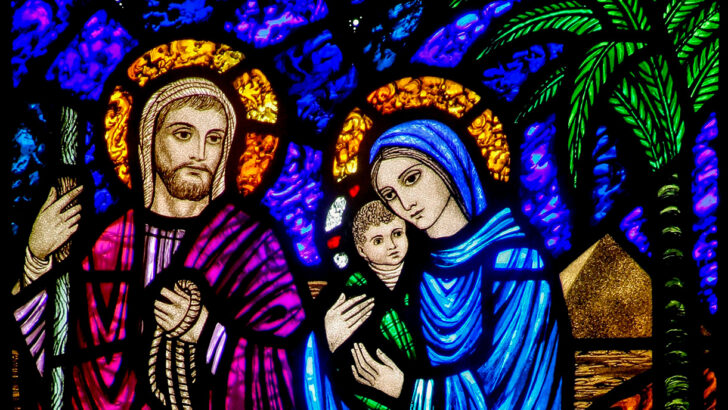
 A detail of a stained-glass window depicting Jesus, Mary and Joseph on their flight into
Egypt. Photo: OSV News illustration/Crosiers
A detail of a stained-glass window depicting Jesus, Mary and Joseph on their flight into
Egypt. Photo: OSV News illustration/Crosiers There is a long tradition of historical fiction that seeks to imagine the interior lives of minor Gospel figures. Pär Lagerkvist’s Barabbas, or even parts of Bulgakov’s The Master and Margarita all step into the inner world of figures who appear fleetingly in Scripture. Works like these opt to reimagine the figures through the lens of the author’s own questions and beliefs. More recently, The Chosen has brought to the screen richly imagined portrayals of the apostles and the many named characters surrounding Jesus to great effect. What these works reveal is a perennial fascination in the lives of the saints and even bystanders of the Gospel stories.

Anne Golden’s Son of David: Joseph of Nazareth – A Love Story enters this tradition with a certain reverence. Her aim is not to reinvent St Joseph, or to impose modern psychology upon him, but to take us into the ponderings and emotions of the man who is scripture is famously silent. Throughout the Gospels, Joseph never utters a word. Yet we catch glimpses of his inner life – his fears, dreams, deliberations, and obedience to God. Ms Golden, in some ways, seeks to fill this silence and bring us closer to an ordinary, steadfast man drawn into a story far greater than himself.
What sort of man could be entrusted with raising the Son of God?”
When speaking with the author, she explained that the book began during a month long devotional to St Joseph. Though she would be the first to tell you that she never felt a strong attachment to St Joseph, it was during those days she began to ask the question. What sort of man could be entrusted with raising the Son of God?
From the outset, Joseph emerges as a man seeking to follow God with all that he can, even before his betrothal. He is a man trying to do right, listening and obeying God. When the angel instructs him to flee to Egypt, he acts decisively. What Ms Golden captures are the intimate scenes that these life altering decisions would have included. An example being the conversations Mary and Joseph have as they weigh up their future following the birth of their son. Discussing when and how might they use their gold frankincense, and myrrh but also the prospect of uprooting their lives to escape Herod’s violence.
Joseph and Mary arrive in Egypt as strangers among strangers, speaking a different language even from some of their kin. Ms Golden imagines the practical realities of building a life in a foreign land: finding work, navigating unfamiliar markets, raising a child in exile. Joseph the worker comes alive not as an idealised icon, but as an ordinary man sustaining his family through extraordinary circumstances.
The novel also challenges the well-meaning but misguided phrase, “God gives us what we can handle.” Joseph’s story shows something truer: God often calls us into situations that exceed us, not to test self-sufficiency or stoic resolve, but so that we might rely more deeply on his strength.
Joseph dies, like Simeon and Anna, a fulfilled man—having seen the Messiah, raised him, and offered his life to God’s hidden work”
The narrative follows Mary and Joseph from their betrothal, to Bethlehem, to Egypt, and finally back home. Ms Golden chooses to ‘time skip’ over the final, quiet years of Joseph’s life, ending before Jesus’ public ministry. Joseph dies, like Simeon and Anna, a fulfilled man—having seen the Messiah, raised him, and offered his life to God’s hidden work.
If God chose Joseph for the upbringing of Jesus, it was for a reason. Ms Golden’s novel invites us to contemplate that reason, and to rediscover in Joseph a model of faith, courage, and quiet fidelity.