

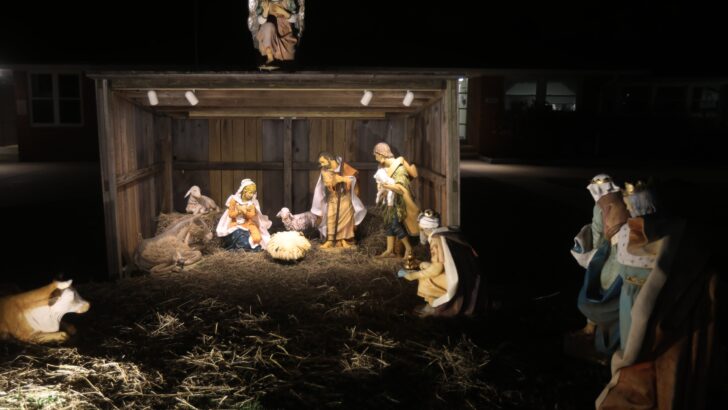
 A Nativity with an empty crib is displayed outside St. Anthony's Catholic Church in North Beach, Md., Dec. 15, 2021.(CNS photo/Bob Roller)
 Our Christmas cribs generally include a more or less fixed set of characters: the Baby Jesus, Mary and Joseph, the Wise Men, some shepherds, the ox and the ass, an angel, and perhaps a lamb or two. In Italy – especially in Naples – there is a tradition of extending the Nativity scene to include a host of other characters: the baker, the blacksmith, the farmer, the milkmaid, the tailor, the elegant folk of the town, the children playing in the street. Some Nativity scenes locate an entire city around the Child in the crib.

Those elaborate scenes are not just a matter of art: they make a clear statement to the effect that the new-born Saviour is for everyone; all are invited to rejoice at his birth; all are urged to heed the gospel of repentance and conversion that the adult Saviour has proclaimed.
There is one character in the Christmas story whom we might not particularly wish to place in the crib, but I would like to make a case for including him – Neapolitan style – in the general vicinity. Perhaps it’s already been done; perhaps he is depicted, sitting in his palace in a sullen, murderous rage, in numerous extended Nativity scenes. Be that as it may, the character I have in mind is Herod – Herod the Great, to give him his full historical moniker.
When the Wise Men reached Jerusalem, their presence came to Herod’s attention; and when, with that naïve honesty that is the hallmark of more than a few wise persons, they broadcast the purpose of their visit, Herod was filled with fear and anger. If there was indeed a new-born king, Herod would eliminate him. The region could not – must not – accommodate two rulers. Herod’s serpentine charm might well have fooled the Wise Men; they might well have come back and let Herod know where the infant was, so that he too could – according to his lie – go and pay homage. But as we know, the visitors from the East were warned in a dream, and they gave Herod a wide berth on their return to the East.
So, why place a homicidal, paranoid, deceitful potentate in the vicinity of crib? Why risk tarnishing the loveliness of Christmas? The answer lies in why Christmas is lovely in the first place. It is lovely not primarily because of the sentiment, the nostalgia, the wistfulness, the welcome break. Christmas is lovely because it marks that moment when God began to deal definitively with darkness, despair, anxiety, loss, disappointment and betrayal.
Whatever its marketability, the sanitised Christmas, the one in which the hard edges of life do not feature, is not the real Christmas. The Christmas that cannot accommodate the poor in spirit, the bereaved, the meek, the betrayed, the broken, the wounded and the sad is not the real Christmas. The Christmas that has nothing to say to a world seared by war and rumours of war is a redundant pretence.
Given the reality of sin and the tragedy of the human condition, Herod is always in the vicinity. And this is precisely why he is knitted right into the account of the first Christmas; his presence there reminds and assures us that God has, in Christ, dealt with the very worst that humanity can do, including the infanticidal machinations of an insecure despot.
Saccharine, rosy-cheeked sentiment has little to offer to those who have lost loved ones, or received a worrying diagnosis, or struggle to make ends meet. That’s not to say that we should become puritanical, and frown on sentiment and celebration, or reject whatever seasonal libations might induce a little rosiness in our cheeks. But Christmas – the Christmas of Scripture, of faith; not the ersatz version – is about salvation rather than escapism; it is about promise rather than pretence. Herod and his ilk do not have to be airbrushed from the proceedings, because their actions, far from reversing God’s plans, are seen to be no match for the power of his love.
And if it’s not all ‘out there,’ and we should find something of Herod within ourselves? All the more reason to keep him in the vicinity, that we might remember and rejoice in Christ’s love for sinners, a love expressed in the call to repentance and newness of life.