

 Peter Costello
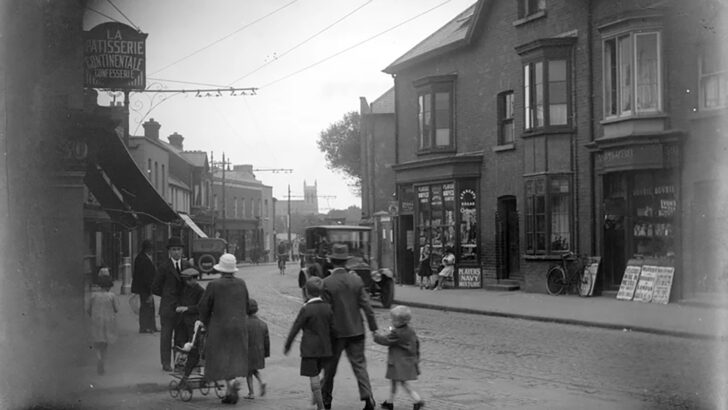 Donnybrook village around 1926.
 The big event in Ireland in recent days has been the release by the National Archives of the online version of the digitalised forms filled in by every household in the country on April 18, 1926 forming the first census since 1911, a census which now presents us with a picture of the then Irish Free State.
The present generation is thus enabled to literally come face to face with facts about their grandparents, even great grandparents, with all the surprises that may entail – in what came to be called by many “the Twenty-Six Counties”.
(A census was held on the same day in Northern Ireland. The statistics of this were extracted and published, but the actual forms were later destroyed. Why is not known. The Public Record Office of Northern Ireland suggests that it might have been during the paper salvage campaign in World War II. Others, of course, would see this destruction as an effort to obscure the actual house to house details of local life across “the Six Counties”, which might have undermined the claim of the regime in Belfast to run “a Protestant state for a Protestant people.”)
The National Archives claim this is “the story of us”. In the foyer of their establishment in Bishop Street in the lead up to this release, I was surprised and delighted to see a greatly enlarged photograph of my own local ‘village’ of Donnybrook as it was circa 1926.
Strange
It was a strange experience, one which will perhaps replicate what many others are now finding out.
The actual buildings shown in the photograph were much as they were in the childhoods of my wife and me. The view looks south east towards the tower of the Sacred Heart Catholic church across the unseen Dodder.
The street is busy with families with small children, outside shops of various kinds, including one entitled “Continental Patisserie” – very sophisticated touch one might have thought, though Dublin at that date had several shops at key points which called themselves “Italian Warehousemen”, which sold such exotic items as macaroni and olive oil.
In the scene too are a couple of cars, but not the tidal wave of traffic that there is through that rush hour choke point today. What strikes one is that though the people are clearly a very mixed group, they all look well turned out and clean – a striking contrast to those many photos one sees used to illustrate 1920s Dublin, taken in York Street or Church Street, with their crumbling slums.
The personal details which people will be able to find about their ancestors will provide them all with many insights. But we have also to remember that some facts about Ireland were then well known and should not now be forgotten.
The recorded population was 2,971,992 persons. This was a decrease of 5.3% – approximately, 168,000 from the previous 1911 census. The “flight from the land” that had begun with the Famine meant that Dublin had grown exponentially, while actual emigration to Britain, the USA, Canada, Australia, New Zealand and Argentina was at a very high rate.
Visa
When the United States opened its visa office in Dublin in 1924 people queued “around the block” to apply for papers to leave Ireland – many of them people who had joined the Free State Army in 1922 only to be stood down in 1924. Many of them, who had fought for an Independent Ireland in various ways, left her never to return. This high rate of emigration contused to the 1960s.
What were people doing in 1926? 51.4% were termed “agricultural workers”, 2.8 % were in public administration, while nearly 10 % were in what is called “domestic service”, doubtless working in the homes of the 4.2 % labelled “professionals”. Donnybrook would have been a largely professional area – some of the Lemass family lived on Victoria Terrace – many of the houses certainly had accommodation not only for their large families but also for their staff, often “a girl from the country”.
In a state dedicated to the revival of Irish only 18.3 % spoke the language. This suggests a complex picture not easily reduced into a simplified overview. We should in fact be delighted with complexity which will be the subject of investigation by many people in the decade to come.
To return to that photograph: in the distance, as I say, the tower of the Catholic Church looms over it. That parish is still a prosperous one, but the nature of that church’s life has changed. One of the things that will emerge from new research will be the roots of change, not only socially but also philosophically.
The 1926 Census online Platform can be reached at the National Archive site; it has full instructions for searching the materials just released”
Some 92.6 % of the population were listed as Catholic, served by approximately 3,700 to 4000 priests – this does not include, however, those Irish priests who were aboard on active service so to speak in the missions, and in the UK and the USA.
Today there are about 2000 priests, some 355 of whom are over 60. The century since 1926 has brought about a revolution in the Catholic Church, quite equal to the one that brought about the creation of the Irish Free State.
The 1926 Census online Platform can be reached at the National Archive site; it has full instructions for searching the materials just released.
Exhibitions
Also, exhibitions are to be mounted in Ireland, the United Kingdom and the United States over the next months down to the end of the year. Booking for these can be made online at nationalarchives.ie.
Already as I write the site has had some two million hits: seemingly the Irish people of today are eagerly embracing their collective past.
(The Story of Us, the related book edited by Orlaith McBride, the director of the National Archives, and RIA specialist John Gibney, which contains contributions by historians to the background and nature of the Census and its significance, will be reviewed in an upcoming issue.)