

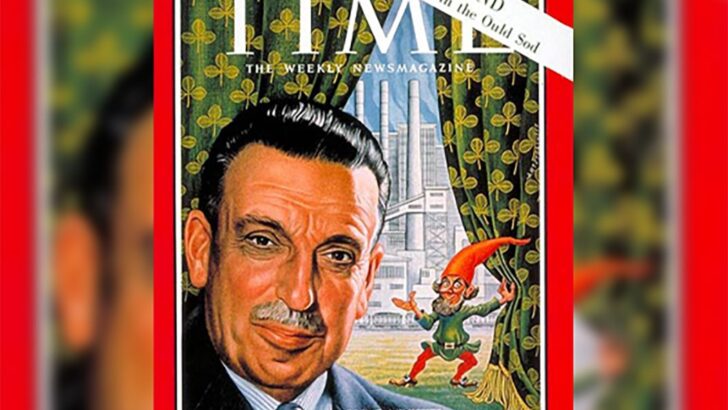
 Seán Lemass and his outlook appraised by Time Magazine, July 12, 1963 - international
recognition of a new kind of Ireland.
Seán Lemass and his outlook appraised by Time Magazine, July 12, 1963 - international
recognition of a new kind of Ireland. Seán Lemass, The Lost Memoir: The autobiography of Ireland’s most admired Taoiseach,
edited by Ronan McGreevy
(Eriu / Bonnier, £22.00 / £20.00)
The title of this book is misleading. It is neither a memoir nor an autobiography of Seán Lemass, but rather the edited transcripts of taped interviews that Lemass gave to businessman Dermot Ryan after he retired as Taoiseach in 1966. In total, there are 22 hours of interviews, conducted between April 1967 and January 1969. Lemass died in 1971, aged 71.
Lemass was a veteran of the 1916 Rising (he served in the GPO in Easter Week), the War of Independence (as one of Michael Collins’s “squad”, he participated in the assassination of British intelligence officers on Bloody Sunday, November 1920), and the Civil War (on the anti-Treaty side, he was one of the garrison who occupied the Four Courts in April 1922).
Lemass was a founder member of Fianna Fáil in 1926 and its chief organiser until the 1950s. He became Minister for Industry and Commerce when Fianna Fáil came to power in 1932”
He rarely spoke about these segments of his life, dismissing all queries with the words: “terrible things were done by both sides. I’d prefer to not talk about it.” Accordingly, he insisted that the interviews with Ryan “shouldn’t go into depth in the period earlier than 1925”.
The editor – journalist and historian Ronan McGreevy – provides a brief account of Lemass’s life before 1925. It was marked by two tragedies: the accidental killing by Lemass of his infant brother in 1916 with a revolver he had in his possession as a member of the Irish Volunteers; and the abduction and brutal murder of his elder brother, Noel, by rogue elements in Free State Army intelligence department in the months immediately after the end of the Civil War in 1923.
Lemass was a founder member of Fianna Fáil in 1926 and its chief organiser until the 1950s. He became Minister for Industry and Commerce when Fianna Fáil came to power in 1932, and held that post for most of the next sixteen years – the exception being the early years of the Second World War (the so-called “Emergency”), when he was Minister for Supplies. From mid-1941 to 1945, he combined the Supplies portfolio with that of Industry and Commerce.
Tánaiste
He was appointed Tánaiste in 1945, and was thereafter generally recognised as de Valera’s chosen successor – though he would have to wait fourteen years for the succession. The interviews occasionally hint at his frustration that de Valera hung on to power for so long. He was Minister for Industry and Commerce again in 1951-54 and 1957-59.
Lemass’s long career exemplifies the dictum widely attributed to John Maynard Keynes: “When the facts change, I change my mind.” The first, relatively trivial, change was a change of name: he gaelicised his name from Jack to Seán after the 1916 Rising, reflecting his identification with the new Ireland then emerging – though he was never an Irish language enthusiast.
Then, in the 1920s, he was quick to recognise that the anti-Treatyite policy of abstention from Dáil Éireann was “increasingly unrealistic” and that the Sinn Féin party, of which he was still a member, was “living in a dream world” (to quote from the interviews). So he followed de Valera’s lead in breaking with Sinn Féin and founding Fianna Fáil – and later he took the hated Oath of Allegiance in order to enter the Dáil in 1927.
As Minister for Industry and Commerce in the 1930s and 1940s, he adhered to a strict regime of tariffs and customs duties to protect Irish industry and agriculture. However, as he himself explained in one of the interviews, by 1952 he was gradually “coming to the conclusion that protectionism, as an instrument of industrial development, was no longer applicable … [as] there were no further industries that could be set up under protection”.
When Fianna Fáil returned to power after the 1957 general election, Lemass thus embraced the programme for economic development formulated by T.K. Whitaker”
With the formation of the European Economic Community in 1957, he recognised that Ireland had no alternative but to embrace Free Trade and that the State would need to invest heavily in the promotion of economic development in order to survive in the new environment.
When Fianna Fáil returned to power after the 1957 general election, Lemass thus embraced the programme for economic development formulated by T.K. Whitaker. This provided the leitmotif of his years as Taoiseach. He fails, however, in the interviews to give credit to the inter-party governments of 1948-51 and 1954-57 for kick-starting the modernisation of the Irish economy with the establishment of the Industrial Development Authority in 1949 and the introduction of export sales tax relief in 1956.
Lemass is probably best remembered today for extending the hand of friendship to Northern Ireland, symbolised by his meeting with the N.I. premier Terence O’Neill at Stormont in January 1965. No meeting between the leaders of partitioned Ireland had occurred since 1925. It was a dramatic break with Fianna Fáil’s entrenched policy of refusing to acknowledge the legitimacy of Northern Ireland.
He explained the change in the following terms: “we had to recognise the facts that the government there existed; that partition had persisted for 40 years; that there was no immediate prospect that the situation would end.” McGreevy comments: “He believed only persuasion could bring about an end to partition.”
Enduring
The enduring value of this book – and of the interviews upon which it is based – will be the insight it gives into the process by which the shibboleths of the first fifty years of Irish independence came to be abandoned and the State entered the modern world in which, despite some setbacks, it has prospered ever since.
Lemass was the key person in effecting that change, and the measure of his greatness was his capacity to change direction in response to changed circumstances.