

 Peter Costello
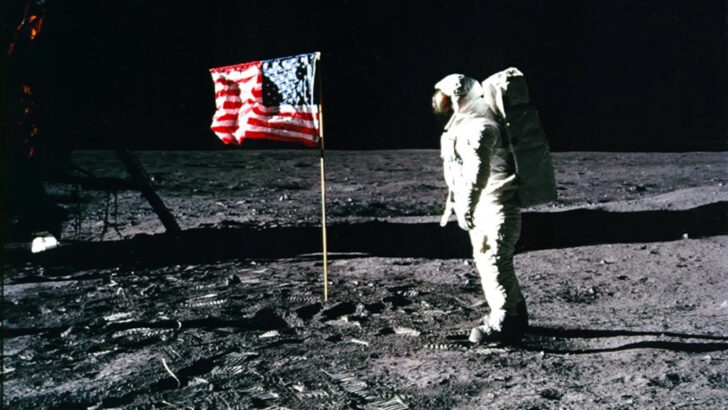 Astronaut Buzz Aldrin standing on the surface of the Moon side the American flag he had erected. Photo: NASA.
 From the Earth to the Moons and Around It, by Jules Verne (Aladdin Books / Simon & Schuster, €16.50 / £14.50; many other editions also available)
The successful voyage around the moon by the crew of Artemis II brought to my mind this pioneering novel by Jules Verne, who is rightly described as the “inventor of science fiction”.
These novels from the early years of his long career were first published back in 1865 and 1870. But they read very strangely in the light of the astonishing trip of Artemis II.
But the very success of the trip to celebrate in part the 250th anniversary of the USA raises an important moral question for our day: just who owns the moon?
These novels are not children’s books, but provide a very amusing grown up read, satirising the American military mind in post-Civil War years.
The Gun Club of Baltimore decides on an effort to fire a projectile at the moon, which turns into what we would now call a manned mission, when an adventurer offers to fly in it.
Verne’s fiction parallels the later facts: the great gun is cast and erected in the vicinity of what is now Cape Canaveral, both Verne’s calculations and those of NASA showing this was the ideal point of launch. All goes well, and the story ends with a splash down at sea just like Artemis II.
The Artemis flight was trying to discover traces of water on the surface of the moon. This is an essential preliminary to establishing a colony on the moon’s surface. But does the moon or mars indeed belong to those who first land on them?
Aside from being a spectacular event to mark the 250th anniversary of the United States of America, it was perhaps overshadowed by the war with Iran. The essential part of the mission, however, was to find evidence of the existence of water on the moon in accessible quantities, an essential prerequisite for establishing an American colony there in the near future.
Political
The issue of who owns the moon might seem to be a political issue but is in fact a moral one. Is our “common home” in the cosmos to become a sort of private estate, with the US president as a sort of Duke of Devonshire, the ground landlord of a cosmic colony.
Will the United States claim that a base on the moon gives them ownership of the moon? Certainly, though the scientific exploration funds of NASA are being largely cut in next year’s US budget, colonising the moon is very much on the agenda of the Trump administration. The moon has, of course, immediate commercial value to a man with a property developer’s mind: it may have no sandy beaches, but it certainly has minerals of many kinds.
This, I think, is not a trivial matter, not just a moment of great power exhibitionism. It is a moral matter which will need attention and some sort of settlement, say through the United Nations.
But the Trump administration has cast off such international constraints, prioritising its own private commercial interests over those of humanity in general.
But any case, it is likely that the Chinese will get there first.