

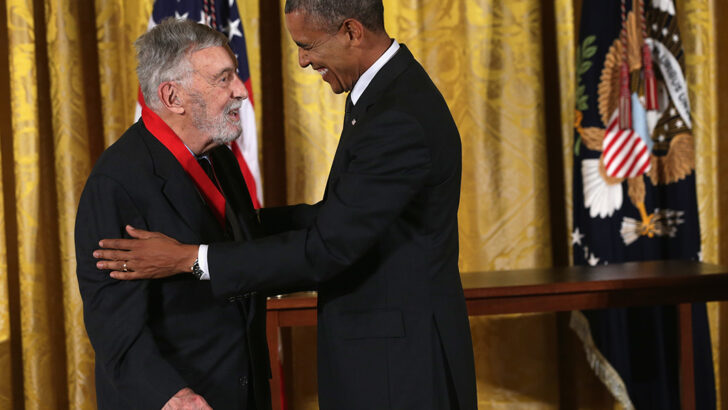
 A moment inconceivable in the 1860s: the late Prof. David Brion Davis, one of the important historians whose work
reshaped American ideas about slavery, with President Barack Obama, the first Black American elected to the White
House, when the author was awarded the National Humanities Medal in 2014. Photo: WJCT Public Media.
A moment inconceivable in the 1860s: the late Prof. David Brion Davis, one of the important historians whose work
reshaped American ideas about slavery, with President Barack Obama, the first Black American elected to the White
House, when the author was awarded the National Humanities Medal in 2014. Photo: WJCT Public Media. Slavery: America’s long reckoning from the Founding Era to Today,
by Scott Spillman
(Basic Books / Little Brown, €35.00 /£30.00)
This is not a book about slavery. It is, instead, about how Americans have made sense of slavery: how they have researched and written about it; how they have justified and criticised it.”

Such is the opening declaration of this elegant, informative, and sometimes absorbing text. More than 360 pages on, it concludes on a more muted note: “ideas about slavery are a mirror image of ideas about freedom, and complicated legacies about slavery and freedom lie at the heart of our country.”
In the intervening pages the contours of those legacies are surveyed, and several are illuminated. But the extent to which they have been penetrated is limited.
Divided into eleven brisk chapters the book offers an easily digestible approach to a deeply complex subject and is made especially attractive by its strongly biographical approach.
The cultural impact of slavery is explored not through themes, topics or events, but through the presentation and discussion of a broad range of interesting personalities on both sides of the debate. Relatively familiar figures appear, such as Harriet Beecher Stowe, George Bancroft, and W.E.B. du Bois.
But readers are made acquainted with such significant but now obscure figures as the Quaker abolitionist Anthony Benezet, the adventurer Edward Wakefield, the Southern pseudo-scientists William Cooper Nell and Josiah Nott, and many more.
Fascinating
One of the most fascinating parts of the book concerns the struggles of Carter Woodson to establish the first academic journal devoted to black history, The Journal of Negro History, and as the book advances its focus narrows toward a review of writings about slavery by academics in universities and research institutes.
Such historiographical discussions will be of interest to those seeking a guide for further reading of scholarly research, and they are enlivened by the use of the archived correspondence of several scholars concerning the trials and triumphs of their engagement with their subject.
Deep into his fourth rum punch with the sun sinking slowly on the horizon and the surf sloshing softly on the beach”
But the academics are not the only cultural segment who ought to be considered; and while Spillman occasionally departs to consider evidence from other modes of expression as film, fiction and journalism, the emphasis given to historiographical debates, though informative, seems to be quite disproportionate.
And not everyone given to academic gossip needs to learn that Vann Woodward began to appreciate the power of Eugene Genovese’s Roll Jordan, Roll: The World the Slaves Made (1974), “deep into his fourth rum punch with the sun sinking slowly on the horizon and the surf sloshing softly on the beach” (p.290).
David Brion Davis is among the historians included in this overview, but while the psychological and professional difficulties he faced in the course of his work are interesting (and sympathetically recorded), he fits rather awkwardly in Spillman’s schema for several reasons: he was writing earlier than, and independently of, much of the scholarly work reviewed, and in seeing slavery in the broader context of ‘Western culture’, he raised questions of a comparative nature which highlighted the very distinctive character of America’s ‘peculiar institution.
Racism
Of these there were many: its racism, its definition of slaves as chattels; and the fact that it was defended and rejected by those sharing the same form of Christianity – Protestantism. Though the critical importance of these divisions within American Protestantism is recurrently evident in Spillman’s account, they are not further explored, as the biographical format tends to militate against the pursuit of this, or any other, theme
There was independently a good deal of rampant racism on show which the Church did little to restrain”
If Spillman’s discussion of the place of Protestantism in the slavery debate is limited, he has nothing at all to say about American Catholicism, as Catholics accounted for no more than 12% of the total population by 1860, his neglect is understandable and perhaps a blessing, for the record is quite inglorious.
The notorious anti-abolitionism of Irish-American groups in the 1840s and 1850s can in part be explained by the vigorous nativism and anti-Catholicism of many abolitionists and of liberal Northern Protestants in general. But there was independently a good deal of rampant racism on show which the Church did little to restrain.
No less significantly recent research has shown that while older generations of Catholics settled in the Upper-South were prominent among the leaders in the American Revolution, they were also among the largest slave-owners, and the least likely among their peers to consider manumission, that is to say, formally release their slaves from bondage.
In this, these early American Catholics embodied a paradox that Edmund Morgan in his American Slavery / American Freedom (1975) identified at the centre of American culture. This is that the ease with which Revolutionary White Americans embraced liberty and equality was facilitated by their ready acceptance of racial inequality and slavery.
This is indeed one of the “complicated legacies” that Spillman acknowledges evasively at the end of this book. And while it cannot be said that he has contributed much to its resolution, he has supplied much thought-provoking material for its further investigation.