

 Peter Costello
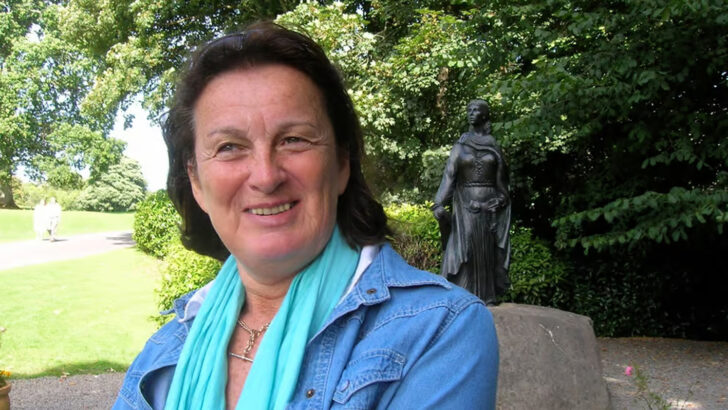 Anne Chambers with a statue of Grace O’Malley in the grounds of Mayo’s Westport House.
 Biographers are usually so busy investigating other people’s lives, as to pay little attention to their own. However, in this revealing book Anne Chambers recounts some of her experiences as a biographer, providing interesting sidelights on Irish writing and publishing.
As an account of a long career by a non-fiction writer, it is a rare and unusual publication in Irish culture. Her subjects, as often as not, had some connection with Mayo: such as Grace O’Malley, and Col. Ranjitsinghi, the famous cricketer, who was nicknamed “the Maharaja of Connemara”. She also wrote a biography of Eleanor, Countess of Desmond, one of the longest-lived women in recorded Irish history. In this array of historical figures, however, a more recent book stands out. This is her biography of T. K. Whitaker, written with his active participation.
Here she was dealing with a person whose influence over the development of modern Ireland was critical and controversial, depending on one’s point of view.
There were some readers of the book who felt that the subject himself had managed, by his cooperation, to very adroitly prevent a political scientist or commentator dealing in greater and more uncomfortable detail with Whitaker’s influence on the Department of Finance and so on the opening out of the Irish economy, way of life, and social development.
Be that as it may be, this book provides an interesting account of how one biographer goes about the task of selecting a subject, researching the sources, trying to sound the hidden depths, and to make it all a readable pleasure to read.
To attempt to recover historical truth rather than provide a “re-imagination” in fictional form is a civilised task which deserves respect and often admiration, especially when the subjects are strong-willed women active in a male-dominated world.
One has to wonder if the connections with Mayo are important whether the idea of a biography of Mary Robinson has never crossed her mind? Certainly, it would have even greater potential as an important document on our times if she did.
Or, better still, a book on Queen Elizabeth I’s lifelong relations with Ireland, a fraught but exciting topic. Such a book would indeed provide a contrast to what she refers to here as her own “mundane life”.