

 Brendan O’Regan
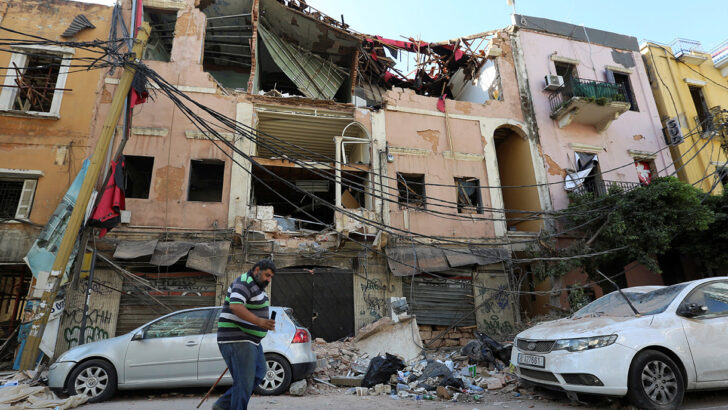 A man walks past rubble of damaged buildings August 7, 2020, following an August 4 blast in Beirut’s port area. The blast killed more than 200 people, injured some 7,000 others and displaced more than 300,000. Photo: OSV News / Aziz Taher, Reuters.
 It should be no surprise that I’m interested in stories about journalists, and I’m particularly drawn to stories about war correspondents on the front line.

The Road to Hope with Fergal Keane (BBC News, Thursday) was a reflective and retrospective documentary narrated by the Irish journalist who worked for the BBC for years. It was quite moving but while there were indeed elements of hope, there was quite a lot that was grim. From the mid-1980’s he covered so many ugly wars – Northern Ireland, South Africa, Rwanda and Gaza. A lot of it featured “the story of the killer”, examples of “so much inhumanity”, as he had witnessed “the terrible power of political violence”. At times he felt it involved the “truth under siege”, but he liked to find hope in “the smaller voices”, stories of hope where a positive outcome wasn’t always obvious at the time. In covering the violence in Northern Ireland, he found the media being “hostage to the drama of the moment”, and yet he found voices of hope and love – like Gordon Wilson, whose daughter Marie was killed in the Enniskillen bombing, or Joyce McCartan who felt God had been good to her as her baby grandchild lived on, though an act of violence took her son Garry.
In South Africa, we saw both Keane and a peace-monitor Irish priest coming under fire. Keane thought apartheid would end with a race war but was glad that he was wrong, as Nelson Mandela and F.W. de Klerk steered a course to reconciliation. Apart from the political leadership, he credited the decision “in millions of hearts” to move forward peacefully. There was an emotional reunion with a woman he had interviewed back in the 90’s.
The genocide in Rwanda, with “hatred deeply embedded”, had the biggest impact on his life. Here he found “the stench of evil”, with one group of villagers massacred soon after a visit by Keane and the BBC team. Even here there was hope – with the rescue of truckloads of children, including a teenage girl and her mother who were hidden under the younger children. In recent times he visited this woman again – she was now living with her own family in Bordeaux. In Gaza, he regretted journalists not being allowed in by the Israeli Defence Forces, allegedly for their safety – but it meant they were prevented from “bearing witness”. They had to rely on Gazan journalists. The ensuing issue of reliability wasn’t raised. Again, he found “rare moments of positivity” as a young Palestinian girl, after much difficulty, was finally allowed to go to Jordan for life-saving treatment. Despite amputations, she was such a cheerful child when Keane visited her after treatment.
He referenced the “great inheritance” of BBC news coverage and paid tribute to the journalists who had died on assignment. The BBC’s recent troubles relating to professionalism and neutrality weren’t referenced but maybe this wasn’t the place for it. He concluded by referring to the priorities of Bishop Desmond Tutu – compassion, integrity and gentleness.
Such qualities mark the current papacy. If you wanted another injection of hope, you could look back on coverage of Pope Leo’s visit to Spain. On Vatican News (Saturday) we saw the Pontiff’s visit to a social care centre in Madrid run by CARITAS and his joyful meeting with thousands of young people, where he called on them to “be the sparks of a new humanity”. On the Nine O’Clock News (RTÉ One, Sunday), it was reported that more than a million people attended an open-air Mass and procession for the feast of Corpus Christi, likely to be the largest event of his visit. He said that “God stands with the society’s poor and forsaken”, and that the faith was not a “museum of the past” but a “school of faith” for today. A young woman in the enthusiastic crowd spoke of an experience that was “very very beautiful”.
Finally, Mornings with Kieran (Spirit Radio, Thursday) featured an item, to coincide with the St Kevin’s feast day, on an event involving several pilgrim routes in Glendalough, an area described as “one of Ireland’s most treasured sacred landscapes”. Cormac O’Ceallaigh of the Glendalough Hermitage Centre spoke of the varied routes in the area – with walks as short as one hour or as long as five hours. He spoke of Glendalough as “the next step to Heaven” – can’t argue with that!
Nationwide
RTÉ One, Monday, June 15, 7pm
Nationwide looks back 50 years to St Brendan’s journey to the Americas and a Church of Ireland community marks its 200th anniversary.
Papal Audience with Pope Leo XIV
EWTN, Wednesday, June 17, 9am
From the Vatican, Pope Leo XIV delivers his weekly address to the faithful.
Fíorscéal
TG 4, Thursday, June 18, 10.30pm
It’s an undisputed fact that the best place to raise a child is in a family, but all over Europe, there’s a shortage of foster families for those children who can’t live with their biological families.