

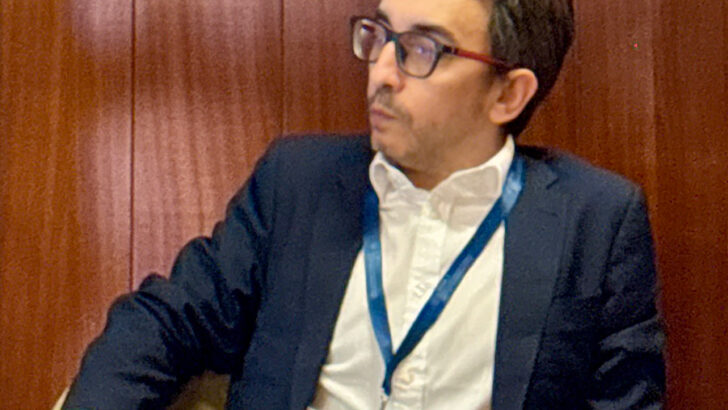
 Bruno Maçães
 A Colloquia took place at the Institute of Political Studies, Universidade Católica Portuguesa, Lisbon, earlier this month entitled ‘Restless World, Restless Democracies’. It was the third event in an annual series, the purpose of which is – as its chief organiser Prof. Lívia Franco put it – to serve as a laboratory for ideas. This year, the keynote address was given by Bruno Maçães, the Portuguese public intellectual, New Statesman columnist, and senior adviser at the consultancy firm Flint Global. His theme was ‘World Builders: A new way to think about World Order’, and his remarks drew on his similarly titled book World Builders – Technology and the New Geopolitics (Cambridge University Press, Cambridge, 2025).

At the outset, that book contains a quote from Plato: “However, let us return and inquire further concerning the cosmos, after which of the models did its builder construct it?” This is a ‘tell’ because there is something of Plato’s ‘philosopher king’ about Maçães. In fairness, he’s better qualified than many for the role – he has a PhD from Harvard University and served as Portugal’s Secretary of State for European Affairs from 2013 to 2015. Yet as I shall attempt to show, philosopher kings are not infallible.
Theme
Referring to the overall theme of the Colloquia, Maçães said that he likes the idea of restlessness. While it is not an entirely positive concept, it brings with it the idea of change, of adventure, of never settling. The cover of the Portuguese language version of his book features a 1943 surrealist painting by Salvador Dalí, ‘Geopoliticus Child Watching the Birth of the New Man’.
He sees the painting as being about the birth of the American world, adding that, in his opinion, we are now witnessing the birth of a new order, replacing the American one.
Historians like to find turning points, he said, and he suggested that May 12, 2025, was one such. That was the date on which Trump was forced to climb down in relation to swingeing tariffs he had imposed on China just a few months before, faced with US dependence on the China supply chain – from highfalutin rare earths to everyday products to stock the shelves for Christmas. It was a very striking moment, he felt, because it showed that the US no longer had the ability to impose outcomes on China.
Something similar came to my own mind regarding the diminished power of the United Kingdom. Whereas in 1994 the then UK Prime Minister John Major was able to block the Belgian Jean-Luc Dehaene from becoming President of the European Commission, in 2014 David Cameron was unable to block the appointment of Luxembourg’s Jean-Claude Juncker to that same role.
In a state of permanent flux, rules will be changing all the time because they are being shaped and contested by different actors. It’s a rules-based disorder”
What does that US tariff climbdown mean for the world order? In Maçães’ view, expecting a binary choice between America or China is not helpful – we are facing something different. Any idea that China will replace the US is extraordinarily implausible, he believes. Different poles of power will shape the global order. There’s now a fundamental change: the global order is being shaped and reshaped. We are in a constant process of ordering and disordering. The old descriptors don’t apply. It’s as if a large computer programme is being coded by different programmers. No moment is permanent, stable, or final. It will be a metamorphic order, not a multipolar one. In a state of permanent flux, rules will be changing all the time because they are being shaped and contested by different actors. It’s a rules-based disorder.
This is the process which he calls ‘world building’. The highest form of power is to create a world which others have to inhabit. He’s a fan of the Keanu Reeves film The Matrix movie, seeing it as relevant to what he is outlining.
Digressing briefly, he lavishly praised the Financial Times (FT) newspaper as the only one worth reading, considering it to be free of propaganda. However, a recent article by FT columnist Janan Ganesh entitled ‘The physical world strikes back’ had upset him a bit, he said. The article’s message was contained in the sub-heading – viz., that “The Iran war is a reminder that geographic facts rather than digital tech shape our lives”.
Conceding that Ganesh was partly right about this, he nonetheless thinks the FT columnist made a mistake in not seeing that while yes, we’re reverting a lot to a geographical world, this is actually a sign of decay and of how the American order is unravelling. According to Maçães, world builders have to rise above geography. With the Iran war, which in a recent interview with Spanish digital platform Agenda Publica he described as “insane”, the code is crashing, there’s a system error. In his piece, Ganesh was not giving the full picture, Maçães thinks.
Maçães recalled a visit he’d made to the London offices of the (often highly criticised) company, Palantir. What he witnessed there seemed like the best possible summary of geopolitics today, featuring a computer programme with almost an entire reproduction of the (Iran) war, detecting targets, and even the likely efficiency of each weapon. Comment: how revolting.
Glitch
Wrapping up, Maçães described the COVID pandemic as another “glitch moment”. What was remarkable about it was that we saw that suddenly – overnight, as it were – we saw that we could change things – closing offices, getting people to work from home, closing schools. Yet, he contended, nothing came tumbling down. People realised we have a lot more power over social and economic reality than we thought. The famous London department store Harrods did not close during the Blitz in 1940, but it did close during the pandemic.
This ‘take’ on COVID strikes me as an example of the downside of ‘philosopher king’ syndrome. The pandemic caused so many deaths, wreaked havoc on people’s lives, and led to huge restrictions on personal liberties. When he says, “we have a lot more power” what he really means is ‘some of us have a lot more power’.
In the Q&A, I had a chance to ask him how much of an aberration did he see Trump as being? In response, Maçães dismissed any idea of Trump being aberrant. Instead, he views Trump as a symptom and as the best example of a system crash. Trump has no understanding of any abstract idea – the same goes for his cabinet. In the interview with Agenda Publica, Maçães expanded on this, saying that “Joe Biden, whom the European left seems to like, was responsible for the complete destruction of Gaza, even more than Trump.”
Dismissing Trump as a mere ‘symptom’ downplays to a huge extent the importance of individual leadership in international affairs, but that’s a subject for another day’s work.
Michael Sanfey is a researcher at the Institute of Political Studies, UCP Lisbon.