

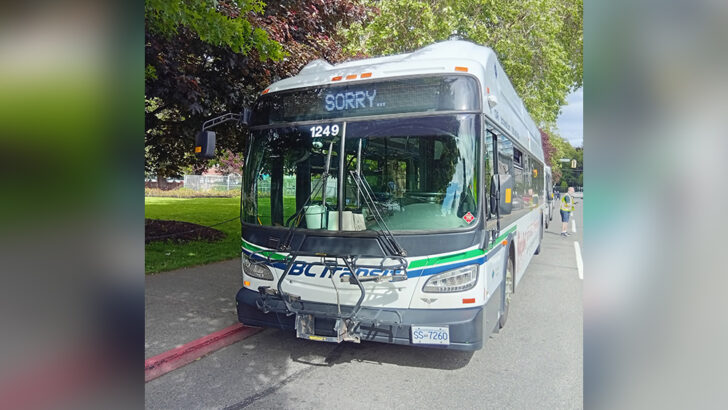
 A BCTransit bus in Victoria BC displays the word supposedly typical of polite Canadians: Sorry. Photo: Fr Bernard Cotter.
 I arrived in Canada in mid-January. A few days later, I headed to a government office to get my first monthly Senior Bus Pass. I went armed with evidence that I was eligible; passport, driving licence, every proof I could think of. The assistant didn’t look at any of my IDs but proceeded to issue the pass. Surprised, I mused that I must look really old. “Not a bit of it,” she said, “indeed for all I know, you could be getting the bus pass for someone else!” That’s a level of trust and respect I’m not used to experiencing at a government office.
I see respect incarnated every time I take a bus trip. I used to think sometimes that the bus driver was hesitant to leave the bus stop. Then I realised the operator of the bus was waiting for me, making sure I was seated before pulling out onto the road. It’s thoughtful – and typically Canadian.
On those few occasions when I haven’t accepted the offer of sitting, the offerer stood beside me, and the seat remained empty till eventually I gave in!”
Even though I don’t feel particularly aged, there is no danger I will ever be without a seat on a bus; passengers will insist I take their seat. On those few occasions when I haven’t accepted the offer of sitting, the offerer stood beside me, and the seat remained empty till eventually I gave in!
Those with special needs are accommodated with ease on public transport. Every bus in Victoria BC, where I live, has the facility to ‘kneel’ to street level, so that older people leaning on strollers can easily wheel their way on.
Wheelchairs
People confined to wheelchairs get the best treatment. On request, or when the driver spots a wheelchair user in the queue for entry, a fold-out ramp is opened from the floor of the bus, which means that wheelchair users can propel themselves directly onto the bus. Each bus has this facility, not just a few specially equipped ones. Immediately, passengers rearrange themselves so that the wheelchair slots into position: it’s no hassle, and there are never complaints about delay or inconvenience. Making space for people with such special needs is part of life.
You don’t have to travel by bus to feel the Canadian civility. Walking the city streets is a similar experience”
The best moment of each bus trip is when a bus stop is reached, and travellers leave by the exit door towards the back of the bus. Then each passenger, without fail, turns towards the front of the bus and shouts a ‘Thank you’ to the driver. You might think this could be the traditional gesture of the older riders. In fact, young people are the most insistent that the driver be thanked; teenagers, college students, everyone who leaves either shouts the same message, or waves to the observing driver. It’s a civil, respectful way of organising a country.
You don’t have to travel by bus to feel the Canadian civility. Walking the city streets is a similar experience. At pedestrian crossings in other countries, including Ireland, walkers often feel they must traverse quickly, as drivers fume and wait. In Canada, drivers hang back, so no one is under any pressure to cross at speed. It’s another instance of the Canadian way.
Dissimilar
It’s interesting to me how dissimilar Canada is to its nearest neighbour, the USA. Everything looks the same, yet the similarity ends with the visual. The streetscapes, strip malls, even the cars look alike, with their distinctively small registration plate. Both countries share those oddly-shaped orange school buses, and black and white police cars. Yet everyday life feels different in Canada; the streets are safer, the people much friendlier, the authorities seem on the side of the people; the quality of life is immeasurably better. I learned why when I travelled by bus.