

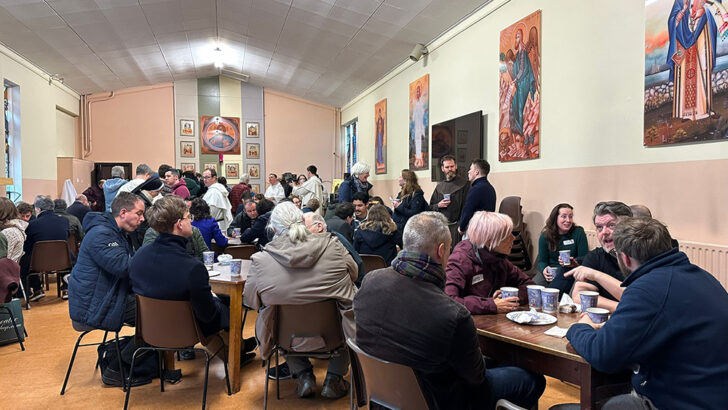
 Conversations over tea and pastries
 You know the story, three times, on the shore of lake Galilee after the resurrection, Christ asks Peter the same question, and three times Peter answers, and three times comes the same command: feed my sheep. It’s a commission to the whole Church, handed to a single, frightened, newly-forgiven married fisherman.

Two thousand years later, a primary school invited its new five-year-olds and their families to Sunday Mass, forty-two children enrolled, fifteen families turned up —simply invited, and they came. Roisín Coll, writing in this paper this week, describes what greeted them: a lovely prayer, a wave from the pews, and then nothing. No one mentioned the tea and coffee already laid on in the hall. No one asked who they were. Families who had taken a real step — chosen a Catholic school, answered an invitation, walked through a church door on a Sunday morning — left having been seen, briefly, and met by almost no one.
Jesus doesn’t seem to have received the secular memo; he keeps inviting people to his so-called ‘dying’ Church. Ask any priest in a busy parish as this paper has been doing recently. There’s the non-practicing mother asking for baptism so her daughter can make her First Communion with her class. The couple booking the landmark church, upfront about their absence from the Church. The funeral family, standing grieving in a place they haven’t stood in for years. The problem is the priest has a half dozen similar requests for baptisms; loads of couples asking about marriage and any amount of funerals.
The Church is dying they say and yet at the coalface priests will tell you that they are busier than ever and that cultural Catholics are coming, looking for something and we are for the most part turning them away unfed. But aren’t those the people Christ said he came for, the lost sheep and yet we are unable to attend to their deepest needs.
The task of feeding was always meant to be shared among the baptised, not reserved to the ordained and then quietly abandoned wherever the ordained run out of hours”
Christ did not ask Peter whether he had time. He did not ask whether Peter had a curate, or a full diary, or the capacity to feed five thousand sheep personally. He asked him whether he loved him, and told him that was the qualification. When it came to resourcing, the early Church discovered within a generation that it needed deacons, elders, widows, hosts of house-churches, precisely because the commission was never about one man. The task of feeding was always meant to be shared among the baptised, not reserved to the ordained and then quietly abandoned wherever the ordained run out of hours.
So who will feed these sheep the priests ask? If not the overworked priest then the stark answer currently is no one. What is sad about Roisín’s parish is they had the tea and coffee, they were aware of the new families, but it never occurred to them that they should welcome the newcomers and invite them to take part. It’s not badness, it’s complacency. It’s a lack of love and understanding of Eucharist.
And this is the core of the problem for the laity. Who steps up? Next month at the National Synod, bishops and those invited to be part of the deliberations will sit around in circles asking ‘what is God saying to his Irish Church today?’ And yet what he is saying is echoing through time –feed my sheep. A community that loves will be open, welcoming and caring. Has it occurred to us that if our parishes are loving communities that people will be attracted to them, and will remain and want to be part of it if it is real and nourishes them. Secular Ireland is crying out for community, to escape loneliness, addiction, loss and pain. To find meaning in a world that suddenly seems to have lost meaning and feels very unsafe. The mission we are called to is not to go out, it is to open the doors of our parish and our hearts and welcome in the people who are coming to us asking for bread. Let’s not give them stones.