

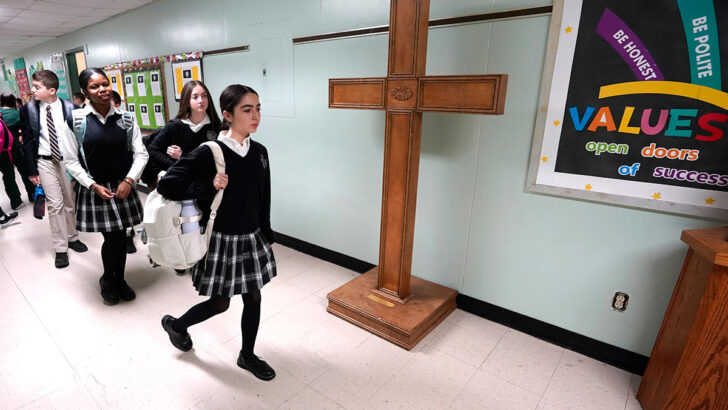
 Students walk near a cross as they change classes at St Patrick School in Smithtown, NY, US. Photo: OSV News /
Gregory A. Shemitz.
Students walk near a cross as they change classes at St Patrick School in Smithtown, NY, US. Photo: OSV News /
Gregory A. Shemitz. Two things happened in Catholic education this month, and read together they tell an uncomfortable story — not about the Church’s willingness to change, but about the State’s.

On October 16, the Catholic Education Partnership (CEP) will launch the ‘Irish Church’s new Vision for Catholic Schools in Ireland’, the opening move in a three-year formation process that the Association of Patrons and Trustees of Catholic Schools (APTCS) is now hiring someone to drive. It follows last week’s launch of an SPHE resource, ‘Living Love’, for Senior Cycle, with a Junior Cycle version due next year and bishops already commissioning resources and training trainers to deliver it. These are not paper exercises, we are assured. It is a sustained, funded, multi-year commitment to renewing what a Catholic school is. This is a welcome commitment by the bishops to the future of quality catechesis in our schools.
Contrast that with the picture Alan Hynes, chief executive of the CEP, painted in conversation with this newspaper of the State’s parallel project: divesting patronage of Catholic schools to give parents the choice of school type they are said to want.
Where it has worked, it has worked well. In Nenagh, Mr Hynes helped manage a process that saw two single-sex schools become co-educational and a third school move to multi-denominational patronage, leaving the town with Catholic, Church of Ireland, multi-denominational and Gaelscoil options. But that is the exception that proves the point: divestment happens when someone — a diocese, a trust, a community — does the sustained patient work of making it happen, not because the State has driven it through.
Elsewhere the pattern is one of good intentions and thin follow-through. In Limerick, the sitting minister’s own local Modal School retains a Catholic ethos that the Minister could, in principle, change at the stroke of a pen; it hasn’t moved. In Dublin, at the State’s request, a school was made available for divestment through the amalgamation of schools, and the Department simply failed to follow up.
And in one fast-growing area outside the capital, a bishop proposed that a new school be built, rather than his school being doubled in size, precisely to give a growing population the pluralism of choice it was said to want — but the State insisted on the Catholic school being expanded. Subsequent coverage that followed sought to frame the Church, yet again, as the party dragging its heels.
The financial support on offer from the State for this work of divestment is, as previously reported by this paper threadbare; officials are struggling to recruit facilitators for what is meant to be a two-year process. Mr Hynes’s own experience of school change processes suggests they take considerably longer than that, and cannot be rushed without addressing the concerns of the communities involved. The Church puts in real time and real money. If the State wants to be taken seriously, it needs to match that — and to be honest with itself about whether some of this work is a decade-long undertaking, and whether some of it is not needed at all.
The CEP’s own survey work, drawn from the recent national survey of schools and read with appropriate caution for margin of error, complicates the usual story further. Roughly one in six parents surveyed actively expressed a desire for change — hardly the groundswell sometimes implied. Support for divestment is strongest in large urban centres along the coast and in the counties ringing Dublin, Meath excepted, with Limerick an outlier and DEIS schools showing greater attachment to denominational education.
A significant minority of parents in some existing multi-denominational schools, meanwhile, expressed a desire for denominational education. In previous engagements on divestment, many Muslim families in particular reported encountering not neutrality but a “hostile indifference to faith” in some multi-denominational schools. The national survey is, as Mr Hynes put it, in reality thousands of small local surveys that cannot capture the full national complexity — the real picture will only emerge as the process itself unfolds.
All of this plays out against a demographic cliff-edge that ought to concentrate every patron’s mind: Ireland stands to lose some 100,000 children from the primary system over the coming decade, unevenly across the country, a trend the GAA’s own demographic research has independently confirmed. There will, quite simply, be fewer schools of every kind.
Against that backdrop, the Church’s willingness to invest in a considered, decade-scaled process of renewal — rather than a headline announcement — deserves recognition. The State, which likes to describe the Church as slow to embrace pluralism, might usefully ask whether it has shown anything like the same seriousness itself.