

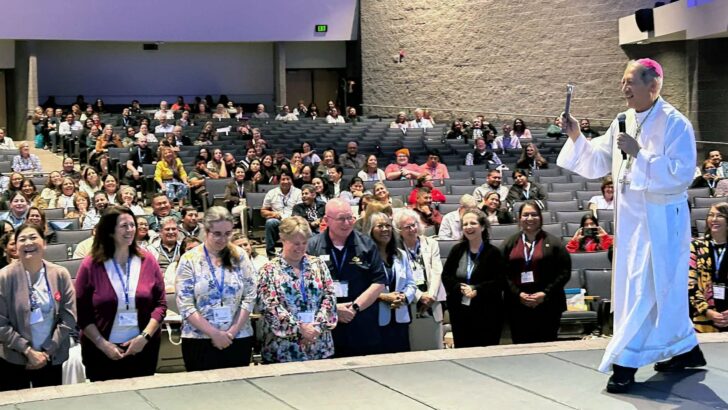
 Bishop Oscar A. Solis of Salt Lake City commissions 31 "Worthy and Suitable Catechists" on Sept. 19, 2026, during the closing ceremony of the Utah Catholic Conference at the Skaggs Catholic Center in Draper. The newly commissioned can now administer minor rites of the Order of Christian Initiation of Adults, or OCIA, to those joining or completing their initiation into the Catholic Church. (OSV News photo/Marie Mischel, Intermountain Catholic)
Jesus asked us for a plain answer: “All you need say is ‘Yes’ if you mean yes, ‘No’ if you mean no.” After five years of planning and deliberation, delegates at Saturday’s National Synodal Assembly were essentially offered to vote “Yes, yes”, or “Yes”, or “Yes, but not now”: highly recommend, recommend, or requires further discernment. Only one box, worded as politely as possible, allowed a delegate to decline the motion: “I do not recommend.” On 31 of the 35 proposals, fewer than one delegate in five ticked it. A ballot built to produce endorsement is not discernment. It’s a consent form.
Just read the proposals. Between them, they would create seven new bodies, including two commissions, two national offices and a permanent national ecclesial council, along with a national strategy, framework, review and formation pathway. That is a lot of new structure for a Church whose parishes are merging and some close to closing and whose priests are mostly in their seventies. One proposal is titled ‘National commission for faith-based social infrastructure and abiding.’ It is hard to know what that means. Yet none of the 35 titles mentions the Eucharist, Christ, the priesthood or vocations. The document is fluent in management speak. It says almost nothing about God.
How we got here matters too. Before the high priest, Jesus said he had spoken openly to the world and said nothing in secret. A process conducted in his name should meet that standard. This one often did not. For months this paper asked in vain who sat on the working groups and who chose them. As we eventually revealed, they drew heavily on familiar ecclesial networks, with rural Ireland and lay voices holding to the Church’s settled teaching largely absent. The names of the some 300 delegates appeared three days before the assembly, too late for any parish to know who spoke in its name. Readers have complained to us they did not know who represented their diocese! It’s not hard to understand why so many were disengaged from the Assembly, or entirely unaware of it. The communications was appalling.
This is not a secular standard imposed from outside. It is the Church’s own. Communio et Progressio teaches that “individual Catholics have the right to all the information they need”, and the Synod’s own Final Document sets transparency against secrecy. Pope Francis warned that clericalism can be fostered by lay people as much as by priests. A closed circle is a closed circle, whoever runs it.
Yet thankfully the delegates showed better sense than the process. What they wanted was clear. A review of catechesis and sacramental preparation was the strongest result on the ballot. The parish as a place of faith formation also got a strong vote. Given a sensible choice grounded in reality, they chose the handing on of the faith. It took five years and considerable money to learn what any parish priest in Mayo or elsewhere could have said in an afternoon session: Irish Catholics want to know their faith and hand it on to their children, and they want someone trained and paid to help them do it. In fact the laity did say it in the original synodal listening process.
In May 2021, two months after our bishops announced the Pathway, Pope Francis instituted the lay ministry of catechist in Antiquum Ministerium. Ireland has taken five years to arrive where Rome had already pointed. Archbishop Eamon Martin told delegates that “many of our parishes and even our dioceses are unsustainable in the current model and will struggle to survive.” Such a Church cannot staff a new layer of bureaucracy, but it can employ catechists.
Training lay people as faith formators is good. But training without a role is a course, not a ministry. There must be posts, contracts and a place in the life of the parish. The age of the volunteer is ending. The generation that ran our parish councils, sacristies and sacramental programmes for decades is tiring, and it is not being replaced on the same terms. Meanwhile the mission is at the doorstep: parents seeking baptism for their kids in First Communion class, couples who don’t really believe booking Catholic weddings, families arriving for funerals who haven’t been in a church in years or ever. Our priests, ageing and few, cannot accompany them all or take time to instruct them all. Give young adults paid work as catechists alongside them, and the Church gains two things at once: real help for clergy, and young people in ministry.
There is good news in all of this. Strip away the jargon and the secrecy, and the faithful have said something hopeful: they still want the faith handed on, and they are ready to see it done in new ways. The bishops have their answer. If they act on it, the Synodal Pathway may yet be remembered not for its committees, but for its catechists.