

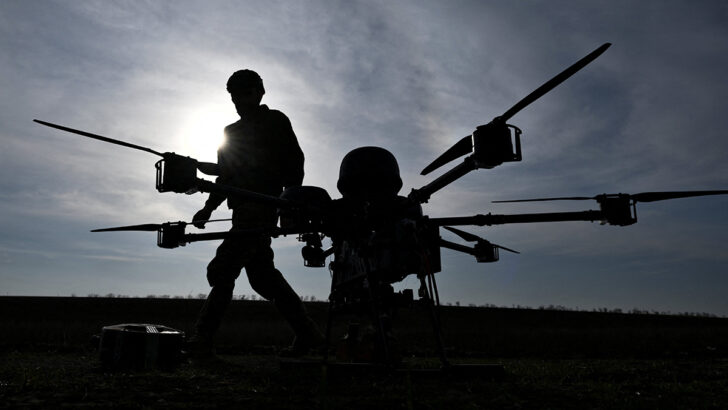
 A service member of the 422nd Unmanned Systems Regiment walks next to a heavy strike drone at a training ground, amid Russia’s attack on Ukraine, in Zaporizhzhia region, Ukraine, March 23, 2026. Photo: OSV News / Reuters.
 A patient lies unconscious in the intensive care unit. Days have passed without improvement. An artificial intelligence (AI) system, having analysed vast amounts of clinical data, concludes that the likelihood of recovery is extremely low. It recommends withdrawing life support.

The medical team studies the report. It seems detailed, logical and persuasive. Yet at the bedside, deeper questions arise. What is owed to this patient? Who speaks for her? Can decisions about life and death ever be reduced to probabilities and outcomes alone?
This is no longer hypothetical. As AI systems become more embedded in our lives, we are confronted with a fundamental question: who bears responsibility, and to whom are we accountable?
Eroding responsibility
There was a time when responsibility was clearly personal. A doctor made a decision and carried its weight. A judge pronounced a sentence and answered for it. A leader chose a course and was responsible for the consequences.
Today, that clarity is beginning to fade. Algorithms increasingly mediate decisions in medicine, finance, law, employment and public services. When outcomes are good, the system is praised. When they are not, the system is blamed.
If the data reflects past injustice, the system may perpetuate it”
AI is often perceived as objective and authoritative because it relies on data and mathematical models. Yet every system reflects human choices: the data used, the factors excluded, and the outcomes prioritised. If the data reflects past injustice, the system may perpetuate it.
The danger is not only that machines may make flawed decisions, but that human beings may begin to believe the “scientific” nature of the system absolves them of responsibility.
Machines without conscience
The moral questions surrounding AI are not confined to everyday decision-making. They extend into areas of grave consequence.
Consider the development of autonomous weapons capable of selecting and engaging targets without direct human intervention. Here the issue goes beyond efficiency or accuracy. It concerns the delegation of life-and-death decisions to machines.
We stand at a profound moral threshold. If machines are allowed to decide when to use force, or against whom, we risk severing the vital link between human action and moral responsibility.
As Antiqua et Nova, the Vatican’s 2025 note on artificial intelligence and human intelligence, emphasises, AI must never operate beyond meaningful human oversight. At the heart of the matter lies a fundamental moral principle: every human life possesses inherent dignity and must never be treated merely as a means to an end.
The voice of conscience
Before we speak of conscience, we must first recover a deeper truth about the human person. Sacred Scripture reveals that man is not merely an intelligent being, but one created in the image of God: “God created man in his own image… male and female he created them” (Gen 1:26–27).
Conscience, then, is not a private opinion or a passing feeling. It is the interior place where the human person encounters truth”
This divine imprint is the foundation of human dignity, freedom and moral responsibility. Because we are made in God’s image, we are capable of knowing the good, recognising truth and freely responding to it. As St Paul writes, “what the law requires is written on their hearts, while their conscience also bears witness” (Rom 2:15).
Conscience, then, is not a private opinion or a passing feeling. It is the interior place where the human person encounters truth. St John Henry Newman called it the “aboriginal Vicar of Christ,” binding us to truth even when it is difficult. The Catechism describes conscience as “a judgement of reason whereby the human person recognises the moral quality of a concrete act” (CCC 1778).
It is here, in this interior sanctuary, that the human person stands before God, listens, and chooses.
Outsourcing discernment
Increasingly, some turn to AI not only for information but for guidance in relationships, conflicts and important life decisions. Yet questions of love, forgiveness, vocation and commitment are not technical problems. They involve intention, responsibility and a living relationship with God.
An AI system may offer responses that appear thoughtful, balanced and even compassionate. Yet it does not know our anxieties, wounds or hopes. It cannot grasp the true weight of a decision, the cost of reconciliation or the grace required to forgive.
When guidance is repeatedly sought from an external system, the habit of interior discernment may weaken. Instead of wrestling with difficult choices through Scripture, prayer and the guidance of the Holy Spirit, one may begin to look for immediate, ready-made answers.
AI, however advanced, does not possess freedom. It does not love, seek the good or bear responsibility. To allow it to decide in our place is to risk surrendering the very capacity that makes moral responsibility possible.
To choose is not merely to select an option, but to respond faithfully to God’s call in concrete circumstances.
The patient is not a statistic
This challenge is not limited to personal decisions. It becomes even more critical in professional settings, where responsibility is greater and consequences more profound.
Consider the physician again at the bedside. An AI system may propose the most statistically effective treatment. But the patient is not a statistic.
She is a human person experiencing pain, fear and vulnerability, yet also bearing hope and dignity. No system can fully comprehend the meaning of suffering, the value of presence, or the spiritual depth of the human person.
The physician’s role is not merely technical; it is moral. It calls for prudence, compassion and responsibility. AI may assist, but it cannot replace the conscience that must decide.
Forming conscience
If conscience is to remain alive and true, it must be formed with care; otherwise, it risks becoming weakened or disoriented.
This formation begins with Sacred Scripture, where God’s Word shapes our judgement. It deepens in prayer and silence, where we learn to listen to God and the movements of the heart (cf. 1 Kgs 19:12).
We are guided by the teaching of the Church, especially in new and complex moral questions. We grow through the examination of conscience, and we are strengthened by acting upon what we know to be right.
As St John Paul II reminded us, true freedom is found not in doing what we want, but in choosing what is good.
Moral courage
And so we return to the central question: Who decides?
Not the system. Not the algorithm. Not the data.
The human person must decide—guided by a well-formed conscience, accountable to truth and ultimately to God.
As Pope Leo XIV writes in Magnifica Humanitas, “But we bring a wisdom concerning the human that our present time desperately needs: every person is unique and irreplaceable, a free and intelligent subject with a conscience, capable of seeking God, serving one another, caring for our common home.” The admonition is timely.
In the end, the future will depend not on how intelligent our machines become, but on whether we remain faithful to the voice of conscience within us.
And if we forget we are created in the image of God, we risk handing over not only our decisions, but our very humanity.
Let us then have the courage to remain human: to listen, to discern and to choose what is right before God.
Ultimately, it is not the machine that will answer but us.