

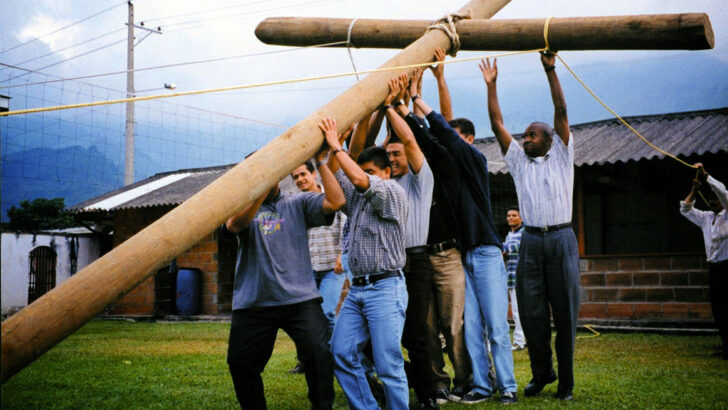
 Missionary Servant seminarians raise a cross at their mission in Costa Rica. Photo: OSV News/Courtesy of Fuzati.
 The good news, ‘The kingdom of heaven has come near.’

The Gospel
Matthew 9:36 When Jesus saw the crowds, he had compassion for them because they were harassed and helpless, like sheep without a shepherd.
Matthew 9:37 Then he said to his disciples, “The harvest is plentiful, but the labourers are few;
Matthew 9:38 therefore ask the Lord of the harvest to send out labourers into his harvest.”
Matthew 10:1 Then Jesus summoned his twelve disciples and gave them authority over unclean spirits, to cast them out, and to cure every disease and every sickness.
Matthew 10:2 These are the names of the twelve apostles: first, Simon, also known as Peter, and his brother Andrew; James son of Zebedee and his brother John;
Matthew 10:3 Philip and Bartholomew; Thomas and Matthew the tax collector; James son of Alphaeus and Thaddaeus;
Matthew 10:4 Simon the Cananaean and Judas Iscariot, the one who betrayed him.
Matthew 10:5 These twelve Jesus sent out with the following instructions: “Do not take a road leading to gentiles, and do not enter a Samaritan town,
Matthew 10:6 but go rather to the lost sheep of the house of Israel.
Matthew 10:7 As you go, proclaim the good news, ‘The kingdom of heaven has come near.’
Matthew 10:8 Cure the sick; raise the dead; cleanse those with a skin disease; cast out demons. You received without payment; give without payment.”
Initial observations
The appointment and sending of the twelve marks an important evolution in the ministry of Jesus. The Gospel reading today offers us three panels: the motivation, the call and the sending. Each moment will speak to us today: why proclaim the Gospel? Who is to proclaim it? How is it to be offered?
Kind of writing
Matthew 9:35ñ11:1 gives us the Mission Discourse in the context of a narrative framework. The narrative frame starts in 9:35–10:5a providing the setting for the discourse. Next follows the discourse proper in Matthew 10:5b–42, changing to second person, which is right for a discourse. Finally, 11:1 is a third-person summary, drawing the discourse to a conclusion.
The discourse itself is in two main sections: the mission of the twelve disciples to Israel (10:5b–23) and the ongoing mission of the post-Easter disciples (10:24–42). It is important to remember that we have here a double context: the setting in the life of Jesus and the setting in the life of the later church.
Old Testament background
They said, “We, your servants, are twelve brothers, the sons of a certain man in the land of Canaan; the youngest, however, is now with our father, and one is no more.” (Genesis 42:13)
And Moses wrote down all the words of the Lord. He rose early in the morning, built an altar at the foot of the mountain, and set up twelve pillars, corresponding to the twelve tribes of Israel. (Exodus 24:4)
He made to rest on the head of Jacob; he acknowledged him with his blessings and gave him his inheritance; he divided his portions and distributed them among twelve tribes. (Sirach 44:23)
New Testament foreground
Now when Jesus had finished instructing his twelve disciples, he went on from there to teach and proclaim his message in their cities. (Matthew 11:1)
Jesus said to them, “Truly I tell you, at the renewal of all things, when the Son of Man is seated on the throne of his glory, you who have followed me will also sit on twelve thrones, judging the twelve tribes of Israel.” (Matthew 19:28)
St Paul
For I handed on to you as of first importance what I in turn had received: that Christ died for our sins in accordance with the scriptures and that he was buried and that he was raised on the third day in accordance with the scriptures and that he appeared to Cephas, then to the twelve. Then he appeared to more than five hundred brothers and sisters at one time, most of whom are still alive, though some have died. Then he appeared to James, then to all the apostles. Last of all, as to one untimely born, he appeared also to me. For I am the least of the apostles, unfit to be called an apostle, because I persecuted the church of God. But by the grace of God I am what I am, and his grace toward me has not been in vain. On the contrary, I worked harder than any of them, though it was not I but the grace of God that is with me. Whether then it was I or they, so we proclaim and so you believed. (1 Corinthians 15:3–11)
Brief commentary
Verse 36 The word for compassion points to a deeply felt, spontaneous empathy (see Matt 14:14; 15:32; 20:34). In the Gospels, it is used of Jesus or of God as represented in the parables. The pastoral imagery is an echo especially of Ezekiel, who lamented the lack of good shepherds at the time of the great exile in Babylon (Num 27:17; 1 Kgs 22:17; 2 Chr 18:16, Ezek 34:5; Zech 13:7).
Verses 37-38 Harvest imagery was traditionally used to point to the time of judgement and, later, to the end of time (Is 24:13; 27:12; Joel 3:13). Here it underlines an awareness that the task is urgent, enormous and daunting. Hence we should ask the Lord of the harvest — a prayer which is answered immediately in the next verse.
Verse 1 Twelve echoes the number of the sons of Jacob, the progenitors of the twelve tribes of Israel. The mission of the historical Jesus was to his fellow Jews and the project was the restoration of Israel. The symbolism of the twelve sons precisely should play no role in discussions about women in ministry.
It is interesting — salutary — to note that the twelve lose significance almost immediately after Pentecost. Once the mission was open to non-Jews, the symbolism of the tribes of Israel lost its force. The twelve are mentioned once or twice in John’s Gospel but have very little significance (John 6:67, 70–71; 20:24). Of course, they have no “descendants” in terms of ministry.
Notice that the task of the twelve is identical to the mission of Jesus himself — no small challenge.
Verses 2-4 The twelve are named in sets of pairs (10:2–4; cf. Mark 3:16–19; Luke 6:14–16; Acts 1:13). In a way, their individual identities are of little importance. Instead, the symbolism is what counts. Of the twelve, only Peter, James and John are prominent in the synoptic tradition. Simon Peter is “first”; Andrew is “his brother”; and Matthew is the “tax collector.” The confusing note about the “sons of thunder” in Mark 3:17 is omitted entirely.
Verse 5 The first subunit is 10:5b-15 (our reading takes us just to v. 8). Jesus’ ministry was indeed limited in focus, something which can still surprise. The “city” of the Samaritans could refer to Samaria-Sebaste or to Mount Gerizim. V.5b may not to go back to the historical Jesus — why forbid what is not happening? At the end of his Gospel, Matthew makes clear the opening out to “all nations.”
Verse 6 The “lost sheep” are not a subset of Israel but point rather to the whole people in need of the good news.
Verse 7 The proclamation is the same as that of Jesus: From that time Jesus began to proclaim, “Repent, for the kingdom of heaven has come near.” (Matthew 4:17) In turn, that is an echo of the proclamation of John the Baptist: “Repent, for the kingdom of heaven has come near.” (Matthew 3:2) Matthew, writing for a break-away community, underlines the continuity of John, Jesus and the twelve.
Verse 8a In chapters 8-9, Jesus has just done exactly that: (“heal … raise … cleanse … cast out”). Cf. a later summary: Jesus answered them, “Go and tell John what you hear and see: the blind receive their sight, the lame walk, those with a skin disease are cleansed, the deaf hear, the dead are raised, and the poor have good news brought to them. And blessed is anyone who takes no offence at me.” (Matthew 11:4–6) The comportment of the apostles is made specific in the next few verses: Cure the sick; raise the dead; cleanse those with a skin disease; cast out demons. You received without payment; give without payment. Take no gold, or silver, or copper in your belts, no bag for your journey, or two tunics, or sandals, or a staff, for labourers deserve their food. Whatever town or village you enter, find out who in it is worthy, and stay there until you leave. As you enter the house, greet it. If the house is worthy, let your peace come upon it, but if it is not worthy, let your peace return to you. If anyone will not welcome you or listen to your words, shake off the dust from your feet as you leave that house or town. (Matthew 10:8–14)
Verse 8b Giving without charge is well within Jewish and early Christian tradition:
- Hillel says, (4) “And the one who uses the crown (of the Torah to make money) passes away.” (Avot 1:12–13)
Did I commit a sin by humbling myself so that you might be exalted, because I proclaimed God’s good news to you free of charge? (2 Corinthians 11:7)
The good news is a gift from God; it is received as gift and should be handed on as a gift.
Pointers for prayer
- Compassion is the characteristic of Jesus throughout the Gospels — a deep empathy and love, in the face of suffering. In my world, who are the people who challenge me to compassionate living? When I find it difficult (for whatever reason), how do I respond?
- Jesus first called the disciples and then, after time with him, he chose and sent out the twelve apostles. As my discipleship deepens, is the Lord calling me to some ministry, a concrete commitment to service and the building up of the community of faith? How am I responding?
- Jesus wants his messengers to be focussed on the mission — first of all to their fellow Jews. In the early church, this vision widens to making “disciples of all nations” (Matthew 28). Moving from maintenance to mission is the only way forward. How do I see myself as a disciple on a mission in our world today?
Prayer
Compassionate God, your word calls labourers to the harvest. Send us who are blessed with the gift of your kingdom to announce its coming with gladness and to manifest its healing power.
We make our prayer through our Lord Jesus Christ, your Son, who lives and reigns with you in the unity of the Holy Spirit, God for ever and ever. Amen.
Thought for the day
We can identify easily with the double expression “harassed and helpless”, a wide expression of frustration and naked need. There can indeed be a sense of aimlessness, “like sheep without a shepherd”, as we look for direction in life, values to live by and a sense of overall meaning and purpose. Dennis O’Driscoll captured it in his poem ‘Missing God’:
Miss Him when the TV scientist
explains the cosmos through equations,
leaving our planet to revolve on its axis
aimlessly, a wheel skidding in snow.
The message of the kingdom is no less real — rooted in compassion — and relevant today as never before. In the pithy expression of Bishop David Jenkins: “There is God. He is as he is in Jesus. There is hope.”
Prayer
God of the cosmos, you come close to use all in the compassion of Jesus. As we take to heart his proclamation of the kingdom, show us how we can be bearers of the good news to all around us. Through Christ our Lord. Amen.
**
God demonstrates his own love for us: Christ died for us

The first reading
Romans 5:6 For while we were still helpless, at the right time Christ died for the ungodly.
Romans 5:7 (For rarely will anyone die for a righteous person, though for a good person perhaps someone might possibly dare to die.)
Romans 5:8 But God demonstrates his own love for us, in that while we were still sinners, Christ died for us.
Romans 5:9 Much more then, because we have now been declared righteous by his blood, we will be saved through him from God’s wrath.
Romans 5:10 For if while we were enemies we were reconciled to God through the death of his Son, how much more, since we have been reconciled, will we be saved by his life?
Romans 5:11 Not only this, but we also rejoice in God through our Lord Jesus Christ, through whom we have now received this reconciliation.
Initial observations
Our first reading from Romans, one of the greatest Christian writings. We will hear from it until the 24th Sunday in Ordinary Time, Year A. Of course, we always hear excerpts, a little out of context, so it would be really good to read the full text along with these passages. At the very least, the start of chapter 5 should be read. The version used in the notes is the New English Translation.
Context in the community
The context can be reconstructed. The Roman house churches were divided along the lines of Jews and Gentiles. What seems to have happened is this. Originally, Christianity came to Rome via Jewish traders. The faith became established enough for rows to break out and for it come to the attention of the authorities. Claudius expelled “all the Jews form Rome” — probably just the one causing the trouble, the Christ-believing Jews such as Prisca and Aquila. In the absence of the Jewish matrix, the Christ-believing Gentiles evolved a version of The Way without the markers of Jewish identity, that is, food laws, circumcision and Sabbath observance. When the expulsion was relaxed and the Christ-believing Jews could return, there was friction, with each group regarding itself as superior. The Jews could say “we are being faithful”. The Gentiles could say, we are putting new wine into new wine skins”. It is about identity, tradition and innovation.
The division is the capital disturbed Paul sufficiently to write to a church he had not founded.
Kind of writing
Broadly speaking, across Romans, Paul works like this:
1-4: Jews and Gentiles in need of grace.
5-8: Jews and Gentiles in Christ.
9-11: Jews and Gentiles in God’s plan.
12-15: How to live with differences.
In the second large section, 5-8, Paul “rehearses” all the gifts received in Jesus: Justification, grace, faith, the Holy Spirit, a new Adam, baptism, the moral struggle (ch. 7), the gift of the Spirit who helps us in our weakness and finally nothing can separate us from the love of God in Christ Jesus our Lord.
It is quite a drum roll of affirmation and deep reassurance. In 1-4, Paul showed that both Jews and Gentiles were in need of grace (“there is no distinction”). Here, the grace is profiled sequentially, in so powerful a way that the differences dividing the Roman house churches must seem to be of no importance whatsoever. At least, that is Paul’s intention.
Related passages
But now apart from the law the righteousness of God (although it is attested by the law and the prophets) has been disclosed— namely, the righteousness of God through the faithfulness of Jesus Christ for all who believe. For there is no distinction, for all have sinned and fall short of the glory of God. But they are justified freely by his grace through the redemption that is in Christ Jesus. God publicly displayed him at his death as the mercy seat accessible through faith. This was to demonstrate his righteousness, because God in his forbearance had passed over the sins previously committed. This was also to demonstrate his righteousness in the present time, so that he would be just and the justifier of the one who lives because of Jesus’ faithfulness. (Romans 3:21–26)
Brief commentary
Verse 6 The “we” is all humanity, both Jews and Gentiles. The cross and resurrection are central to Paul’s thought. Paul does not teach “substitutionary atonement” and so “to die for” means not instead of but for the benefit of. In Paul’s mind, the cross is the disclosure of God’s compassionate solidarity for us all.
Verse 7 The brief excursus serves to underline the gift and grace of God in Jesus. The “thought experiment” of dying for a really good person just doesn’t apply in any case!
Verse 8 The cross demonstrates, discloses, displays even, God’s love (not his anger!). A key passage is Romans 3:21-26 (above). The words in italics give the flow of the passage. You may like to compare this translation with the one in our own Bible.
Verse 9 The context here is apocalyptic, in which the travails of the end time are experienced as “wrath”. The argument is a fortiori: having been, how much more. There is nothing to fear.
Verse 10 Paul repeats his a fortiori argument in slightly different words, bringing in the resurrection. Here he anticipates the last section of 5-8, where we hear the marvellous words:
Who will bring any charge against God’s elect? Is it God, who one who justifies? Who is the one who will condemn? Is it Christ, the one who died (and more than that, he was raised), who is at the right hand of God, and who also is interceding for us? (Romans 8:31–34 NET adjusted.)
Verse 11 Paul conviction spills spontaneously over into joy, a joy which is at the heart of his faith in Jesus.
…through whom we have also obtained access into this grace in which we stand, and we rejoice in the hope of God’s glory. (Romans 5:2)
Now may the God of hope fill you with all joy and peace as you believe in him, so that you may abound in hope by the power of the Holy Spirit. (Romans 15:13)
Pointers for prayer
- It is good to be able to recognise our need of grace — perhaps only clear to us in retrospect, in the light of faith.
- Often, we have to let go of things we learned as children. This is especially true of salvation. Paul’s teaching is more wholesome, more life-giving, more joyful.
Prayer
God, we glimpse your grace incrementally, “in a glass darkly,” and still we are overwhelmed by your extraordinary love, shown in Jesus’ cross and resurrection who lives for ever and ever. Amen.
**
You shall be for me a priestly kingdom and a holy nation
The second reading
Exodus 19:2 They journeyed from Rephidim, entered the wilderness of Sinai, and camped in the wilderness; Israel camped there in front of the mountain.
Exodus 19:3 Then Moses went up to God; the Lord called to him from the mountain, “Thus you shall say to the house of Jacob and tell the Israelites:
Exodus 19:4 ‘You have seen what I did to the Egyptians and how I bore you on eagles’ wings and brought you to myself.
Exodus 19:5 Now, therefore, if you obey my voice and keep my covenant, you shall be my treasured possession out of all the peoples. Indeed, the whole earth is mine,
Exodus 19:6 but you shall be for me a priestly kingdom and a holy nation.’ These are the words that you shall speak to the Israelites.”
Initial observations
The reading — which initially may seem obtuse — gives the reason of the escape from Egypt. They have been set free and become God’s treasured possession. In this way, the first reading mirrors the proclamation of the twelve in the Gospel. It is also foundational for the image of the people of God as a priestly people.
Origin of the reading
Our reading is the opening of Exodus 19-24, the climactic section telling the story of the theophany, covenant and law at Mount Sinai — the defining moment in Israel’s relationship with God.
Kind of writing
The larger narrative of 19-24 is introduced by 19:1-15. Scholars have detected different sources, the subject of dispute. These verses form a two-part introduction to theophany and covenant, and that is what determines the form it takes. The first part of that introduction (vv. 1–8), the heart of which is the famous “Eagle’s Wings” speech of Yahweh, serves as a general prologue to the entire Sinai narrative sequence. The second part of the introduction (vv. 9–15) functions as a specific anticipation of the account of the appearance of YHWH, the Lord himself.
Related readings
Say therefore to the Israelites: I am the Lord, and I will free you from the burdens of the Egyptians and deliver you from slavery to them. I will redeem you with an outstretched arm and with great acts of judgment. I will take you as my people, and I will be your God. You shall know that I am the Lord your God, who has freed you from the burdens of the Egyptians. (Exodus 6:6–7)
“I am the Lord your God, who brought you out of the land of Egypt, out of the house of slavery; you shall have no other gods before me.” (Exodus 20:2–3)
As an eagle stirs up its nest and hovers over its young, as it spreads its wings, takes them up, and bears them aloft on its pinions, the Lord alone guided him; no foreign god was with him. (Deuteronomy 32:11–12)
…but those who wait for the Lord shall renew their strength; they shall mount up with wings like eagles; they shall run and not be weary; they shall walk and not faint. (Isaiah 40:31)
Brief commentary
Verse 2 The people find themselves in the desert surrounding Mount Sinai. There will be there for just short of a year (Numbers 10:11). In spite of long tradition, it is futile to try to locate the mountain.
Verse 3 The house of Jacob, that is the Israelites, reminding of us the end of the book of Genesis and the start of the book of Exodus.
Verse 4 God reminds them of what he has done for them — a standard introduction to covenants of the period. Cf. Exodus 20:2–3 above. The imagery of the eagle’s wings is very appealing. God led Israel swiftly and safely through the wilderness, like an eagle training its young to fly, catching them on its back when they tire or fall. Cf. Deuteronomy 32:11–12 above.
Verse 5a The covenant is conditional, as always. The precise word used for treasured possession (sagullâ) indicates the private, personal property of a ruler. Although Israel is designated as unique, there is a culture context: A Hittite king described one of his vassals by this term, and an ancient Syrian royal seal describes the king as the servant, beloved, and treasure of the gods. Israel is expected to hear, to listen to the word of God:
He said, “If you will listen carefully to the voice of the Lord your God, and do what is right in his sight, and give heed to his commandments and keep all his statutes, I will not bring upon you any of the diseases that I brought upon the Egyptians, for I am the Lord who heals you.” (Exodus 15:26)
Verse 5b-6a The language here is especially evocative: the people will enjoy the status of priests, close to God and sacrosanct. The phrase mamleket kohanim ‘priests kingdom’ is unique and unparalleled. Gôy qadôš ‘holy nation’ is also unique, but paralleled by the more common am qadôš ‘holy people’. Many other verses in the Bible carry the same message.
“…for him to set you high above all nations that he has made, in praise and in fame and in honour; and for you to be a people holy to the Lord your God, as he promised.” (Deuteronomy 26:19)
The Lord will establish you as his holy people, as he has sworn to you, if you keep the commandments of the Lord your God and walk in his ways. (Deuteronomy 28:9)
“…but you shall be called priests of the Lord; you shall be named ministers of our God; you shall enjoy the wealth of the nations, and in their riches you shall glory. (Isaiah 61:6)
Politics and religion collide (not for the last time!): kingdom/nation and priestly/holy.
Verse 6b Moses is commissioned to bring this message to the assembled Israelites.
Pointers for prayer
- The special place of Israel is God’s affection is both gift and task. This people is holy but also called to be holy: You shall be holy, for I the Lord your God am holy. (Leviticus 19:2)
- Being the “people of God”, the pobal Dé, was fundamental to the new vision of Vatican II and for the Synodal Pathway. What has been my most recent experience?
- To tell the greatest story every told is the call of every believer, as we given an account of the hope that is in us.
Prayer
Our gracious God, help us to realise more and more that we are you treasure possession, called to be holy as you are holy. Through Christ our Lord. Amen
**
The Liturgy
Readings 1 and 3
Both readings reflect on “what happened for us”. We are invited to embrace the gift and proclaim again our salvation.
The responsorial Psalm
Psalm 100 (99) is much loved — a marvellous invitation to be joyful, a recognition of God’s grace, mercy and love.
Sunday introductions
First reading Exodus 19:2-6
The image of the eagle in today’s reading is striking: God led Israel swiftly and safely through the wilderness, like an eagle training its young to fly, catching them on its back when they tire or fall.
Second reading Romans 5:6-11
Paul is overwhelmed by the extraordinary love of God, displayed in Jesus’ death and resurrection. Because such grace is at the heart of Christian faith, it spill over into ecstatic joy.
Gospel Matthew 9:36-10:8
The Gospel reading today offers us three panels: the motivation, the call and the sending. Each moment will speak to us today: why proclaim the Gospel? Who is to proclaim it? How is it to be offered? Excellent material for reflection today.
Weekday introductions
Monday 15 June
1 Kings 21:1-16
Our reading today tells the first half of a very nasty abuse of power by a king and his wife. The rest of the story will be heard tomorrow, when the culprits get their comeuppance.
Matthew 5:38-42
We are always tempted to meet violence with violence. Jesus’ alternative is radical.
Tuesday 16 June
1 Kings 21:17-29
This reading is the second part of the yesterday’s nasty story. The powerful monarch is reproved by the proclamation of the prophet, who does not mince his words. The king does respond and even repents…nevertheless, the wheels of justice are set in motion.
Matthew 5:43-48
Jesus quotes the usual attitude—love your neighbour, hate your enemy—and then gives a series of penetrating arguments to offer his alternative vision.
Wednesday 17 June
2 Kings 2:1, 6-14
This reading tells the very famous story of Elijah and his (underused!) chariot. Behind the drama stands a very ordinary question: when a great spiritual leader departs or dies, will anything of his leadership remain? Yes…but it all depends!
Matthew 6:1-6, 16-18
These two paragraphs surround the Lord’s Prayer and represent a Jewish devotional triad: alms, prayer and fasting. Any attraction to showiness in religion is resolutely set aside.
Thursday 18 June
Ecclesiasticus 48:1-15
The book of Ecclesiasticus was written long after the life and ministry of Elijah – perhaps some six centuries later. The ancient prophet was still admired and treasured. Today we have a poetic, even glowing account of his career.
Matthew 6:7-15
The introduction to the Lord’s Prayer in Matthew is central and helps us understand the prayer and its brevity. In reality, the Lord’s Prayer is not so much a prayer as a form of words but a method or series of steps in prayer.
Friday 19 June
St Romuald, abbot
2 Kings 11:1-4, 9-18, 20
Our story today is complex: a king’s mother tries to do away with all the surviving members of the royal family. It is not uplifting but also not uncommon in imperial families. Nevertheless, you will notice that there is one survivor, a baby, who ensures that David’s line continues. In this way, the writer tries to show that God’s own faithfulness to the house of David cannot be set aside even by unspeakable horror. The Psalm which follows captures the true meaning of this difficult reading.
Matthew 6:19-23
Our gospel is a challenge and at the centre of that challenge we hear the words of Jesus: For where you treasure is, there will your heart be also.
Saturday 20 June
The Irish Martyrs
2 Chronicles 24:17-25
Today we have once more a difficult story: a king who turns away from God to idols and even has God’s prophet put to death. The clue about the reading is in the Psalm which follows: even though the kings of Judah were sometimes very unfaithful to God, yet, God remained true to his promise to the house of David. There is some good news—Gospel—in God’s continued fidelity.
Matthew 6:24-34
This is a favourite passage from the Sermon on the Mount, prized by people well beyond frontiers of Christianity. The vision is Jesus is not “airy-fairy” detachment, but a costly choice of values and attitudes, grounded in faith in God. We might feel there’s risk of sheer impracticality but this is overcome by the general statement: “You heavenly father knows you need all these things.”