

 Peter Costello
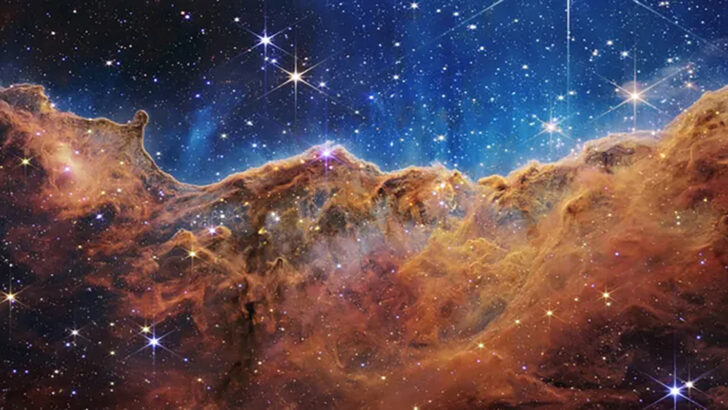 In deepest space - The Carina Nebula first imaged by the James Webb Space Telescope.
Photo: NASA, ESA and CSA.
In deepest space - The Carina Nebula first imaged by the James Webb Space Telescope.
Photo: NASA, ESA and CSA. The Miracle of the Universe: Science, Christian Faith and Personal Experience,
by Jim O’Connell, MHM
(London St Pauls Publishing, €11.99 / £10.95)
The author of this book is a Mill Hill Missionary, who has spent many years in Kenya, as well as at home, teaching and editing. This is his third book, and again as in the earlier one he tries to bring together his own personal experiences of the world and of people, and to make sense of them in the light of what he understands about science and what it has to say.

He quotes in several places an observation from St John Paul II: “Faith and science can draw each other into a wider world in which both can flourish.”
Society, however, more usually thinks that science explains everything. Yet it is clear that science has its limitations: It can, for instance, tell us about the human eye’s 107 million cells which enable us to capture not only a monochrome world but also see in colour. The human eye is only a small part of the human body, and that body a small part of the world, a minute fraction of the cosmos.
As an example: among the scientists he evokes Sir David Attenborough, especially his films made since 2006. My own recollection of Attenborough goes back a much longer way to the first films he made for the BBC in the 1950s; these were in black and white, the later ones in colour. In fact I still reread his early books, but not the latter ones in colour. Reading O’Connell I have come to see this as strange.
South America
His first book was called Zoo Quest to Guiana, about a trip to South America filmed for the BBC. These films were created by Attenborough and his single cameraman Charles Lagus, working as a team in the field.
So two men alone made the earlier films. Today when David Attenborough creates a programme, it is with the aid of perhaps forty people. This is an example of just how the means of communication has altered how what can be presented to us, an excellent example of just how our vision of the world as seen by Attenborough has changed. But Attenborough, everywhere he went also collected examples of local art, which he describes in a book called The Tribal Eye. Yes, a book about art.
Science cannot truly explain how a poet makes a sonnet, or a tribal artist, or any artist, makes a piece of art”
And that goes to the heart of the problem. Science can largely tell us about how animals are made and work; but it failed to fully explain just how the creative faculty in man works. It can say how and why the songbirds sing – not for joy – but to claim their territory. Science cannot truly explain how a poet makes a sonnet, or a tribal artist, or any artist, makes a piece of art.
So it is with this book. Jim O’Connell can tell us what we know about the cosmos, and its wonderful intricacy and effective working. And also how it does not work.
One of the striking factors he does not allude to, however, is the long-standing search for intelligent life in the cosmos. Are we alone in the cosmos?
Extent
Given the almost immeasurable extent of creation as we now glimpse it, there are places which would seem likely to support the sort of carbon-based life we know here on earth. Yet if we do encounter these distant intelligences, will they be like us? Certainly, in one way they will: in the possession of an opposable thumb, which is what makes man a maker.
Yet for theologians there is a problem here. They will not be affected by “Adam’s sin”. They will not, as C. S. Lewis hinted at in one of his own science fiction books, share our fallen nature, being untainted by original sin, and what that means for salvation history as theologians understand it.
So our encounter with intelligent life in the cosmos will involve perhaps what here on earth historians have called “the fatal impact” of an advanced culture on a less technical one.
The miracle of what we can see astounds us; the nature of what we cannot yet know will do far more than that”
The Jesuit astronomers at the Vatican Observatory outside Rome are aware of this aspect of philosophy. Yet one never sees it discussed in any large way. The miracle of what we can see astounds us; the nature of what we cannot yet know will do far more than that.
I am groping here to go behind the vitally interesting thoughts that Jim O’Connell relays to us. But like things we examine intently, the future will be more complex than we can know, or can even imagine. This little book which culls the thoughts of many insightful people certainly provides food for thought and is well worth reading.