

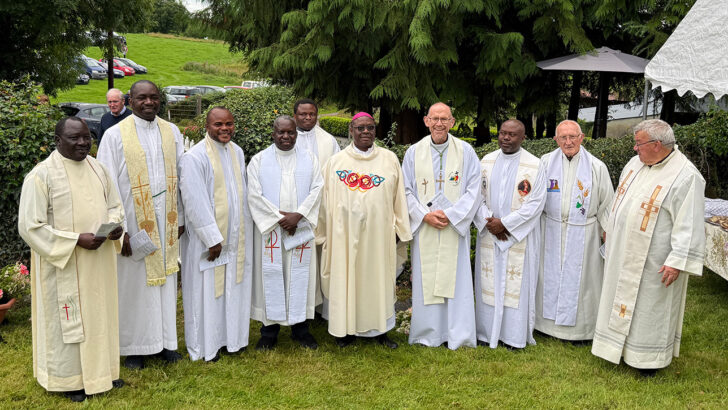
 Bishop Charles Hammawa of Jalingo, Nigeria, and Bishop Fintan Monahan of Killaloe with concelebrating priests after the annual Mass of St Feichin in Abbey, Co. Galway.
 For generations, Ireland sent priests and religious across Africa and Asia, helping to build up local Churches. Today, in some places, that direction of travel has reversed, with priests from those Churches now coming to serve in Ireland.

For Fr Anselm Emechebe MSP, a Nigerian priest serving in Kilsaran, Co. Louth, that reversal is personal. He grew up in a Catholic environment formed in part by Irish missionaries; an Irish priest of the Society of African Missions celebrated his First Communion and Confirmation.
“The Irish people were also part of our formators in those days,” he said. “But of course, the Irish came to us and now we are also coming back. And that’s the dynamism of the Church. You can’t really predict. The Church moves. The Church is alive, it moves from one territory to another.”
Fr Amos Ruto, now serving in Castletownbere, came from Kenya after spending almost a year with his bishop, a Cork man who had worked there for more than 50 years and prepared him for Irish parish life. He later recalled hearing an older Irish priest reflect on how quickly the country’s situation had reversed.
Accommodated
“There were so many priests that all of them could not actually be accommodated in their dioceses here in Ireland. And they had to move out, to go and evangelise,” he said. “But now, 40 or 50 years later, he comes back to the country and they are struggling with vocations, the parishes are being merged. It’s kind of hard to believe that is happening within such a short period of time.”
As the Irish Church prepares for its National Synodal Assembly in October, that reversal provides part of the backdrop to questions about the future.
For Fr Jonas Rebamontan, a Filipino priest serving in Boyle and a former seminary formator of nine years, the answer cannot simply be more priests from abroad.
“There must be a massive movement or recruitment for vocations, especially to the priesthood,” he said. “We cannot just depend on the missionaries.”
‘Missionaries’, he added, ‘are not long-term solutions… these are just temporary’”
Fr Rebamontan would like to see greater vocation awareness in schools and more opportunities for young people to encounter priests. “There must also be somebody from the grassroots, from the local, maybe Irish young people who would sign up,” he said.
Asked whether missionary priests offer a complete answer to Ireland’s shortage, he replied: “It’s not the complete answer as far as I have observed.”
He described his own role through the image of a couple stranded at the roadside with a flat tyre but no jack. A passer-by can lift the car, he said, but the couple still has to replace the tyre.
“I’ll serve as a jack. I’ll lift your car, but you have to double time with your effort in replacing your tyre,” he said. “I find myself that way. I lift some of your burdens, but you have to double time with your effort in recruiting for more priests because I also have to go back to my country.”
Missionaries, he added, “are not long-term solutions… these are just temporary”, and can cover some of the work while the Church seeks local candidates.
The growing reliance on overseas priests also raises the question of how they are prepared for Irish parish life. Fr Ruto’s experience points to one model. His bishop spent months preparing him for what he would encounter. “I wasn’t coming to a place where I didn’t have an idea,” he said. “I was coming to a place where I had a picture, because the bishop had briefed me on what takes place in the Irish Church.”
Chinese-born Fr Paul Yongde Yang SVD also had a gradual introduction. After language school, he began parish ministry in Tramore, where parishioners helped him with English and pastoral life. “I always think I’m so blessed to meet so many very good people,” Fr Yang said. “They knew my situation. They gave lots of help.”
Fr Rebamontan said some incoming priests have a more abrupt transition. According to his understanding, several priests who recently arrived from Uganda were assigned directly to parish work. “I can just imagine the adjustment that you have to do straight from your country to a parish in Ireland,” he said. “You’re not even given an orientation of what’s going to happen.”
Reminders
The interviews, however, also produced repeated reminders of what the Irish Church still does well.
Polish priest Fr Dominik Domagała, newly appointed as a curate in the Castleknock Parish Partnership, returned this September after a period working in rural Italy. Having spent more than six years ministering in Ireland, the time away sharpened his view of the Church here.
“Ireland, really, it’s not a lost battle,” Fr Domagała said. “It’s far away from that. Ireland has some challenges, Dublin in particular, but it has a lot to offer when it comes to the Church and the place of the Church in society.”
He pointed especially to funeral ministry. “The basis is that we make a bond with the family. We care for the family and that’s where we’re coming from when the funeral is organised,” he said. Comparing that with his experience elsewhere, he added: “Poland or Italy should learn from Ireland.”
In Poland, he said, people can sometimes “come to the church and leave as strangers” after a funeral. “This is a very good example of how things should be done,” he said, “and people in Ireland don’t realise this.”
‘I always think it’s the family,’ he said. ‘Catholic [faith] is raised up in the family, not in the schools’”
Fr Ruto also sees something in Irish Catholics that can be obscured by the language of decline.
“Despite the challenges that the Church has gone through in Ireland, we still have people who are dedicated in their faith, who are actively participating in their faith,” he said. “The courage that they have… we still have people who are really dedicated and people who give their best. That is something that inspires me.”
He believes Ireland can also learn from the level of lay participation he knew in Kenya. “There is a lot of lay participation when it comes to liturgical activities, when it comes to running of the parish – people are involved,” he said.
For Fr Yang, renewal begins even closer to home. He comes from a Chinese Catholic family stretching back four or five generations and sees the family as central to handing on belief.
“I always think it’s the family,” he said. “Catholic [faith] is raised up in the family, not in the schools.” Families who want their children to remain Catholic, he added, “have to make some effort”, because “children see, children do”.
Conviction
For Fr Domagała, renewal also depends on the conviction of priests themselves. He recalled a maxim from his seminary professor: “Only convinced one can convince anyone else.”
“If you are not burning with zeal for the Lord, how can you make another person alive within oneself with that same fire?” he asked. “We need to be convinced and touched by the presence of the Lord first.”
Fr Emechebe, meanwhile, does not read the Church’s future simply in numbers. “The grace of God is still very much alive,” he said. “Sometimes the Church can be small, but more authentic.”
In the end, the reversal is not simply that Ireland now receives priests from places where it once sent them. Those priests are helping to carry the Irish Church through a period of change. But if Fr Rebamontan’s roadside image is right, they can lift some of the burden while the local Church works on the repair. But they cannot change Ireland’s tyre for it.