

 Popes Francis and Leo have come from a similar missionary and pastoral experience, so to overlook the influence the Latin American Church had on them would be a mistake as both were formed through the active participation of its peoples.
 Popes Francis and Leo have come from a similar missionary and pastoral experience, so to overlook the influence the Latin American Church had on them would be a mistake as both were formed through the active participation of its peoples.

Their experiences of Church recognise the mission of all the baptised, ‘Pobal De’ (People of God), as we say here in Ireland. From their neck of the woods, their vocations were enriched by a fruitful synodal spirit, where catechesis and committed people incorporated the role of Scripture in everyday life in small Christian communities, and lay ministries at the service of the People of God, recognising their role as an important part of the organic structures and ministries of the Church.
They see themselves as following the ancient way of the first Christian communities by giving witness while living in the circumstances they face in their daily lives, ministering to their local communities, each through their baptismal gifts in different roles and particular vocations.
Some Background
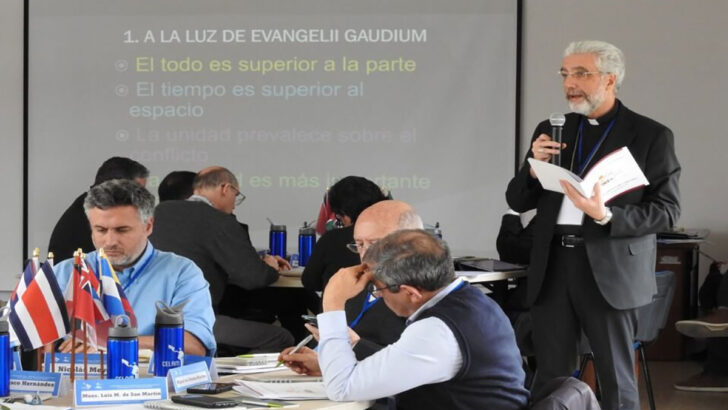
The idea of local and national synods is not something new, as they emerged in Latin America in 1900. Notably, 63 of them were convened, in different forms before the Second Vatican Council. Synods emerged, because missionary bishops needed support as the peoples rose up against the Spanish and Portuguese rule and newly empowered national leaders of the 19th century viewed the Church with suspicion.
Bishops with a missionary spirit and zeal for the faith built up diocesan structures during difficult and dangerous times. They felt the need to come together in local synods and councils to support each other, and discuss their local structures and the problems assailing their ecclesial territories at the time.
Leo XIII was so impressed that he asked the bishops to gather in national conferences”
Pope Leo XIII helped this process with his encyclical of 1898, Quum Duoturnum which granted them the possibility of calling a plenary council for the entire Latin American region. Because of circumstances, this council was held in Rome, and it discussed, Church-State relations, structural development and religious education amongst many other issues.
It resolved that new and local pastoral approaches should be implemented and that clergy should grow in holiness and piety to give example that would draw the faithful to the Church. Leo XIII was so impressed that he asked the bishops to gather in national conferences. Later, when all the bishops of Latin America were gathered in a 1955 council in Rio de Janeiro, they petitioned the then Pius XII to form CELAM, the Latin American Episcopal Council.
This soon became an important synodal and structural initiative and the modus vivindi after the second Vatican Council which called for a more synodal configuration of the Church. Pope Francis believed deeply in these synods and even more on the notion of synodality.
As Cardinal in Buenos Aires, he was elected president of the redacting committee on the final Aparecida document, which focused on pastoral and missionary conversion. Later, these became the principal themes of his papacy. On calling a special ‘Synod on Synodality’, he aimed on fostering a more inclusive and participatory Church which could make significant proposals for reform and allow for a greater involvement of the laity.
The reason for synodality
On having returned to Ireland, I find so many different opinions, misunderstandings and in many cases, a lack of interest in the coming to terms with what the Synodal process is about. This present discernment of the Church in Ireland is not simply another programme or draft of another document, but a process of participation of all the baptised in the hope of accurately summarising the voices of the faithful who are being consulted at various stages.
The end goal is to discern together, as a community of faith and, with the guidance of our pastors, what the mission of the Church in Ireland is in the local and global context. It recognises the empowering and creative gifts of the Holy Spirit, who animates, vivifies and unifies in order to help the Church, fulfil its divine purpose and carry out its mission.
It is in listening to each other that we recognise each other’s baptismal dignity and our common priesthood of the faithful and agree on a way of being Church in which everyone sees themselves reflected.
The International Theological Commission specifies it well and says that synodality is “the specific modus vivendi et operandi (way of living and operating) of the Church, the People of God, which reveals and gives substance to her being as communion when all her members journey together, gather in assembly and take an active part in her evangelising mission.” (Synodality in the Life and Mission of the Church, no. 6)
A ‘Kairos’ moment
Today, after a three-year process of the Synod of Bishops on synodality: a process that included listening to hundreds and thousands of people in parishes and regions across the globe, with national and continental consultations and two month-long assemblies at the Vatican, for the first time, ‘non bishops’, lay women, men and religious orders with an equal vote all agreed that in the face of increased secularisation, poverty and destruction of our common home, we need to find new ways of evangelisation and giving witness as a Church’s in mission.
It can be a challenge but that challenging is something that God askes or even gently invites us to do”
Having experienced the joy and the hope of the South American Church in Ecuador, for twenty-five years, I believe that the Holy Spirit is steering us into a joyful ‘Kairos’ moment to be used for God’s purposes.
Many of us, need to get our heads around a sea change, or a pastoral paradigm shift, as all of us are called by God as a people of faith to trust Him in His perfect time. It can be a challenge but that challenging is something that God askes or even gently invites us to do.
This is a new time for us. Each in our own way and without ideological manipulation we, are convened to foster a Christian ethos and to help in promoting a new pastoral approach in today’s world and, more importantly, in an Ireland that needs the voice of divine wisdom and intervention.
We should not be afraid to embrace the challenge, as it seems to me, that God is putting the pieces in place and gently nudging us forward. Interestingly, and I would suggest, prophetically, both Popes Francis and Leo experienced firsthand how synods can be a source of spirituality and of missionary zeal, launching the Church to evangelise in what seems to be developing as a very indifferent society.
It is exactly what we need at this moment and both Popes are very clear that synodality only happens when done ‘cum Petro et sub Petro’ (with Peter and under Peter). I for one pray that the Holy Spirit illuminates all of us and guides us on this synodal pathway just as He has done with our Latin American sisters and brothers.
The end goal is to discern together, as a community of faith and, with the guidance of our pastors, what the mission of the Church in Ireland is, in the local and global context”