

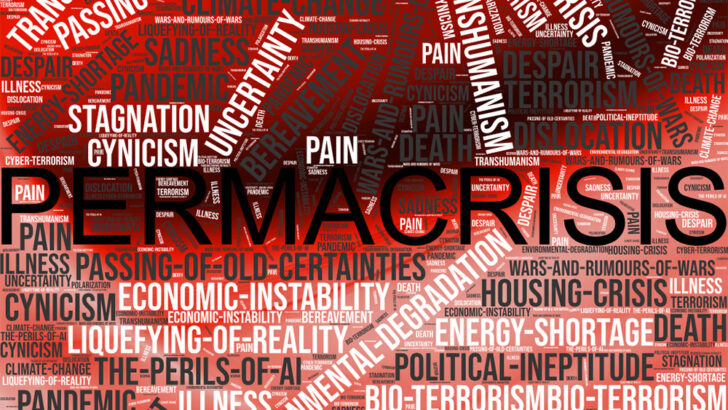
 A word cloud illustrates the many anxieties shaping today’s ‘permacrisis’.
 ‘Faith in a time of anxiety’ is a journey from fear to faith, writes Fr Chris Hayden

Illiness; death; bereavement; uncertainty; worries about loved ones; wars and rumours of wars; economic and housing instability; energy shortage; disruption to health services; climate change; environmental degradation; terrorism, bio-terrorism and cyber-terrorism; the disruptions and perils of AI; memory of the recent pandemic and fear of a further one; political ineptitude, polarisation and stagnation; increasing sadness, cynicism, despair and dislocation; the passing of old certainties; the ‘liquefying’ of so much that was once regarded as solid and unchangeable, from community and family ties, and sexuality, right through to human nature itself.
The list could go on, and it’s not for nothing that an increasing number of commentators have taken to using the ominous word, ‘permacrisis.’ For many, the world has become a frightening place.
On October 22, 1978, as he began his pontificate, Pope St John Paul II preached a homily at Mass in St Peter’s Square, a homily that had a simple but striking phrase at its heart: “Do not be afraid.” Those words were to become a key theme of John Paul’s pontificate.
There is a popular impression that the same words, ‘Do not be afraid,’ occur three hundred and sixty-five times in the Bible: a ‘fear not’ for each day of the year. That’s not actually the case, yet the large grain of truth is that the command not to fear is the commonest command in the Bible, and if we heed it, then all our days can be transformed.
Journey
The journey from fear to courage – which is often a journey from fear to faith – is one of the commonest themes in literature. A lovely example is Hannah Hurnard’s novel, Hind’s Feet on High Places, which tells the story of Much Afraid, a young woman who struggles to reject fear, and to grow in trust and courage. Truth to tell, a novel in which fear played no part would be a pretty dull read.
If we find ourselves to be timid, anxious, fearing creatures, we are in the company of millions. We need to hear the words ‘Do not be afraid.’ Furthermore, we need reason to believe that they are based in reality, and not in wishful thinking. For many people, faith seems to be just that: wishful thinking, a mind-game we play while stumbling fearfully between the non-existence from which we came and the non-existence to which we must return. For others, the prospect that faith is not real, that God does not exist, is a cause of fear and sadness.
Faith does not say that God is a psychologically effective idea, but that God is real”
To ponder how faith can help us deal with fear is not a matter of first proving that God exists, then inferring that he will take care of everything, and that, consequently, there is no need for us to be excessively fearful. In a way, it’s the opposite. When we try to commit ourselves to faith, we can gradually come to experience its effects in our lives; and those effects lead us to a growing trust in the reality of God. The vicious cycle of meaninglessness and fear can be replaced by a virtuous cycle of faith and confidence.
For sure, this is easier said than done. It’s a gradual business, with lapses and reversals, good days and bad days. Yet the journey from fear to faith is one that is well worth embarking on. And this, by the way, is not a matter of ‘using’ faith as a ‘resource,’ as part of a therapeutic toolkit that helps to relax us or steady our nerves. Faith does not say that God is a psychologically effective idea, but that God is real.
Ironically, one of the commonest Biblical terms for faith in God is ‘fear of God.’ This is why Moses could say, “Do not be afraid… fear God” (Exodus 20:20). To fear God is to find an anchor in him, to be moored in him; and that solid, strengthening fear helps us not to succumb to other fears. When we stand with God, we are less likely to fall for anything else – or to be felled by anything else. The fear of God fortifies us, whereas fear in general tends to weaken us.
What can we depend on? What can we lean on? Where can we find a sense of security? Again, faith invites us to look to God, and in leaning on him to discover that we are not whistling in the dark, but that we are doing something real, that we are, in fact, being supported and sustained. ‘Do not be afraid… fear God.’
There is more to be said, more fortifying encouragement to be found, and in the coming reflections of this series we will set about unwrapping the priceless gift that is faith in a time of anxiety.
This is the first in a new series by Fr Chris Hayden exploring faith in an anxious age.