

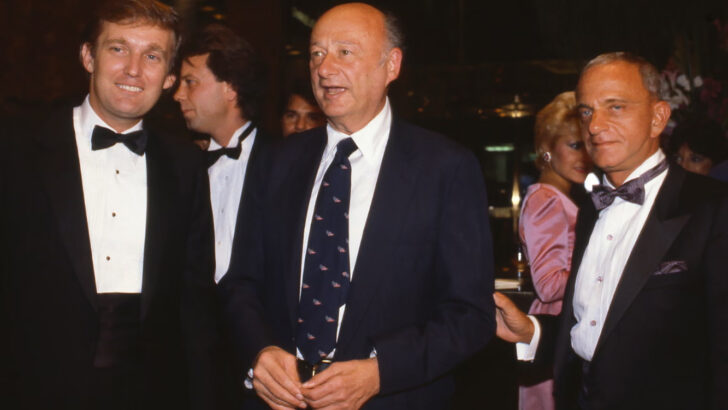
 The young Donal Trump with New York Mayor Ed Koch, and on the right, lawyer Roy Cohn, at the opening of the Trump Tower in 1983.
 Made in America: The dark history that led to Donald Trump, by Edward Stourton. (Torva /Transworld Penguin, £20.00 / €28.00)

My country, ’tis of thee / Sweet land of liberty / Of thee I sing” – the anthem of which these are the opening words has been a staple of American popular culture since its composition in 1832, sung regularly at US presidential inaugurations and many other lesser occasions.
Today, in the age of Trump, few would sing of America as “sweet land of liberty” without embarrassment.
Yet, as this book by veteran BBC journalist Edward Stourton shows, Trump’s disregard for what many see as core American values has deep roots. Stourton’s thesis is that various dark strands long embedded in America’s story have now converged in the person of the forty-fifth and forty-seventh president. Trump’s discontinuous terms as president are numbered separately; the only other double-counted president is Grover Cleveland (whose terms in office were 1885-89 and 1893-97).
Stourton sees the growth of televangelists in the US from the 1980s onwards as being in this tradition of ‘old time religion’”
The first, and perhaps most surprising, dark strand that Stourton identifies is American religion. The separation of Church and State, long regarded as a keystone of American liberty, is a product of late eighteenth-century Enlightenment thinking. Stourton looks back beyond that to the creation of theocratic societies by the Pilgrims and Puritans who fled to America in the seventeenth century. Religious freedom for them, Stourton writes, meant “their freedom” from persecution; “it most certainly did not mean freedom for people who had a different understanding of Christianity”.
Building on that heritage, both fundamentalist Protestantism, which spread westward in tandem with the expansion of the United States in the nineteenth century and the new churches that sprang up at that time in America – the Mormons and Jehovah’s Witnesses, for example – were antithetical to the idea of the separation of Church and State.
Stourton sees the growth of televangelists in the US from the 1980s onwards as being in this tradition of “old time religion”, and as preparing the way – John the Baptist-like – for Trump’s efforts to reverse liberalising trends in social norms. He is building on the bedrock of American religious intolerance.
Strands
The other dark strands in American history that find echoes in Trump’s presidency are more readily recognisable. The expansion of the United States in the nineteenth century – notably the purchase of the Louisiana territory in 1803 from the French, the ruthless annexing of Texas and California from Mexico in the 1840s and the purchase of Alaska in 1867 from the Russians – is a precedent for Trump’s demand to buy or otherwise acquire Greenland.
Trump’s advocacy of trade tariffs follows an economic strategy adopted by President McKinley in the 1890s”
Likewise, his treatment of minorities and immigrants clearly has antecedents not only in America’s “original sin” of slavery, but in the abandonment of so-called Reconstruction in the southern states after the civil war and the failure of government at both federal and state level to effectively enforce civil rights legislation until the 1960s.
Trump’s advocacy of trade tariffs follows an economic strategy adopted by President McKinley in the 1890s (with positive results in building up America’s industrial base) and by President Hoover during the Great Depression (with disastrous consequences for world trade at that time).
Enemies
Moreover, Trump’s intemperate campaigns against those he perceives as his enemies – for example, the “fake news media” – has obvious parallels with McCarthyism in the late-1940s and early-1950s. Curiously, there is a direct link between McCarthy and Trump in that one of the former’s closest associates in his witch-hunt of alleged communists in American society was one Roy Cohn who, Stourton records, would later advise the young Donald Trump in the 1970s.
Stourton argues that Jackson foreshadowed Trump’s presidential style in riding roughshod over the conventions of government and the rule of law”
Stourton concludes his book with a chapter on Andrew Jackson – an “outsider”, like Trump, elected to the presidency in 1829. Stourton argues that Jackson foreshadowed Trump’s presidential style in riding roughshod over the conventions of government and the rule of law.
Thus, Jackson’s wholesale expulsion of Native Americans from their ancestral lands was in defiance of a Supreme Court decision. Stourton points out that Lincoln and Franklin Roosevelt also pushed the limits of the presidency beyond the provisions of the Constitution, but in times of crisis when greater latitude was perhaps necessary. Trump, like Jackson, cannot claim such extenuating circumstances.