

 Peter Costello
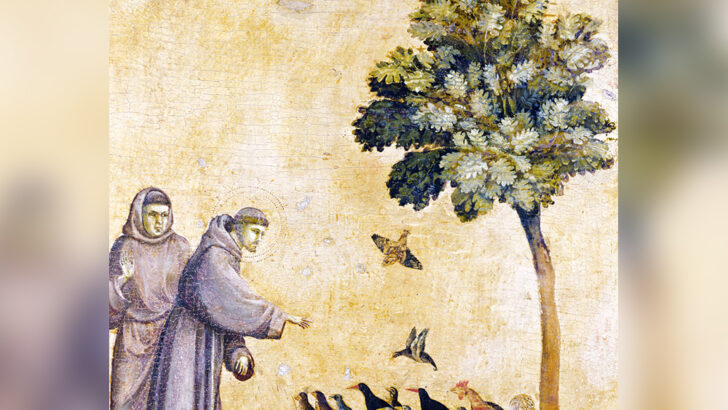 St Francis Preaching to the Birds, by Giotto, Louvre Gallery Paris.
 The Complete Francis of Assisi: His Life, The Complete Writings, and The Little Flowers,
by Paul Sabatier and others
(Paraclete Press, €38.50)

Currently the remains of St Francis of Assisi are on display in the Italian hilltop town where he died on October 3, 1226, some 800 years ago. They are on view until March 23, and some 400,000 people pre-booked to visit them. The church authorities have been dealing 15,000 a day, with 19,000 on the weekends.
The remains have only been on show once before, back in 1978. For a long time indeed the location of the grave of the saint was lost until it was rediscovered in 1818. The bones are now displayed in a plexiglass case filled with nitrogen to protect them from the toxic atmosphere of the modern world.
The pilgrims have a ten-minute period with the remains. One of the first to see them, Ms Silvanella Tamos, who had travelled down to Assisi from Pordenone, north of Venice, with a group from her diocese, expressed herself warmly to a reporter.
“It’s a body that’s alive,” she said. “It’s not a dead body. He still has a lot to tell us today,” she said.
He does indeed. Though piety is served by the exhibition, what St Francis has to say to us is surely better served by his own writings and those of his contemporaries who established him as one of the most remarkable Christians not just of the Middle Ages, but of all times.
Perspectives
And that is surely the point, for St Francis belongs to an age of faith before the Renaissance and the Reformation altered the religious perspectives of Europe, before even there was a full realisation of what this planet we live on really is, and just how extensive is the cosmic creation in which we have a place. So what does St Francis, alive in his words and recorded actions, have to tell us?
The knowledge regarding the life and spirit of St Francis, until a generation ago, was largely limited to some of the medieval sources of his life, particularly The Little Flowers of Saint Francis and The Major Legend of Saint Francis, written by Bonaventure.
These were widely available in all kinds of editions. Yet few people were aware that beyond these St Francis was also the author of a group of other writings and letters, three of which were directly autobiographical.
Today, thanks largely to Franciscan scholars and others who recovered and edited the manuscripts containing these other writings of St Francis, which they presented to the world in well-edited critical editions.
The relevance of the saint preaching to the birds is perfectly clear to us today in a way it wasn’t in previous centuries”
It is these writings that truly opened up our modern view of St Francis, revealing both the man himself as well as his ideals and values. His transcendent love of his fellow humans was an enlarged one that included all of God’s creation. The relevance of the saint preaching to the birds is perfectly clear to us today in a way it wasn’t in previous centuries.
Luke Wadding, the great Irish Franciscan scholar exiled on the Continent by troubles at home, published the first critical edition of the writings of St Francis in 1623. Wadding printed many of the letters of St Francis, along with his Testament and Admonitions, the Earlier and Later Rules, the Canticle of Brother Sun, Office of the Passion, and other prayers. These form the editio princeps, from which all modern editions essentially derive their lineage.
Wadding’s edition remained the only critical edition until the beginning of the 20th century. The publication of Paul Sabatier’s biography of St Francis in 1894 initiated the era of modern research on Francis – in 1904 alone, three editions of the writings appeared. Sabatier’s work was reissued in an enlarged edition in 2002; and is included in this current edition.
Famous
However, the most famous edition of the writings of St Francis in recent times is that of Kajetan Esser, the great German Franciscan scholar, first issued in 1976, two years before his death at 63.
An updated edition was published in 1989, and this edition forms the basis of most of the modern translations of the writings of St Francis in the main European languages.
There are numerous books claiming to be the writings and even the complete writings of St Francis available, but this edition from the Paraclete Press would seem to be the best and most authoritative for the general reader in this anniversary year.
At another level, the saint was the subject of a novel by Nikos Kazantzakis in 1955 which is a classic of modern Greek literature. But for many people might feel themselves better served not by fiction, however admirably passionate, but by biographical insight. These might prefer to begin their explorations with the short life from 1923 by G. K. Chesterton, who called St Francis “one of the most influential men in the whole of human history”. Between them these represent the extremes of the many paths of those who admire “God’s Pauper”.
An exploration of the internet, or indeed any good library, will reveal any amount of writings by and about St Francis, but the wise reader will not stray too far from the Franciscan sources even today.
The celebrations later this year will be a great occasion marked as it is by the feelings many people still retain for the late Pope Francis.