

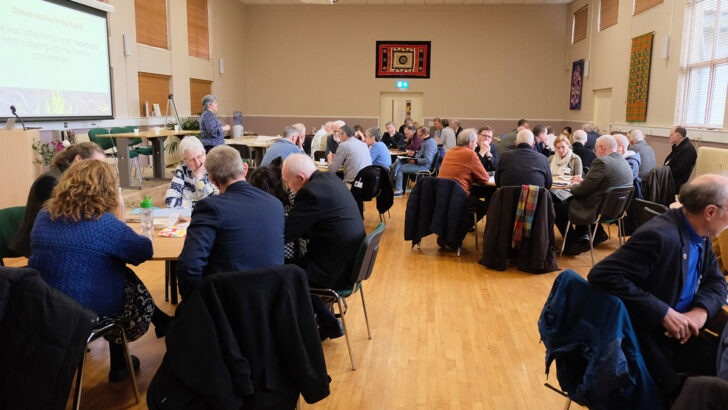
 A synodal assembly at Dromantine Retreat & Conference Centre. Photo: Courtesy of Synodal Pathway Ireland.
 As many readers know, there will be a National Synodal Assembly of the Catholic Church in Ireland on October 17 in Gormanston, Co. Meath. This is the culmination of a five-year process of consultation, listening and discernment, which was launched by the Irish Bishops in 2021 with the question: ‘What does God want from the Church in Ireland at this time?’ It is also a milestone on a longer journey mandated first by Pope Francis, and now endorsed by Pope Leo, when he said: “Synodality is what the Lord expects from the Church in the third millennium”.
There are particular reasons why a National Synodal Assembly makes sense in Ireland. Among them are: the abuse crisis and the consequent loss of confidence and credibility of the Church, in particular in the public square; the issue of secularisation, ‘the God who is missing but not missed’, which has resulted in a massive haemorrhaging of young people in particular from the Church, so that it is clear that the ‘transmission belts of faith’ are broken; the non-reception of some current Church teaching on sexuality and gender, so that many women in particular have long felt alienated from the institutional Church of which they are the backbone.
Substantively
For these and many other good reasons, spelled out eloquently and substantively in recent books by Irish theologians John O’Brien (Transformative Renewal in the Catholic Church, 2025), Bishop Brendan Leahy (What God Expects of the Church, 2025) and Eamonn Conway (Changing to be Faithful, 2026), and in the writings of Maynooth theologian Michael Conway, an Assembly makes sense. It does so despite the immediate and obvious objections – many people in the pews still have little or no knowledge of this synodal pathway in the Church; and among some there is active resistance, while among many more (including quite a number of over-burdened priests), there is a kind of passive resistance, a ‘leave me alone, the old ways will see me out’ kind of attitude.
We may all, often safely from a perch as hurlers on the ditch, holler our frustration at the status quo, but deep down most of us find change hard, and especially if it means stepping up to take responsible action ourselves. Institutional change is particularly difficult, requiring both patience and persistence. This is what the synodal pathway asks of us in Ireland today, and it is a big ask. But, as evidenced by the upcoming Synod, many have responded with commitment and generosity, and the Assembly will be an opportunity to celebrate the fruits to date.
For now I suggest that a key disposition accompanying this time of discernment is that of gratitude”
The Assembly itself will make use of the Working Document ‘Is not this what God asks of you?’ (Micah 6:8), published on September 19 and available to all on the website of The Irish Episcopal Conference. It will form the basis of the prayer, conversation, discernment and deliberation among the delegates at the Gormanston gathering, but everyone is invited to read it. It would be premature to engage in analysis, discussion and debate of this document at this point: we are at the delicate stage of communal discernment using a document that is the fruit of a 5-year listening process in Ireland, always with one ear open to what is going on in Rome and globally. Intrinsic to synodality are the notions of transparency, accountability and evaluation – the kind of exercise modelled by Pope Leo in the Examen section of his first Encyclical Magnifica Humanitas – so that there will be an appropriate time for further analysis and critique.
For now I suggest that a key disposition accompanying this time of discernment is that of gratitude. Gratitude first to God and God’s Holy Spirit. This is our ‘principle and foundation’ – we are fundamentally creatures, willed into life and called into friendship and kinship by God’s love and the sending of God’s Son among us, called to a mission of sharing this hope and love with the rest of humanity. And this is true, our faith assures us, despite appearances, despite the chaos and brokenness which we find all around, and also within ourselves. And so this is first and foremost, and throughout, a work of God, it is God’s Holy Spirit who leads, the Bishops were right to ask “what does God want”, and even if we often think we know better, we do well to “walk humbly with our God” (Micah 6:8).
Gratitude
This gratitude is, then, also due to those who make this moment at Gormanston possible, and through whom God works. I think of the countless, often unknown, people up and down parishes and dioceses on the island of Ireland, and many non-Catholic believers and non-believers, who have been part of this journey. I think also of the Bishops who initiated, facilitated and stood by the process, even at difficult times.
I think of the volunteers at local, diocesan and national levels, synodal teams, parish and diocesan councils. I think in particular of the 7 Working Groups who submitted reports that form the backbone of the Working Document and were so generous with their time. And I think above all of the National Synodal Team Members, chaired by Fr Declan Hurley, who held their nerve after the birth pangs of Kilkenny last year, and with patience and creativity midwifed the process through to this moment of new life that we will celebrate in Gormanston. They, including their four episcopal members, Paul Dempsey, Martin Hayes, Brendan Leahy and Michael Router, have made an enormous contribution to the transformation of the Catholic Church in Ireland. They, and we all, are in particular debt to the extraordinary and indefatigable contribution of Julieann Moran, General Secretary of the Irish Synodal Pathway and member of the National Synodal Team.
Allied to this spirit of gratitude, and very evident in the contributions of the Working Groups and indeed throughout this process going back to 2021, is the Pauline notion of ‘hypomene’, that patient and generous listening to others, in particular to those with whom we disagree and even may not like, born of the conviction that, through our common dignity as creatures and as baptised, we are bearers of the Holy Spirit and God talks through one another.
Inhibit
None of this should inhibit our right, and indeed responsibility, to speak at the Assembly and afterwards with parrhesia, with openness and truth, out of conviction, advocating what we believe to be true. And so, conflict is something good, sacred, not to be evaded or avoided. This, too, is intrinsic to what synodality is about.
We are at a transformative moment for the Irish Catholic Church, and for its contribution to Irish society. By all means let us look for ways of doing better, for going further. But let’s not look this present gift horse in the mouth. Of course, hard work remains ahead: but this is also a moment to give thanks, to rejoice and be glad, and to hope that the Assembly in Gormanston may make its own contribution and receive what has been discerned with peace and joy.