

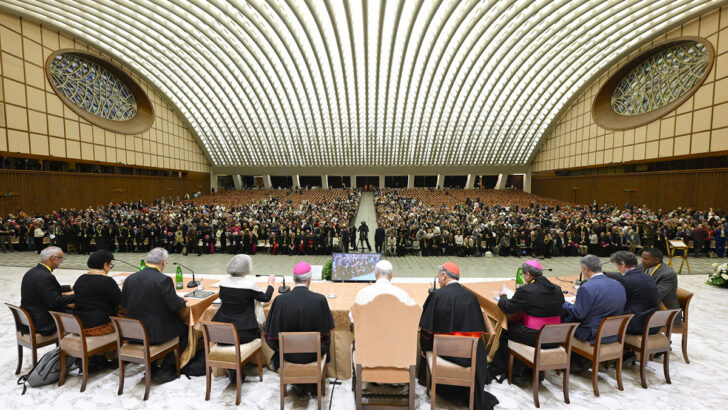
 Pope Leo XIV, with regional representatives of synod teams, listens to and answers questions from participants in the Jubilee of Synodal Teams and Participatory Bodies in the Vatican audience hall on October 24, 2025. Photo: CNS / Vatican Media.
 Like those involved in overseeing the synodal process all along, the people who served on working groups producing proposals for this weekend’s National Assembly deserve appreciation for their efforts. Nevertheless, their proposals require close scrutiny, as the Synodal Pathway is not simply another venture in renewal, but makes the extraordinary claim of having determined the will of God for the Church in this country.
Whatever it might have achieved, this latest synodal publication appears problematic. It begins, like previous documents, by presenting its proposals as the fruits of the discernment of the “People of God in Ireland.” This, for a start, is misleading. A collation of statistics from the diocesan reports of 2022 indicated that, at most, 1.5% of Ireland’s Catholics had engaged in the synodal consultations. In terms of popular interest since then, it’s widely recognised that the Synodal Pathway never really took off. Note, for instance, the recent remarks of Fr Tony Flannery – someone passionate about the Pathway and previously a delegate at its gatherings: “From what I see, hear and read, there seems to be very little happening on the ground in parishes and dioceses”, wrote Fr Flannery on October 4. He added how “Many people have told me they haven’t heard one word about synodality in their church at any stage of the process.”
Transparency
Given that full transparency in Church life has – quite rightly – become a core demand voiced by the Synodal Pathway, its reluctance to acknowledge the very low levels of engagement with its own processes can seem to undermine this. Much more consequential, however, is the fact the apparent unwillingness to admit this limited engagement – and to allow that to sink in – has left the Pathway vulnerable to planning and proposing ways forward significantly out of sync with the reality of Church life here. And that’s the key impression conveyed by this latest proposals document.
It is difficult, however, to see how the combined contents of this document could offer the Church a realistic programme going forward”
The working groups which contributed to the document were set up in the wake of the Pre-Synodal Assembly in Kilkenny, this time last year, and the much-publicised priorities which it believed were key to the renewal of Church life. The groups were charged, in turn, with producing practical and achievable proposals to give concrete expression to those priorities. It is difficult, however, to see how the combined contents of this document could offer the Church a realistic programme going forward. Indeed, it’s hard even to read it without feeling overwhelmed.
Proposal
Consider, for example, a number of its proposals for the Church at national level: a national plan for ecumenical-type encounter; a national digital evangelisation strategy; a national commission for faith-based social infrastructure and abiding; a national commission for healing; a revised national process for catechesis and sacramental preparation; a permanent national ecclesial council; a national governance reform to review and develop governance structures within the Irish Episcopal Conference; a national directive on co-responsibility and synodal ministry; a national process for the recognition, commissioning and support of lay ministry; a national office for life-long faith formation; a national formation and training pathway for youth and young adult ministry; a national office for women; a national review of the Church in Ireland in light of para. 60 of the Final Document from the 2024 Synodal Assembly in Rome – on maximising opportunities for women to exercise leadership. The expectations seem remarkably ambitious and would surely require the recruitment of a very sizeable and, presumably, costly body of personnel. Yet, how sustainable would that ultimately be?
There’s no discernible awareness – anywhere, really, in the document – of the struggle typically involved in keeping ministries going on the ground”
Space does not permit a detailing of the recommendations for parishes/pastoral areas, but the list is equally daunting. There is undeniable worth in many of the proposals and it will be recognised that many of them are already in place, in some fashion, at local level. However, there’s no discernible awareness – anywhere, really, in the document – of the struggle typically involved in keeping ministries going on the ground, finding volunteers, and having to turn, repeatedly, to already committed parishioners to ask more.
Jargon
A further feature of this document, reinforcing the sense of its remoteness, is the prevalence of a kind of technical jargon which conveys an impression of soullessness and makes the document, often, quite difficult to understand. The introduction to ‘Pathway 5’, for instance, explains: “In this pathway, the proposals explore steps that might be taken so that all the baptised can be empowered to serve in a differentiated co-responsibility in a synodal-style Church”. What is “a differentiated co-responsibility” to the average parishioner? Or take the proposal that the Bishops’ Conference “develop a strategy for the provision of home-based faith tools”. What happened to reading Bible stories to the young and saying their prayers with them?
While it’s undoubtedly well intentioned, would it not be more straightforward – and more worthwhile – to simply encourage them to think about coming to Mass?”
At local level, meanwhile, there’s the suggestion to establish a “welcoming programme of follow-on gatherings for families in the period after the Baptism of their child – offering a series of gentle, invitational touchpoints where families can reconnect with the parish and their peers in a relaxed and supportive environment”. It sounds like something adapted from a health farm brochure. Again, while it’s undoubtedly well intentioned, would it not be more straightforward – and more worthwhile – to simply encourage them to think about coming to Mass?
This latter example also points up something readily identifiable throughout much of the document. While humility is vital in the context of mission – and the Church in Ireland has very good reason to feel chastened in light of its scandals – the document appears reluctant to propose the Chrisitian and Catholic faith in anything like its fullness. It would seem sorely limited, therefore, as a resource for any serious evangelisation for – as Pope Leo told a St Peter’s Square audience last week – “It is certainly not by watering down the content, or softening the demands, that Christianity can be made attractive.”
Paradigm
The dominant paradigm adopted by the document is “accompaniment” – an accompaniment which is required to be “attentive”. Accompaniment has been, of course, a recurring term in the universal synodal literature, with historic connections to Latin America and Liberation Theology. It certainly merits a place among our approaches to pastoral care, but hardly to the almost exclusive extent it features here. We hear how the Church’s “accompaniment’ must extend ‘to people in every state of life” – and so it should. What never becomes particularly clear, however, is where this accompaniment should lead, or in what it might hope to result. The promise of something more concrete appears to emerge when the document eventually appeals for the appointment of “dedicated catechists”. However, even this proposal is subjected to the caveat that the “role of the catechist is not simply to deliver content” but to be, among other things, “a minister of accompaniment”.
We are told, early in the document, that the “model for such accompaniment” is the Christ of the Emmaus story who “draws near, listens attentively to the disciples, walks alongside them in their confusion and disappointment, enlightens them through the scriptures, reveals himself in the breaking of bread, and sends them forth renewed in hope.” Note how this summary omits critical elements of the story – namely the fact that Jesus rebuked the disciples’ own thinking, upbraided them as “foolish men”, and set about correcting and teaching them. Indeed, what strikes the disciples afterwards was not how “attentive” a listener Jesus had been, but how their hearts had burned as he “explained the scriptures” to them.
While this document speaks of encountering Jesus and portrays him as the source of life, love, joy, hope and healing – and other such gifts – core aspects of the gospel message remain noticeably absent. There appears to be no focus whatsoever upon the call to “repentance” for forgiveness of sins, so central to the preaching of Jesus and of John the Baptist. No focus, either, on the call to conversion which comes alongside Christ’s proclamation of the Kingdom. This is consistent with a Synodal Pathway which has avoided any exploration of the question of personal sin – or the place of the Sacrament of Reconciliation in the life of the Church – at any stage. In fact, where it raises the concept of either “sinfulness” or “conversion” at all, this document appears to apply these exclusively to the institutional life of the Church. Meanwhile, aside from concerns over technological advances and climate change, it is the “social teaching” of the Church which is most frequently referenced throughout the document as worthy of attention in the context of outreach, catechesis or faith-sharing endeavours.
It’s a vision revolving largely around power dynamics and structural reform – likely dependent for its delivery on an ever-expanding bureaucracy”
Again, this could be said to echo Liberation Theology, with its emphasis upon conversion of “structures” and its “preferential option for the poor”. But that would be only partially true. Liberation Theology also stressed the need for personal conversion – Gustavo Gutierrez famously warning that structural reform, at the expense of individual repentance, reduced Christianity to little other than a political programme. Indeed, it might be respectfully suggested that – with its lack of attention to core aspects of the Chrisitian kerygma, and its substitution of “co-responsibility” for personal responsibility – the Synodal Pathway is offering the Church here little more than a political-type programme as a way forward. It’s a vision revolving largely around power dynamics and structural reform – likely dependent for its delivery on an ever-expanding bureaucracy.
Heart
Structural reform and power dynamics are, of course, important and need critique and development – but they can never become the heart of Christian renewal. Throughout this document, meanwhile, the practice of prayer, maturing in the spiritual life, or growth in holiness – things the Church considers basic to the vocation of the baptised – gain little more than passing references. The living out of one’s baptismal calling, moreover – supposedly the paramount concern of the Synodal Pathway – is effectively reduced here to an equal opportunities project. While sharing in the ministry and leadership of the Church can be undoubtedly significant expressions of one’s baptismal identity, they are not the only expressions. Its apparent failure to grasp this has left the document unintegrated and imbalanced.
No questions are anywhere raised, however, as to the potential for harm to children, youth and others by the promotion of LGBT+ ideologies in our day”
Given the dominant mindset at work, it becomes inevitable that – as it progresses through its programme – the tone and language of the proposals become increasingly ideological. Almost invariably, they evince political correctness and echo the predominant preoccupations of the social “progressives” of our time. We have, for example, the concern to “Identify and support parish team leaders to undergo anti-racism and cultural competency training.” Then there’s the apparent suggestion that those who believe themselves to have experienced “marginalisation and exclusion in the Church” be classified alongside those who have suffered genuine hurt and abuse and draw – like them – upon the services of a healing commission. Flowing from this is recommendation that “members of the LGBT+ community” be recruited to such a commission, to ensure ‘balanced and credible oversight.’ No questions are anywhere raised, however, as to the potential for harm to children, youth and others by the promotion of LGBT+ ideologies in our day.
Meanwhile – reflecting the feminist outlook – there’s the suggestion to “offer periodic reports and timely assessments on impediments and opportunities for the full engagement of women”. There’s the rather ominous proposal to “Support national agencies and committees working towards similar aims for women”. There’s the recommendation of “A thorough and systematic examination and correction of texts, hymnals and other materials that do not recognise the baptismal dignity of all persons”. (The Synodal Pathway hasn’t, apparently, encountered copyright). And then, of course, there’s the explicit, but distorted, use of Liberation terminology – which here becomes a “preferential option for women at the margins”. Of course women in need deserve every possible care and support from the Church – but so do men facing hardship. What an absurd proposal in a country with disturbing levels of suicide, of which 80% of the cases are male.
Absent
Noticeably absent from the multiple recommendations relating to women is any suggestion that the Church support or make common cause with pro-life advocacy groups in our country. This is hardly because our growing rates of crisis pregnancies and consequent abortions are of no concern to God. It is, presumably, because they are not a concern to “official” Ireland and are, therefore, relegated from public discourse and from popular consciousness. Indeed, their absence from these proposals will further confirm the suspicions of many that the Synodal Pathway has been more an expression of the “spirit of the age” – in an increasingly post-Catholic Ireland – than any reflection of the will of the Divine.
Finally, the document’s contents contain proposals that the Church in Ireland advocate – at universal level – for “a more respectful and life-giving vocabulary when speaking about LGBT+ people” and for “on-going exploration of women’s ministry, including the diaconate”. The first of these proposals is based upon an assumption which is neither explained, nor justified, anywhere in the document – and is obviously controversial. The second could be said to be less so, but will draw concerns and critics nonetheless. Given the very low levels of engagement with the Synodal Pathway to date – and given that the few hundred going to Gormanstown, this weekend, are unlikely to be especially representative of Irish Catholics at large – it would seem unwarranted to present any decisions of this Assembly, further afield, as the authentic voice of the Church in Ireland.