

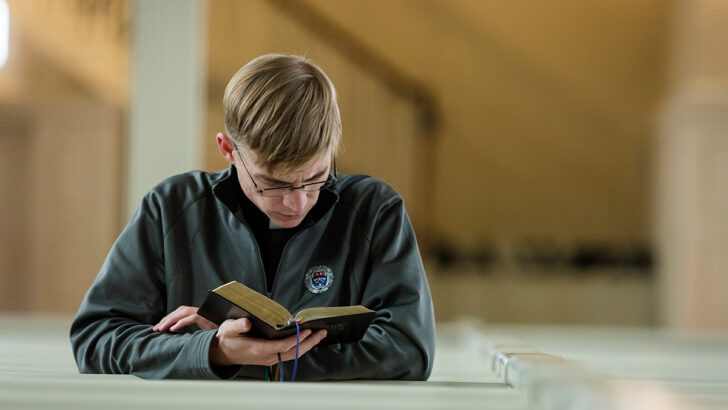
 A priest is pictured in a file photo praying with a Bible. Photo: OSV News /courtesy Mundelein Seminary.
All Catholics worth their salt know that love is the meaning of life. In the First Letter of St John, we read that “God is love” (1 Jn. 4:8), and in response to the lawyer of Matthew’s Gospel, Jesus confirms that the summation of the law and prophets is found in love, affirming, “You shall love the Lord your God with all your heart, and with all your soul, and with all your mind… [and] your neighbour as yourself.” (Matt. 22:37-39).
These are familiar words; we all know them, and, ideally, by orchestrating all our energy toward their realisation, we strive to live up to them throughout our lives. The great challenge, then, is not found in knowing what we must do, but rather in living up to these words and making them a reality—in ourselves and in all those entrusted our care—while difficulties and sufferings abound.
The value of study
But if this is the case, if love is all we need, what on earth could motivate us to study the faith? What good could possibly be achieved in spending our time studying the things of God? Or, more simply put, what value is love to find in knowledge and what good is knowledge to love? And even if there were such value and goodness in knowledge, could we actually hope to find answers to the questions we ask? Or indeed, answers with sufficient clarity to actually matter in our lives? Would not the whole thing be just a massive waste of time and effort? Or worse still, would it not make us more like the pharisees, sanctimonious and self-righteous, knowing the life of faith in a sophisticated way but failing to live out its central dynamism: that of love of God and love of neighbour?
Well, before exploring a fulsome assessment, let’s give an immediate answer: Without knowledge there is no love, for we simply cannot love what we do not know. Hence, knowledge of God is necessary to our love of God. Since knowledge both brings what is lovable before us and carries us forth toward our beloved, and since knowledge sets lover and beloved in relation to one another while also mediating between them, it must be that knowledge opens the way and facilitates the movement of love. Thus, knowledge is a condition of the possibility of love, and knowledge stands at the heart of the self-giving communication of love.
Therefore, if we do not come to know God—that he is, what he is, who he is—and if we do not come to know him better and better as life progresses towards its culmination, then we will not be able to love him as he deserves. We will not be able to love him as the supreme and universal good in whom our happiness abides. And, on the other hand, if we do not come to know the privileged place of the human being within the created cosmos, standing before the face of God as his image, then we will not be able to love one another in the way God so dearly desires, and nor will we even be able to love ourselves as he wishes.
Why not just come to know God through prayer and reading Sacred Scripture? Why must we also study the faith?”
And so, we simply must study the faith. Through such study we come to a deeper and fuller knowledge of God and ourselves, in addition to the whole of the created world. We come to know the whole of reality—both God and creation—from the perspective of God himself, precisely as he has revealed it to us and as we have communally reflected upon throughout the centuries since the beginning of Revelation.
In a word we will come to God with the knowledge of God, and his creation with this same knowledge. This unparalleled knowledge of things divine will then capacitate us to realise a deeper and fuller love for God himself, with our whole being, for his own sake, and for our neighbours, those immediately entrusted to our care, and for ourselves, we who live our lives under his loving gaze.
But even should this be granted, why not just come to know God through prayer and reading Sacred Scripture? Why must we also study the faith?
Study as devotion
Though we should certainly come to know God through a living prayerful relationship with him, by living a life aware of his presence, as well as through reading his revealed word, we must ask why we would exclude exploring of every possible avenue of knowledge? Would not study complement our prayerful devotion to God with the kind of knowledge that augments and enhances our relationship with him.
It is a kind of loving-knowing that you simply cannot find elsewhere”
Study is a kind of devotion—for ‘to study,’ from the Latin ‘studeo,’ means to devote oneself—and study is also a kind of striving—for the Latin original also means to strive. As to the first, study involves applying attention and understanding, with focus and concentration, toward gaining insight, and, as to the second, study also involves meditation and reflection, mulling thoughtfully over things and pondering their meaning. When we put these things together, we discover that study involves engaging all one’s human power and energy, with diligence and persistence, toward gaining intimate knowledge of the studied object.
Now, if God is in fact God: the fullness of truth in whom all goodness is found, then in addition to our prayerful devotion he certainly deserves this kind of studious devotion. If anything is worth studying, and there is certainly much that is, then surely God, the first principle and final end of all things, our alpha and omega, is worth studying—and so with priority. It is then most fitting to add this particular devotional practice to our other devotions. Though these others have priority with respect to our relationship to God, and though these others also most certainly intensify our love, studious devotion is a highly significant avenue toward the love of God.
Indeed, it is a kind of loving-knowing that you simply cannot find elsewhere.
God’s call, our response
Now, trusting that I have won your confidence in the truth of devotional study, let us look a little more closely at why such study is the ordinary path for Catholics. The Catechism of the Catholic Church structures its exposition of the faith around the call of God and the response of the human being.
In creating us according to his image, God calls all humans to himself and desires that all come to know and love him through their own free response to his creative and redemptive love. God’s call is then a call to enter into relationship with him, while he creates us with a deep longing to find him and become his friend. As St Augustine puts the matter, “Thou hast made us for Thyself and our hearts are restless till they rest in Thee.”
And the Word became flesh and dwelt among us, full of grace and truth; we have beheld his glory, glory as of the only Son from the Father”
Call and response run deeply into the structure of reality and entirely coordinate our relationship with God. We could even say that call and response is the structure of reality. We recall that the Bible begins with the revelation that God creates by speaking things into being: “In the beginning God created… God said, ‘Let there be light’; and there was light.” (Gen. 1:1-3), with this sequence repeating throughout the successive days of creation until the culminating seventh day of God’s rest.
This opening revelation is then expanded upon in the prologue of the Gospel of St John where we find the following beautiful revelation:
“In the beginning was the Word, and the Word was with God, and the Word was God. He was in the beginning with God; all things were made through him, and without him was not anything made that was made… And the Word became flesh and dwelt among us, full of grace and truth; we have beheld his glory, glory as of the only Son from the Father.”(Jn. 1:1-3, 14).
Now, from these central words of the Sacred Scripture we discover that God’s Word is both creative and redemptive. God first calls all things into existence through his all-powerful Word, before proceeding to call us to himself on the basis of this same Word, Jesus Christ, the Word Incarnate. This means that our encounter with and entry into relationship with God is brought about in and through the Word of God, a Word that is expressed in one way in the Mystery of Creation and in another in the Mystery of Redemption—though with both possessing the same pattern.
Truth leads to love
This is why at the very beginning of the Catechism we read that the Christian life is coordinated around our orientation toward truth. Though Christianity proclaims love to be the highest fulfilment of our relationship with God, this fulfilment by love is entirely mediated by truth—the truth of God’s word expressed in Creation and Redemption. The reason for all this is quite simple: the incarnate Word of God, Jesus Christ, is “the way, the truth, and the life.” (Jn. 14:6). He is our life, this life is truth, and our way is to follow the truth. The Catholic faith is then a question of truth—truth stands at its centre.
How it would be possible to love what we do not know? Without knowledge there is no love, for we simply cannot love what we do not know”
God himself is truth, and all things—having been created through his Word—have been made in, through, and with this truth of God. Indeed, this is why all things are meaningful, because they bear the truth of God.
As a result, whenever we seek truth, genuinely and sincerely, we are seeking God, and whenever we seek God, honestly and actually, we find him in truth. This means that we can draw close to God only by knowing him in truth, and moreover, we can cling to God only by clinging to him with truth. In all circumstances, then, and at all times, it is only by the way of truth that we can enter into the love of God, and continue to participate in that love through friendship.
We can illustrate all this in another way by asking how it would be possible to love what we do not know? Without knowledge there is no love, for we simply cannot love what we do not know. Love is not in fact blind but is rather seeing—a true and deep knowing. Therefore, should we come to know God—that he is, what he is, and who he is, all to their proper depth—then we can discover in ourselves an intense and lasting love for him. However, should we fall back from seeking knowledge of him, we simply will not be able to love him as he is in himself… and we will thereby foil the meaning of our own lives.
Over this sixteen part series, I will be exploring the content of the Catholic faith. Through this study, your faith should deepen and grow stronger, while also developing and maturing, and your life should take on a new vigour as the vitality of the faith enters your life in new and interesting ways. Fortified in this way, you should then be empowered to rise more powerfully toward a greater love for God and his creation.
Dr Robert McNamara is lecturer in philosophy at St Patrick’s Pontifical University, Ireland, adjunct at Franciscan University of Steubenville, USA, while also tutoring periodically at the ITI Catholic University, Austria. Robert is an associate series editor of Edith Stein Studies, an associate scholar of the Hildebrand Project, and a research fellow at the Institute for the Study of Man and Woman. He currently resides in Carlow, Ireland, with his wife, Caroline, and their five children. For more of his writing, see https://substack.com/@drrobertmcnamara