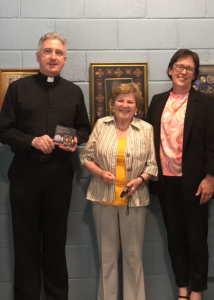
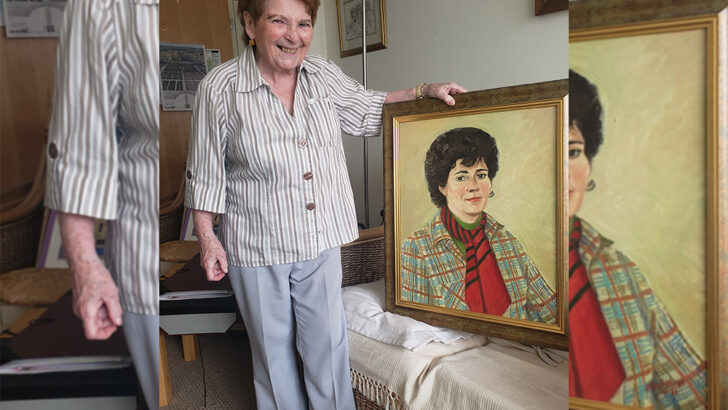
 Artist Sheelagh Duff poses
with an old self-portrait.
Artist Sheelagh Duff poses
with an old self-portrait. At a time when much of contemporary art tends toward transgression, irony, or ambiguity – or with the rise of quick-fire AI generated images. The philosophy of Sheelagh Duff is refreshingly clear – art is made with a purpose. Made for God.

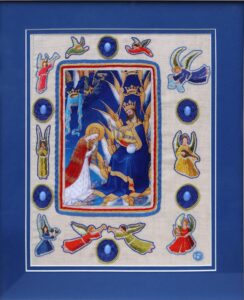
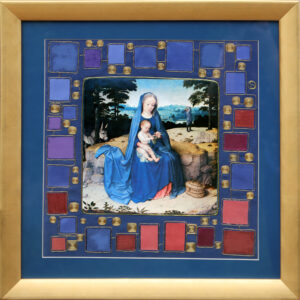
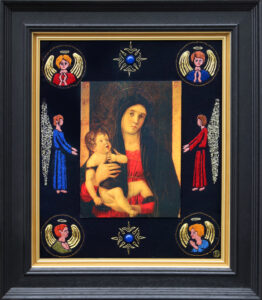
Her embroidery encircles and enshrines a variety of sacred images – Our Lady, the saints, the Stations of the Cross. These works are not designed for the applause or for galleries (though one may find a collection of them in the Knock Shrine Museum). They are meant to be used, to be prayed with, and to direct our vision higher.
Something she made quite clear when I visited her small apartment in West Dublin – a space filled with the paintings, portraits, drawings, and embroidery of a lifetime of artistry.
Her art would take her far beyond Ireland. One might say her artistic life never followed the typical path”
When Ms Duff first wrote to The Irish Catholic, it wasn’t to ask for publicity. It was, in her own words, to ask for help. She had a collection of sacred embroideries in her apartment — framed and ready — and hoped they might find a home in a place of worship. “In the event of my death,” she wrote, “it would be nice to leave them all together to an appropriate place of worship.”
Curious, I wrote back.
Sheelagh Duff has been quietly making art for more than sixty years. Born and raised in Termonfeckin, Co. Louth, she trained in Glasgow and later taught in Newry and Drogheda. Her exhibitions began in the late 1960s — at the Wexford Festival, the Lavit Gallery in Cork, and a now-vanished gallery in Brown Thomas, Dublin. As fate would have it, her art would take her far beyond Ireland. One might say her artistic life never followed the typical path.
Art
Her embroidery began as a private devotion. “We prayed to Our Lady every morning at school,” she told me. “And somehow, I never stopped.” Over the years, that prayer took the form of thread, colour, and texture — goldwork halos, patterned borders, velvets and linen, stitched around sacred images. “There are things I can do with embroidery that I can’t do with paint,” she explained. “There’s a softness. A time. It’s prayerful.”
Her work is deeply Marian, though not limited to Our Lady. She has created full embroidered sets of the Stations of the Cross, each one carefully framed and richly detailed. One such set was lost for years after being left in a shop that closed suddenly. She eventually retrieved it — but not before stitching three missing panels again from memory. “They need to stay together,” she said. “It’s a journey. You can’t break the journey.”
For Sheelagh, sacred art must be used. ‘If it doesn’t help someone to pray,’ she told me, ‘then what’s the point?’”
In another story, Ms Duff recalled offering a large embroidery of Our Lady of Fatima to a priest. He accepted it — but later placed it in his private sitting room, hidden from public view. Discovering this, she politely asked for it back. “It wasn’t made for that,” she said. “It was meant for the church.” The piece is now being returned. She offered a smaller replacement — though, she added, she has yet to receive thanks.
The anecdote is wry and quietly pointed — but more than that, it shows her conviction. For Sheelagh, sacred art must be used. “If it doesn’t help someone to pray,” she told me, “then what’s the point?”
Devotion
Her devotion has not gone unnoticed. In 2022, twenty of her embroidered works were accepted into the permanent collection of the Knock Shrine Museum, where they remain on display. Many are Marian, reflecting her lifelong dedication to Our Lady and featuring a wide range of traditional iconography. She also showed me a notebook containing all her original sketches and plans.
In the late 1980s, she produced over 150 pen-and-ink drawings of Phoenix Park, commissioned by the Office of Public Works — documenting lodges, paths, trees, and landscapes with daily discipline. Those works are now being exhibited at the Phoenix Park Visitor Centre throughout July 2025 — a long-overdue public tribute to her draughtsmanship.
As mentioned earlier, her art has taken her abroad — to Greece, Switzerland, Germany — but her desire has remained constant: to leave behind something beautiful, prayerful, and good. She has no heirs. Her work is her legacy. And she continues, well into later life, to write letters and knock on parish doors, offering beauty for free.
“I have no family now,” she said quietly, “but I have my work. And I want it to be a help to someone. That’s what it’s for.”
Her work is her legacy. And she continues, well into later life, to write letters and knock on parish doors, offering beauty for free”