

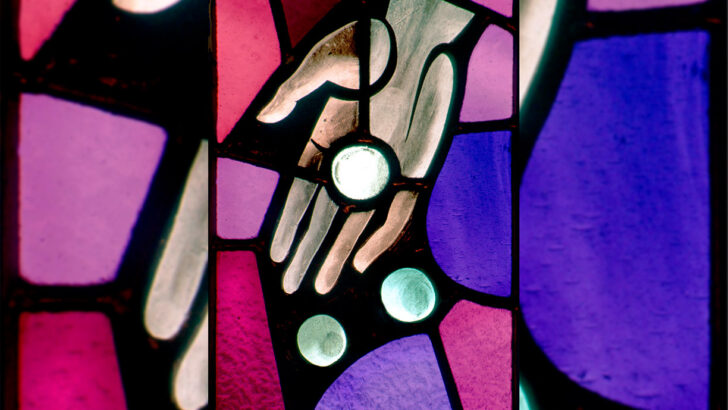
 A stained glass image of almsgiving. Photo: CNS/ Crosiers

In his recent column, the American Catholic writer George Weigel points to a ministry in Denver called Christ in the City. Young Catholics go out onto the streets, not to run a programme but simply to meet the homeless. Its founder, Jonathan Reyes, asks them to approach each person as an immortal being with a destiny that will outlast the universe.

It is a gorgeous idea, and a demanding one. Most of us pass a person sleeping rough and see a problem, and someone to be quickly stepped around. The Denver missionaries see someone who will still be here when the stars have gone out. That changes how you stop and how you speak to someone. It restores a dignity to a life involuntarily living an undignified life.
Advent is a good time to try it seeing the immortal in ourselves and others. Patrick Kavanagh’s poem ‘Advent’ is about a man who has grown jaded. He has seen everything and tasted everything, and it has left him tired and dulled. He longs to recover the wonder of childhood, when even stale things seemed new. Many of us know that weariness, and perhaps the Church in Ireland knows it too. We have had decades of reports, restructuring, and decline, and it is easy to look at the world with half-closed eyes. Kavanagh’s answer is not to pile up more experience but to learn to look again. For him, Advent is a season for a new kind of looking.
Our faith has always said that we are more than we appear. We are spirits as well as bodies, and the visible world is not the whole of it. Modern life makes this easy to forget. We measure people by what they produce, own or achieve, and by that measure the man in the doorway on a cold night counts for very little. The Christian view is the opposite. Every person is made for eternity, and no circumstance can cancel that. That’s a message that we don’t hear often enough.
Jesus lived in that truth. He walked between two worlds and was entirely at home in both. He was at ease in the temple and at the well, at the table with sinners and with rabbis. He never treated the unseen as less real than the seen, and he never looked at a person and saw only what was in front of him. Then he told us plainly where to find him: in the hungry, the thirsty, the stranger, the prisoner, in the least of his brothers and sisters. The heroes among us know this.
Mother Teresa called the poorest of the poor Christ in a distressing disguise. Weigel notes that she and John Paul II belong together here. Evangelisation and care for the poor are one mission, not two, and nobody has to choose between them. The young Catholics of Christ in the City show this in practice. They are not ‘social justice Catholics’ on one side and ‘New Evangelisation Catholics’ on the other. They are simply missionaries, and the Gospel is all of a piece.
Could we do something like this in Ireland? The need is not in doubt, and neither is the goodwill of our parishes and the many groups already serving people who are homeless. What may be missing is the invitation. Young people want to be asked to give something of themselves, not just money. A street team of young adults, linked to a parish or a diocese, with prayer and formation behind it, would not be hard to start. It would need no grand strategy, only a few people willing to say yes and a priest or bishop willing to bless the work.
In Denver, this grew out of a great gathering of young people three decades ago. Here it could begin with a handful of them and a flask of tea. How many have come back from World Youth Days and have not been asked to give back to other young people? Young people will not be found wanting if asked.
This Advent, when we next pass someone on the street, we can try to see what Kavanagh wanted us to recover, and what Christ told us to look for.