

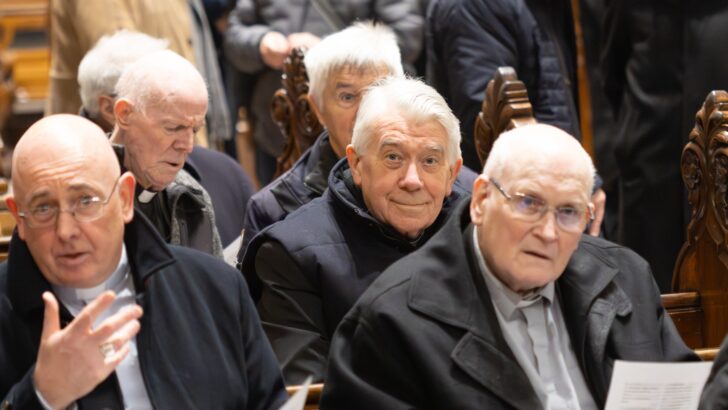
 Dublin's priests gathered for Vespers on St Laurence O'Toole's feast, a reminder of their quiet service to the city's people and poor. Photo: Gabriel Berg
On Friday last, while Europe’s leaders departed from behind police cordons, Dublin’s priests gathered in Daniel O’Connell’s church to pray Vespers.
On Westland Row, beside the rumble of Pearse Station, the priests of Dublin came through the doors of St Andrew’s. They came in ones and twos, from the city and from the far edges of the diocese. Most were no longer young. Some walked more slowly than they once did. They had left their parishes for one evening to sing Vespers on the feast of their patron, St Laurence O’Toole.
Before Vespers there was a pot of tea, coffee and cake, and the fraternal gathering of men who, in their older years, are no longer just parish priests but priests of many parishes, their shoulders loaded with more burdens than have ever been seen in this diocese, and only the dim hope of a distant retirement. For a priest, the parish is his family, and most of these men now have several families to mind. And yet all were in good form.
It might sound hyperbolic but these are the men who keep vigil on the soul of Dublin. They are there when the phone rings at three in the morning and someone is dying on the side of the road. They bury this city’s dead, baptise the babies, sit with the sick, comfort the depressed or lonely, and say Mass on weekday mornings, often only for a faithful few who would be lost without it.
None of this makes the news. But it is where the soul of this city is tended, in a thousand unrecorded acts of fidelity, day after day, across Dublin.
St Andrew’s is Daniel O’Connell’s church. It was raised by a people only newly free to build their churches openly, and they built it as if they meant to stay.
Laurence O’Toole, Archbishop of Dublin seven centuries earlier, knew the challenges of Catholicism in a hostile land. Taken as a boy hostage by the King of Leinster, he grew up to be abbot of Glendalough, feeding the hungry from his own purse. As archbishop he watched his world turned upside down, and when the Normans besieged Dublin in 1170 he went out to their camp to bargain for his people. He died at Eu in Normandy in 1180, far from home and still about his people’s business. His body stayed in France. His heart came home to Dublin.
Laurence’s heart came home; O’Connell’s went out to Rome. Between them they hold the shape of Dublin’s faith: rooted here, and bound to the whole Church. Both knew doubt about the future, much as we do today in our changing times.
In his homily, Archbishop Farrell spoke with evident pride of St Andrew’s and of St Mary’s Cathedral, and of Building Hope, now more than five years in train, and of synodality. He spoke of these great churches with pride; they are part of what Laurence and O’Connell left us, and the stones matter. But walking out into that November night, we were also reminded that the Church in Dublin is first of all its people: the priests who serve them, and the poor at our door.
When Vespers ended, we strolled from Westland Row, around the side of Trinity College, to the hotel where the priests were to have their dinner. The spirit of St Laurence O’Toole walked with us. On the eve of his feast, on a cold November night, we passed the Lighthouse, the centre run by Tiglin that feeds people who are homeless. They were gathered outside, and along the street there were tents, more than I can remember seeing in this part of the city centre before.
It was poignant. We had come from honouring the feast of the saintly archbishop who fed the hungry of this city, and here we were, once again, walking among the poor of Dublin.
As the priests went in to their well-earned dinner on that cold night, Europe’s leaders had left town. What remained was what is always there: the scandal of the poor and homeless sleeping on our streets. The priests were taking a brief respite that evening. In the morning, on the feast of St Laurence, they would be back at work among them. Let’s thank them for their service while we still can.
St Laurence O’Toole, ora pro nobis.