

 Peter Costello
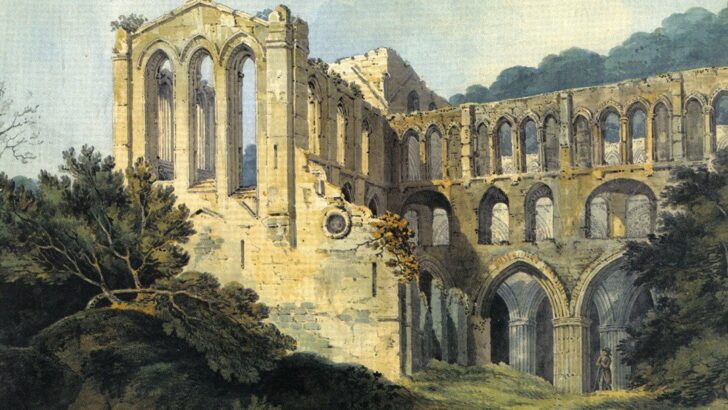 Edward Hawke Locker, Rievaulx Abbey (1802). Photo: Tate.
 William Blake: The Age of Romantic Fantasy,
by Alice Insley, Anne Hodge and Christina Morin
(National Gallery of Ireland / Tate Gallery, €40.00 / £35.00)
Exhibition organised by NGI in collaboration with the Tate Gallery, London, curated by Alice Insley and Anne Hodge. Runs to July 19, 2026; Rooms 6-10. Tickets online from €0 – €16.
The new exhibition at the National Gallery is in many ways a revelation. Not merely because it deals with astonishing visions, but also for the mind-enlarging significance of what is actually on show. The exhibition consists of more than a hundred images in several mediums, over thirty of which are by the poet and painter William Blake.
This is undoubtedly an important show, one not to be missed, with the images being drawn from both the National Gallery and the Tate in London. It is quite a unique experience.
Blake is all too often seen as an eccentric, even marginal artist; yet here he is shown in the company of his fellow artists, his friends and contemporaries”
Readers of this paper will be especially interested in a set of Blake’s images illustrating Dante’s Divina Comedia, the fluent nature of which contrasts with the graphic realism of Doré, discussed here recently. These are matched too by illustrations of Biblical scenes, such as the betrayal of Jesus by Judas, which contrasts with the now familiar Caravaggio elsewhere in the National Gallery.
Blake is all too often seen as an eccentric, even marginal artist; yet here he is shown in the company of his fellow artists, his friends and contemporaries. The seemingly strange visionary world of Blake here takes on a different aspect when seen in this context.
We can see that far from being off-centre, he shares with many other artists of his day new visions of this world, the next world, and fully conceived notions of imaginary worlds.
Blake, like all great artists, is often hard to understand, and few people will want to follow him into his prophetic books. His work is, however, a uniquely seamless whole, for the painter cannot be divorced from the poet. But he is an artist of immediate and long-established appeal, as many of his shorter poems and illuminated texts show. Every child knows his poem on the Tiger, and his poem “Jerusalem” has long been an anthem of radicals in Britain.
Legend
But in that poem, he alludes to the local legend that the child Jesus was brought as a boy by Joseph of Arimathea to Cornwall on a tin trading visit. This hors-norme notion has never found acceptance among the scholarly, yet the poet›s words are still regularly sung with heart-raising effect for many across the water.
The beautifully produced book of the exhibition contains not only a detailed catalogue of what is on show, spread over five rooms, but in addition three important essays dealing with the main themes of the show by Alice Insley of the Tate on Romantic Age fantasy, Anne Hodge of the National Gallery on Blake and Ireland, and Dr Christina Morin of Limerick University, on the Gothic element in Irish art and literature.
The common themes of the period shared by Blake and other artists of the period are illustrated here by Palmer, Calvert, Fuseli, Turner and others mingled among the works of Blake.
The curators emphasise the aspect of the fantastic as it seems than runs through many of the works. But it is also essential to realise that Romantic art was imbued also with a purpose of trying to understand reality, or rather the appearances of reality.
This was an outlook shared with the scientists of the day, though the commentary on this show is less attentive to this aspect. Turner’s experiments, for instance, come directly from the researches of scientists. So too in this show the lurid scenes of natural catastrophe of which there are number, come from notions derived from the researches of earth scientists and geologists.
These works of art are also pervaded with allusions to various texts that today are less well known than they were in past centuries”
The great dispute between the Catastrophists and Gradualists left its mark: the idea that sudden upheavals in the world created the past of both man and geology. One can see this directly in one of Blake’s images for Dante (figure 64) showing an underground lake and soaring arches, might be from a geological handbook.
These works of art are also pervaded with allusions to various texts that today are less well known than they were in past centuries, such as the Old and New Testament, Shakespeare, and the Greek and Roman classics, as well as aspects of medieval life and literature.
The theme of the Gothic, so easily reduced to a matter of ghosts and ruins, derives from the sense of desolation that comes from not just medieval life, but also the ruination in Britain caused by the Reformation. The view of Rievaulx Abbey by Edward Locker (1802) is a direct illustration of Shakespeare’s lines “bare ruined choirs where late the poor birds sang” – evoking the banished monks.
There is much more that might be said about this exhibition. As with any important exhibition, this one gives rise to many thoughts and insights which would take a long time to pursue. Hence the need for further reading.
Further to the bibliography in this book those seeking further reading might like to know of a few unmentioned titles on the mind and visions of William Blake. Ruthven Todd’s important third edition of Alexander Gilchrist Life of Blake (1942), as was his essays in Tracks in the Snow, about Blake, Fuseli and John Martin, are not noted, though they were very influential when they appeared.
Poet Kathleen Raine on Blake and Antiquity, explains much that is obscure in Blake’s allusions to the Druidic and classical past (newly available from Princeton University Press, €32.00 / £30.00).
Classic
But most important of all is David V. Erdman’s classic book, Blake: Prophet Against Empire (3rd edition, 1977), an essential book which deals at length with Blake›s egalitarian political and social ideas in finer detail than is possible in the present book.
Having viewed this show visitors should also go around to Room 21 in the Milltown Wing, where they can see another Apocalyptic picture from the same Blakean era, Francis Danby’s The Opening of the Sixth Seal (1861). This extraordinary picture with its scenes of thunder and lighting and human destruction made a life-lasting impression on the infant James Joyce when he was taken to see it by his nursemaid; it engendered in him fears that echo through the pages of Finnegans Wake – yet another example of how British art influenced Irish literature.