

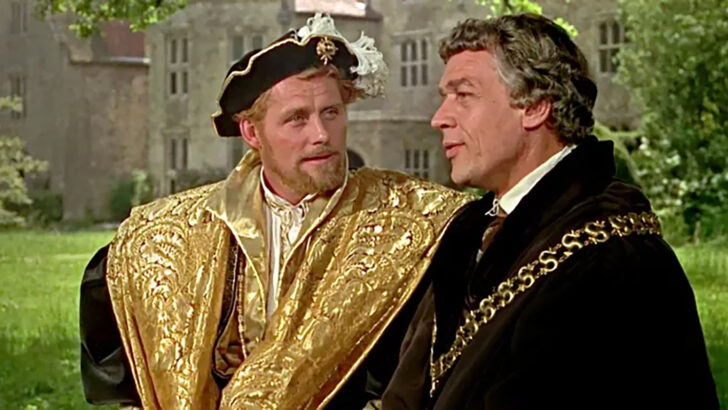
 Paul Scofield as Sir Thomas More with Robert Shaw as Henry VIII in the film version of A Man for All Seasons (1966).
 Thomas More: A Life and Death in Tudor England,
by Joanne Paul
(Penguin Books, £12.99 / Michael Joseph €32.00 hb)
Thomas More has been a figure of such controversy as to make even the opening sentence of this review seem problematic: should he be entitled as St Thomas or Sir Thomas? In following the author of this book and the common practice of historians of all creeds and none, I shall adopt the secular denomination without, I hope, provoking more.
From the beginning, the posthumous reputation of Sir Thomas was steeped in controversy. To his earliest Catholic biographers William Roper and Nicholas Harpsfield writing in the mid 1550s, he was a martyr for the true faith. But to John Foxe in his influential Book of Martyrs (first issued in 1563), he was a bigot, a persecutor and torturer of the early Reformers.
More
Assessments of More continued to be divided on confessional lines. But in the late seventeenth and eighteenth centuries, greater attention to his Utopia (1516) saw him additionally interpreted either as a pioneer of social justice or a conniving hypocrite. Montesquieu praised him; Voltaire denounced him, and Rousseau did both. In the later nineteenth century, More’s prestige began to increase in a paradoxical fashion as Ultramontane Catholics adopted him as a candidate for sainthood – he was beatified in 1885 and canonised in 1935 – and Marxists celebrated him as a prophet of communism.
Between such extremes, More was absorbed into more moderate ideological currents when, in the early decades of the twentieth century, he was represented as a liberal hero standing against tyranny and sycophancy. R.W. Chambers Thomas More (1935) played a central role in this move. A distinguished literary scholar, Chambers’ skilful exposition of More’s Latin and English writings revealed far more of the humanity, grace and wit of the man than had hitherto been appreciated.
Elton could not bear to see his hero denigrated in the interests of a political reactionary”
Chambers’ More influenced many other studies and formed the basis of a 1960 play by Robert Bolt, which in Fred Zinneman’s 1965 film version reached international renown as A Man for all Seasons (a sobriquet first attached to him by his close friend Erasmus).
Even as More was attaining his apotheosis in the flawless performance of Paul Schofield, academics were continuing to dissent. The elevation of the saintly Sir Thomas entailed the demonisation of his nemesis Thomas Cromwell (menacingly portrayed by Leo McKern in the film). And for Cromwell’s principal academic defender, G.R. Elton this was unacceptable.
Having spent half a career reconstructing Cromwell as the author of Tudor England’s ‘revolution in government’ which established parliament’s permanent place in the constitution, Elton could not bear to see his hero denigrated in the interests of a political reactionary.
Exploration
Thus, he set about dismantling Chambers’ More (and Chambers’ reputation) by chipping away at his reputation, exposing his ambition, his political manoeuvrings, his disagreeable personal traits, and (perhaps most deflatingly) the very conventional nature of his final defence, which was the dramatic climax of Schofield’s performance in the film.
Readers coming to the subject for the first time will learn a great deal about More’s life”
Elton’s revisionist More was corroborated by other scholars, and received powerful support in Richard Marius’s scholarly, but hostile biography (1999). It was from sources such as these that an alternative public image of More as the fanatical and pitiless persecutor of dissent emerged in the pages of Hilary Mantel’s Wolf Hall recreated disconcertingly by Anton Lesser in the television series.
Though she has written previously about such controversies, Joanne Paul largely avoids them here, and offers an elegant narrative based on an impressive foundation of primary sources. Far from being weighed down by its learning her biography is absorbing and often colourful. Readers coming to the subject for the first time will learn a great deal about More’s life and about early Tudor England (and early Tudor London in particular). And Paul elucidates the complex politics of mid-Henrician England with admirable assurance.
Life
She also devotes some space to expositions of More’s major writings: his History of King Richard III (1513 -8?), Utopia and his Dialogue of comfort against tribulation (1534). But while she had written on these in an earlier monograph, Paul’s discussions here are largely descriptive, slotted in between long sections of biographical narrative.
In defence of this self-denying decision, it might be said that this book is not an intellectual study but A Life. Yet the distinction is not as easy as it may seem. Intrinsic to More was the conviction that truth could be attained in a mysterious world by the use of a God-given intellect to explore and apply complex God-given languages.
{{Paul’s biography makes an excellent starting point for those seeking to understand the world”
He was, in short, a humanist. As such he was committed to controversy, not as an occasional diversion, but as a central and ethical obligation. In this the wit and charm and delight in irony for which he has been celebrated was of a piece with the ruthless and scabrous character of his confessional polemics for which he has been reproached. Both were exercises of the same moral obligation to attain true (and reject false) knowledge by the expert manipulation of language.
Paul’s biography makes an excellent starting point for those seeking to understand the world in which More lived his life, but to truly understand him, a deeper engagement with his own sense of existence and the methods which he applied at once to improve it, and also to preserve it from error, must also be addressed.
Prof. Ciaran Brady is a leading Irish authority on the Tudor period.