

 Peter Costello
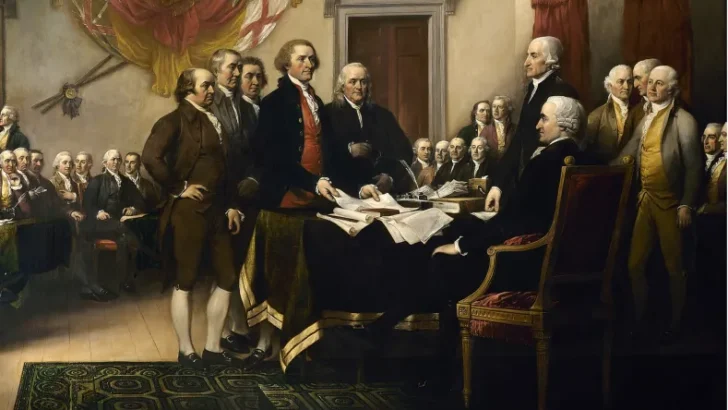 The Committee of Five present at the draft of the Declaration of Independence to Congress on June 28, 1776 - from the painting by American artist John Turnbull, now in the US Capitol Building, Washington, DC. Photo: Wikipedia images.
 Sergeant Lamb of the Ninth and Proceed Sergeant Lamb,
two novels by Robert Graves (Penguin Modern Classics, £10.99 each)
Oliver Wiswell,
by Kenneth Roberts
(Published in 1940, and though no longer in print, early editions are widely available on the internet)
===
Starting at the beginning of this month, the celebrations and ceremonies to mark the anniversary of the 1776 Declaration of Independence of the thirteen British colonies in North America, are in full swing.
Though the American revolution is the subject of continuing historical re-evaluation by historians and indeed writers of all kinds, it is worth pausing a moment to look back, through the pages of these books, one by a once popular American journalist turned author, the other a series of two by the Anglo-Irish poet and novelist Robert Graves, who maintained his family connections with Ireland to the end of his own career – his grandfather had been Anglican bishop of Limerick. He even recorded a reading of his prose and poems with Claddagh Records.
Unusual
Both of these novels approach the events of 1776 from unusual angles. Both are the work of writers who approached of historical writing very seriously.
Robert Graves “Sergeant Lamb” novels, indeed, recount the experiences of a Dubliner in the British army in North America. The first novel opens in Ireland, with vivid accounts of life in 18th-century Dublin and in rural Ireland, while the signed-up Roger Lamb makes his way to embarkation for the Colonies.
Roger Lamb was a real person whose existence Graves had become aware of in 1914, when he was instructing his platoon in the regimental history of the Royal Welch Fusiliers. Lamb had written two books which Graves used as the scaffolding of his own narratives, filling in what Lamb had been forced to leave out by his Dublin publishers, and correcting what the sergeant had misunderstood.
All the opinions on the war which are put into the mouths of Lamb or quoted from his friends and enemies”
During his stay at Princeton in 1939 Graves became interested in the stories of Washington and the other revolutionaries, especially (as he saw it) the cliques of Boston lawyers who made the running.
“These were for me very serious questions – for I now regarded the American Revolution as the most important single event in modern times – and I had found them equivocally treated in American as in English text books of history,” he wrote in 1940.
“All the opinions on the war which are put into the mouths of Lamb or quoted from his friends and enemies – however shockingly they may now read – are actual opinions recorded during the American War of Independence.”
Lamb later came back to Dublin after his adventures. Graves researched with the help of Dr Dermot Coffey of the Public Record office in Dublin.
Lamb appears to have lived until 1824. On leaving the army he became a schoolmaster of the Free School at White Friars’ Lane – a Protestant school. He was married to one Jane Crumer in St Anne’s Parish Church in January, 1786.
Secret
Graves tells his long tale of the often secret events of the revolution through the eyes of a working-class Dubliner. Kenneth Roberts is very different.
His character also has an historical model, but is rather a Loyalist one of those who did not support the Patriots. Though written for a wide popular audience (he had once been a star on the Saturday Evening Post), Roberts also conducted extensive research into the fate of those who did not support the revolution – again a theme which has Irish echoes.
This is a book more hard to come by, for though it was a best seller in the 1940s and remained in print into the 1990s, it is no longer available, except second hand. This is a pity, it shows how badly the Loyalists were in fact treated by the Patriots and later by popular American historians (of the kind that President Trump might read). He even has a good word to say about Benedict Arnold.
In the minds of many Americans of the right and left, the revolution is far from over, and there are lessons to be learned from these books.