 Peter Costello
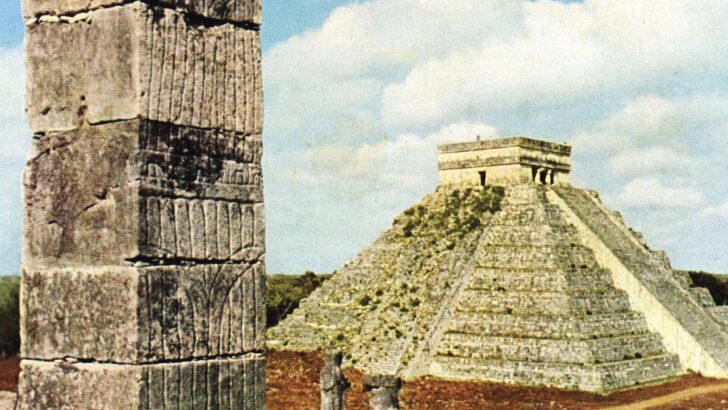 The so-called ‘Castillo’ temple at Chichen Itza. Photo: K. P. Karfeld, taken about 1948.
 The Four Heavens: A New History of the Ancient Maya,
by David Stuart
(Princeton University Press, £30.00 / €36.00)
This year as we are all too well aware is a year of special celebration in the United States, to many 1776 being “the beginning of America”. In my personal experience from living in the great republic, most North Americans have little interest in anything before that date on their continent that does not pertain to European culture. There is little real interest in the civilisation of the ancient Americas.
This was not the case back in the long 19th century. Then many if not most literate households would have owned copies of William Hickling Precott’s two important and influential books, The Conquest of Mexico (1843) and the Conquest of Peru (1847). He was essentially the founder of American history as a scientific discipline.
In these books he dealt with the Aztecs and the Incas of Peru. The Spanish invaders had some contact with the Maya in Yucatan in what is now southern Mexico; but it was only on 1843, with the publication of John L. Stephens’ Incidents of Travel in Yucatan, illustrated so finely by Frederick Catherwood, that this third civilisation came into its own.
But there was a barrier to understanding, as at first the hieroglyphs that the Maya used were not readable. But eventually they were deciphered and the whole epic of Mayan history was opened up to view.
This era of investigation and revelation is basically what this new history of the Maya recounts in detail. David Stuart, clearly a man of exceptional energy, is the professor of Mesoamerican Art and Writing at the University of Texas at Austin.
Triumphant
He opens with three chapters dealing with the extended period of exploration, investigation and triumphant decoding. This in itself is quite a story; but once the inscription and surviving manuscripts could be read, the way was open to recreate in extraordinary detail the whole long saga of Maya culture. (The three appendices deal with more technical matters of genealogy, chronology and the Mayan manner of time keeping.)
It applies to the ancient Maya the procedures of modern scientific history that began with Prescott but in a far wider and deeper realisation of how societies work, rise, thrive and fail
The tangled jungles that smothered Mayan history in the 1840s has been torn away: the buildings, temples and cities have been revealed, at least in part (for there is always more work to be done on any archaeological site, a narrative that goes back to about a thousand years before the present era. What survives is among the most impressive relics of the past.
The importance of this book for readers lies in the text. The illustrations are often a little gray and the colour pictures are limited in scope. (A book such as The World of the Ancient Maya, by John S. Henderson (Cornell University Press/ John Murray, 1997) will provide larger drawings and images.)
But Stuart’s book is what it says it is, a history. It applies to the ancient Maya the procedures of modern scientific history that began with Prescott but in a far wider and deeper realisation of how societies work, rise, thrive and fail.
Involving
It is a long and involving read, but brings before the readers an aspect of the Americas at the time when the Vikings were making those first tentative and finally repulsed contacts with the New World, as it came to be called. What was new to Europeans was the outcome of great antiquity, as great as anywhere else in the world.
Histories of the Americas which began with Washington Irving and Prescott, carry for Catholic readers a grim account of how the native peoples were treated, by the greed and viciousness of the Spanish. The conquest of the New World as it seemed to Cristoforo Colombo and others carries a moral burden which the present-day Church recognises only too well, for they have left the countries south of the Rio Grande with a social burden that still deeply affects the daily life of the people, especially those in Yucatan, Mexico and Peru.
But as they say, “past is prologue”: this book reveals the birth, growth and evolution of civilisations that have vanished, but which we can now know in detail thanks to the inventions of writing and art and the skill of modern scholars in reading them for us.
Leaders in Washington today, in looking back, need to be more aware of the true past of countries often derided north of the Rio Grande. David Stuart is one of those scholars whose work will enlighten them to the fact that cultures, however great they may seem at one moment in time, can decay and decline.