

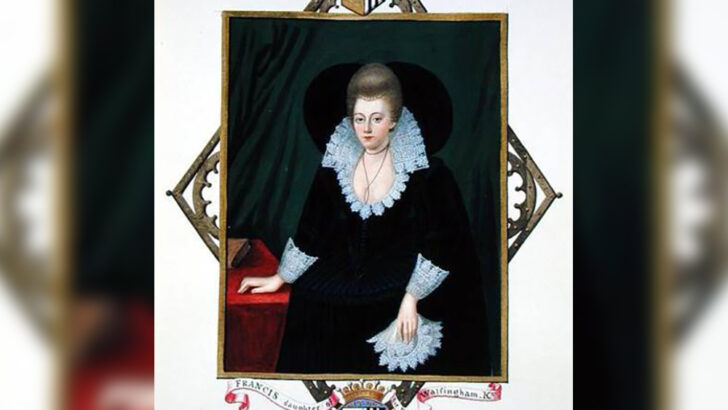
 Frances Walsingham, later Countess of Clanricard - a Catholic woman in a period of dangerous dispuputes. Photo: Wikipedia.
 English Countess, Irish Earl: the social world of Frances, Countess of Clanricard, 1567–1632,
by Bernadette Cunningham
(Four Courts Press, €39.95 / £35.00).
his biographical investigation of one woman’s life reveals a very great deal about the dangers, personal, social, political and religious that affected even the lives of the great in a “glorious” period of history for some.
The author Dr Bernadette Cunningham, now retired from her position as deputy librarian in the Royal Irish Academy, is steeped in the sources both in Irish and English relating to her topic.
Frances, countess of Clanricard was born Frances Walsingham, sometime around October 1567. A younger sister died in childhood, so Frances grew into adulthood as an only child.
Both her parents, Francis Walsingham and Ursula St. Barbe, however, had children by earlier marriages. Aged four, while her father was an ambassador at Paris, she and her mother barely escaped with their lives amidst the massacres of St Bartholomew’s Day.
At fifteen, as she was approaching marriageable age, Sir Francis disapproved of an early suitor and had him gaoled, favouring instead an arranged marriage to Philip, son of the sometime Irish viceroy Sir Henry Sidney, who was twelve years her senior.
Motivations
The marriage had political rather than financial motivations. Though a long established gentry family, the Sidneys were then heavily in debt, while Walsingham, who had twice married into wealth and was now Principal Secretary to the Queen, was then financially secure.
But Walsingham was of “the advanced” Protestant party, led by the earl of Leicester, who were urging support for Protestant rebels in the Netherlands, and opposed the marriage of Elizabeth to any within the Catholic French royal family. Sidney, nephew of the earl of Leicester, and a client of Walsingham, had already placed himself as a rising figure within this movement.
Frances was not Philip’s first choice. In the late 1560s he had been close to marrying Anne, daughter of Sir William Cecil (Lord Burghley) before negotiations broke down. And in the 1570s he had been passionately in love with Penelope Devereux, daughter of the earl of Essex.
While Sidney’s correspondence for the period is comparatively rich, not a single letter to his wife has been found”
A number of other possible matches were explored and abandoned before Sidney, now desperately indebted, agreed to a marriage with the fifteen-year-old heiress in September 1583.
Though Frances gave birth to a daughter, Elizabeth, in October 1586, Sidney was not present at the baptism, and indeed was mostly absent, engaged on a number of, usually abortive, foreign adventures. And while Sidney’s correspondence for the period is comparatively rich, not a single letter to his wife has been found.
Elizabeth was again pregnant when her husband lifted his objections to her joining him on his expedition in the Netherlands in 1586, but within three months of her arrival he was fatally wounded and died in October. In the following December Frances miscarried.
Four years later Frances married the rising favourite, Robert, earl of Essex after a long secret courtship. Though Frances bore Essex no less than six children, including three potential male heirs.
The marriage proved to be a disaster in many ways. First, Queen Elizabeth was furious that the couple had married without her permission, and while she soon pardoned Essex, she never forgave Frances who remained permanently excluded from Court.
Second, Essex soon became disillusioned with the match, and he became notorious at Court for his liaisons, of which Frances was all too painfully aware. At the same time Essex ran through the countess’s wealth already damaged by her marriage to Sidney.
Calamitously
But most importantly Essex fell calamitously, rising in futile rebellion against Queen Elizabeth after a failed campaign in Ireland. He suffered attainder and execution as a traitor in 160.
During Essex’s period of imprisonment, Frances humiliated herself, dressing in sombre black of the poorest cloth while entreating men of influence at Court (she had no access to the Queen) for mercy, or even for permission to visit her husband.
Essex’s death as a traitor deprived his widow of all her husband’s assets, leaving her only his debts. She was close to destitution: her personal income no more than an annual £40, dependent on the charity of her mother and her Sidney in-laws.
She had no hope, she wrote humiliatingly to her husband’s nemesis, Robert Cecil, except for that of an early death: she was even incapable of penning her own letters.
Her ordeal was acute, but transient. On the succession of James I the attainder of Essex’s heirs was reversed, and Frances was restored to some financial security. More surprisingly she became engaged and married to her third husband Richard, 4th earl of Clanricard in 1604.
At thirty-five Francis was five years older than her groom, but she gave birth to a healthy male heir in 1604 , and a second child , a daughter, seven years later at the age of 42, and there may have been other miscarriages to add to the toll of childhood death and stillbirths of earlier years.
Her third marriage was far happier than the other two. But it was not without its own challenges. That this daughter of one, and wife of two of the principal leaders of militant Protestantism should have converted to Catholicism on marrying a Catholic was regarded with deep disapproval by many at Court, especially in the circles of her previous husbands.
She suffered a major burglary, was subjected to blackmail concerning Essex’s indiscreet letters”
At the same time she found isolation in Ireland, even in the newly reconstructed Portumna Castle, difficult and stressful; and far preferred residence in the newly acquired estate in Kent where after 1610 she spent most of her remaining years.
As before she was often abandoned by her husband to attend to his business in Ireland. She suffered a major burglary, was subjected to blackmail concerning Essex’s indiscreet letters (she paid up an enormous £3,000), and regularly threatened with fines for persisting in her Catholic faith.
She lived long enough to see the failure of the marriages of both of her surviving daughters. Then, aged 62, having survived plague, the dangers of sea-travel, and the then appalling perils of pregnancy and child-birth in those days, she died, apparently suddenly, for no record of the event has survived.

Conditions
Culled from Bernadette Cunningham’s superb and wholly original study, these details reveal more about the conditions endured by early modern women in England and Ireland, even those from a highly advantaged background, than many volumes devoted to general women’s history.
In addition to her authoritative biographical account, Cunningham supplies invaluable material concerning the living conditions, financial and legal troubles and cultural aspirations of women in the Countess’s station. Her examinations of the Countess’s household management, and business affairs will be of great interest to scholars not directly engaged with the Countess herself.
And the book comes with a handsome set of illustrations (several supplied by the author) which makes it an immensely attractive production for which Four Courts Press deserves to be warmly congratulated.