

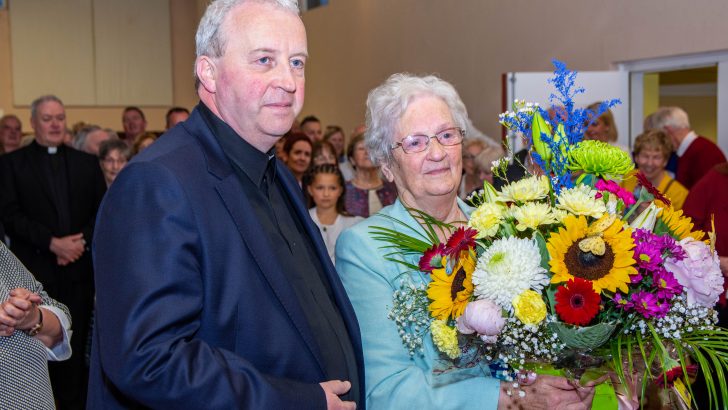
 Bishop Michael Router stands with his mother Nora after his farewell ceremony – she was
honoured with a bouquet of flowers as it was also her birthday. Photo: Colm Fitzpatrick.
Bishop Michael Router stands with his mother Nora after his farewell ceremony – she was
honoured with a bouquet of flowers as it was also her birthday. Photo: Colm Fitzpatrick. Pope Leo XIV has appointed Bishop Michael Router as the new Bishop of Derry following the retirement of Bishop Donal McKeown.
The Vatican announced on Thursday that Pope Leo had accepted Bishop McKeown’s resignation and transferred Bishop Router from his role as Auxiliary Bishop of Armagh. Bishop McKeown will remain as Apostolic Administrator of the diocese until Bishop Router is formally installed in September.
A native of Virginia, Co. Cavan, Bishop Router was born in 1965 and ordained a priest for the Diocese of Kilmore in 1989.
His ministry has included work in education, parish life, adult faith formation and pastoral renewal. Pope Francis appointed him Auxiliary Bishop of Armagh in 2019, where he assisted Archbishop Eamon Martin with pastoral and administrative responsibilities.
Bishop Router also led the archdiocese’s participation in the national and international synodal process, culminating in the Congress on Youth, Family and Faith earlier this year.
He chairs the Irish Catholic Bishops’ Conference Council for Healthcare and the Family Addiction Support Network, and is vice-chair of the Irish Bishops’ Drugs Initiative. He is also a member of the National Synodal Steering Committee.
The new Bishop of Derry will be warmly welcomed by the people of the diocese, but while there is joy, the day will also be tinged with sadness as Bishop McKeown, the longest-serving bishop in Ireland, enters retirement.
There are significant challenges ahead for the new bishop, and not all the tasks awaiting him will be easy.
Derry’s Future
Like most Irish dioceses, Derry faces declining priest numbers, changing parish structures and difficult decisions about how pastoral life will be sustained in the years ahead.
Speaking previously to The Irish Catholic in a wide-ranging interview published over several weeks, Bishop McKeown suggested that his successor could be the last Bishop of Derry, as Ireland could no longer expect to maintain bishops across all 26 dioceses.
“Finding twenty-six bishops for a small country like Ireland isn’t really practical into the future,” he said, predicting a rationalisation in the number of bishops.
Although he did not expect a merger involving Derry to happen immediately, Bishop McKeown said: “My guess is that might happen in the course of the next ten years.”
He acknowledged the geographical logic of a future merger with Raphoe, but said the decision was above his “pay grade”. He also warned that bringing together two dioceses operating across separate civil jurisdictions and as distinct charities could present practical difficulties.
In the same interview, Bishop McKeown said his successor would have to continue developing a synodal Church, encourage greater lay involvement and respond creatively to the shortage of priests. He predicted that more Eucharistic services would have to be led by lay people, particularly in rural communities where local churches could not simply be abandoned. Asked what advice he would give his successor, Bishop McKeown said: “Pray and listen to people.”
Those longer-term structural questions, however, are for another day.
Appointment
Bishop Router comes to Derry having already led the way in promoting a synodal and missionary Church.
Responding to his appointment, he said he came to St Eugene’s Cathedral “in humility and hope” and described it as “an immense honour” to have been nominated to serve the diocese.
He acknowledged that the Church no longer occupied the centre of public life and that many young people did not identify naturally with the institution. Declining clergy numbers, changing parish structures and the challenge of passing on the faith, he said, could neither be ignored nor answered by “nostalgia for a past that cannot return”.
“Managing change is perhaps one of the greatest responsibilities entrusted to Church leaders today. But change is not simply about reorganising parishes. It is about conversion.”
For Bishop Router, synodality is not another programme or administrative exercise. It means asking what the Holy Spirit is saying to the Church and learning again to “walk, pray, listen and discern together”.
“As your bishop, I will minister among you not with all the answers but with a willingness to listen especially to those who have become distant from the Church, those who feel hurt or disappointed and those who continue to search for meaning.”
Renewal, he said, would require deeper communion, greater participation and a renewed commitment to the Church’s mission of bringing people into “a deeper, more authentic relationship with Jesus Christ”.
Bishop Router also paid tribute to Bishop McKeown, saying he had led Derry “with courage and generosity” through a period of significant social, cultural and ecclesial change. “The true strength of the Church has always been found in the faith of the people. Thankfully, that faith remains very much alive today.”