

 Peter Costello
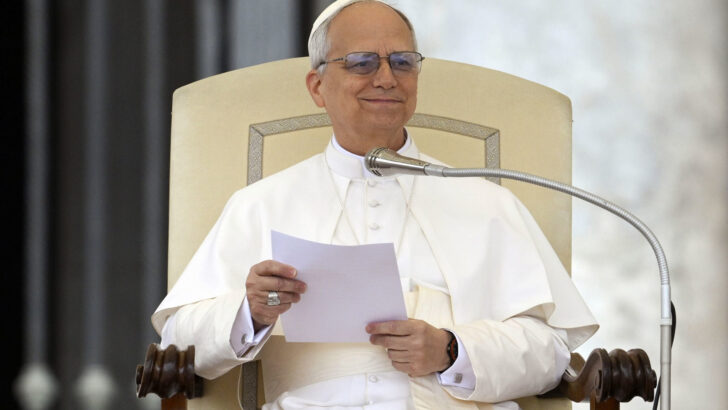 Pope Leo XIV speaking soon after his inauguration
 Leo XIV: The New Pope and Catholic Reform,
by Christopher R. Altieri
(Bloomsbury Continuum, £20.00 / €19.99)
This book is among the very first to try to encompass what the advent of Leo XIV means in general terms. You can be sure many more will follow, but as author Altieri, a born-American with decades of experience of reporting on and commenting on the nature of the Roman Curia and on papal developments of all kinds, is significantly well equipped to write it.
In nine concise chapters he lays out a scheme of who the new Pope is, what the influences that formed him are, how he came to be elected, and what his pontificate might mean.
The first thing to say is that the election of Robert Francis Cardinal Prevost came as a surprise. Yet as the choice was considered Altieri realised in a real way what a fine, even ideal choice Prevost was. Americans were, of course, delighted. But they hardly paused to consider just what kind of American Prevost was, for he certainly is not a normal one.
The talk about what teams he followed back home in Chicago could not disguise the fact that much of his working life had been spent in Peru. When Pope Leo spoke out on the fevered subject of immigration and the savage treatment of those being rounded up in quasi-secret police sweeps of large cities across the US filled with Latinos came as necessary shock. The Pope was no Trumpeter.
In writing this book, Altieri, who teaches history at the Jesuit Fairfield College Preparatory School in Fairfield, Connecticut, emphasises a series of points which are worth keeping in mind.
Characteristics
Though Prevost worked long years in Peru, he had other characteristics and experiences outside America which also shaped him. Just as the late Pope Francis was shaped by the Jesuit outlook, so Prevost was shaped by the outlook of his Order, the Augustinians. But he also had many years experience of the inner workings of the Vatican, how it thinks, and how it communicates, or often enough fails to communicate.
Church going Catholics may see that there are important calls upon their generosity nearer home”
But there are important issues in this context that cannot be avoided. One which Altieri especially emphasises is the question of financial reform. The Vatican needs money to do its everyday work but will that money continue to be forthcoming when local national churches and, more importantly, church going Catholics may see that there are important calls upon their generosity nearer home.
Justice
Then there is the even more tangled matter of the pursuit of justice, justice in the wider world, but also justice within the confines of the Church, and within the Curia. Pope Leo has just the other week held a first meeting with the campaigning group Ending Clergy Abuse: an important step taken in the wake of a Vatican commissioned report which had criticised the Church’s approach so far to resolving this searing issue.
Much of the Church style of governance still derives less from the inspired poverty of the gospels that form the autocratic manner of the Middle Ages and the 17th century”
But beyond the question of abuse by priests there is also the question of social justice not just in Africa, Asia or South America, but also in North America and Europe. Altieri, I think, is stronger on what happens in Rome, less informative about how things appear, say in Cape Town, La Paz, or Manilla. Or indeed in Beijing.
But in his final chapter he returns once again to Rome and a discussion of the nature and limits of papal governing power. The changes relating to the imposition of the palladium are seen as significant. But their outcome is uncertain. Can the Vatican, in an increasingly complex world, in which Christians are very much a minority when compared to the rising numbers of Muslims, Hindus and faithless, hope to maintain what is essentially a medieval system, created, so to speak, when the earth was flat and not global. But much of the Church style of governance still derives less from the inspired poverty of the gospels that form the autocratic manner of the Middle Ages and the 17th century.
Task
In general, this book rather appeared to me as akin to the task of a captain of a ship “boxing the comas”. Testing just how accurate the compass bearings on his bridge really are. There is a difference between magnetic north – the result of local geographical influences on the direction finding, in contrast to the actual bearings of “true north”.
For those seeking their own personal bearings in the papal reign this book will prove a mine of useful insight”
Much that influences Pope Leo belongs to the magnetic north; but I suspect that his “true north”, the point of reality, points to the impoverished barriadas of Peru.
These are early days. We will have to see. But for those seeking their own personal bearings in the papal reign this book will prove a mine of useful insight. But readers should be aware that though the chapters are clearly written and presented, there are many equally important matters and insights to be found in the very detailed notes which take up a third of the book. In these pages there is as much food for thought as there is in the main text.