

 Peter Costello
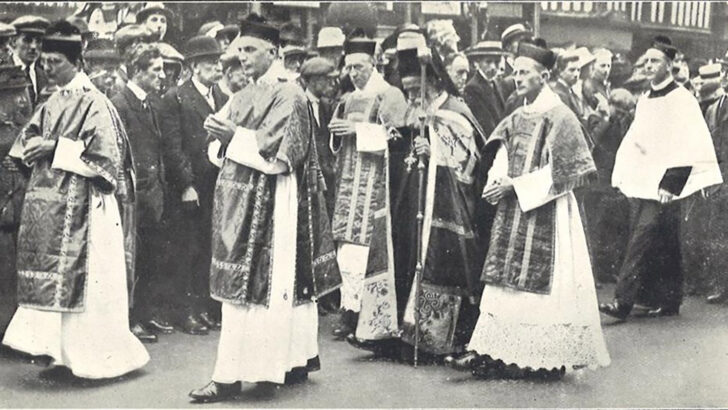 Anglo-Catholic clergy welcome an Eastern Orthodox
prelate to a 1920 congress in London Church Times
Anglo-Catholic clergy welcome an Eastern Orthodox
prelate to a 1920 congress in London Church Times After Newman: A Eulogy for Anglo-Catholics 1845-1965,
by Aidan Nichols OP
(Gracewing, £20.00 / €22.99)
Near our house, off Clyde Road, there used to be a convent of Anglican Nuns. They belonged to the Community of St Mary the Virgin, founded at Wantage in England in 1848. When my wife and I were young the very idea of “Protestant Nuns” seemed strange.
The ladies of St Mary’s convent ran first a school, and then an old person’s home (now transferred to Merrion Road). Wearing their distinctive blue grey gowns with black veils, they also helped out in St Bartholomew’s church, one of the small number of “High Church” communities in Ireland, along with St John’s, Sandymount, and a few others.
On the whole the tone of the Church of Ireland in those days was better represented by Christ Church in Leeson Park, about whose War Memorial a small harvest of poppies appeared every year around this time in November; which was distinctly low.
Roots
These musings on the past were aroused by this new book by the Dominican Aidan Nichols, one of the most prolific Catholic theologians writing today, who is a friar of the Rosary Shrine in Haverstock Hill in London.
Here he has written what I think many readers in Ireland will find a very valuable brief history of the Anglo-Catholic position in the Anglican Church of England, of which we have little experience over here.
St John Henry Newman was, of course, a Tractarian, in his early clerical career; one those in the Anglican Church who sought to trace out the roots of that Church of England in the Catholic faith of the Apostles.
In his own spiritual development Newman reached a point where he realised he must leave his Anglo-Catholic friends at Littlemore and join with those who accepted the authority of the Pope in Rome.
Those local nuns of my childhood with their grey robes were a part of something much larger, much more effective than so many of us then realised”
Aidan Nichols covers over a century of history in some ten chapters and a conclusion, describing what happened after Newman moved out of Littlemore. What did he leave behind and what became of it?
Fr Nichols describes in detail what he was leaving behind, how it developed in so many ways, and points up just how important the movement was for the life and culture of England as a whole (and as I suggest, in a much smaller way to Ireland).
Those local nuns of my childhood with their grey robes were a part of something much larger, much more effective than so many of us then realised. Indeed, in Ireland there was little effort on the part of many Catholics to understand the positions and beliefs of their neighbours when they were members of the Church of Ireland, Methodists, or Presbyterians.
Fr Nichols quotes as his epigraphs two comments. One from Stanley Ollard that “The English Roman Catholics for the most part disliked and derided the Movement”, and another from the Jesuit Anthony Symondson, that “Anglo-Catholicism…commanded spiritual and pastoral success, reinforced by… academic and scholarly plausibility…[through] leading Oxford and Cambridge academics, biblical scholars and theologians…intellectuals, artists, writers, and architects.”
Unity
This is the substance of what Nichols recounts, and what a remarkable story it is. Nor does he neglect the matter of achieving some kind of overall unity of the Latitudinarian, Evangelical and High Church elements in time.
Such unity will undoubtedly always be a fraught and difficult path. Demanding from all the deepest sense of charitable love for those they do not agree with them in everything, but with all seeking to define themselves as the Church revealed in the gospels.
In some ten packed chapters he provides an overall view of what lay behind the patient, happy work of those sisters of the Community of St Mary the Virgin which will be largely unknown to many Catholics in Ireland.
With all the conversation that surrounds the creation of a synodical Catholic Church this historical background needs to be better known. So Fr Nichols book will unfoundedly bear a fruitful harvest in due course