

 Peter Costello
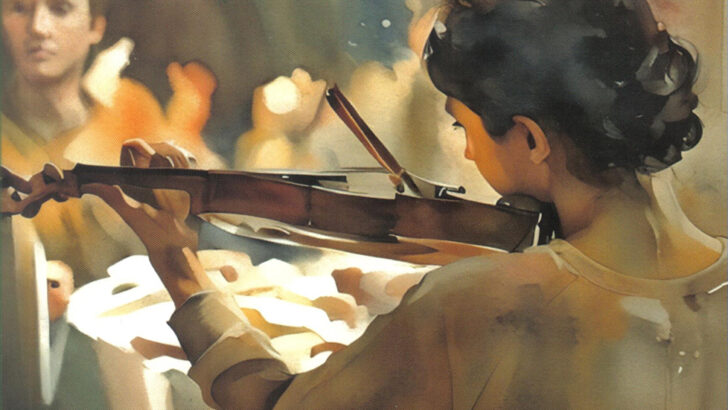 Julie McCabe performing
on her fiddle.
Julie McCabe performing
on her fiddle. The Gospel of Irish Music,
by Julie McCabe-Johanning
(Atlantic Papers, €16.49)
Traditional Irish music is one of the most important identifiers of Irish culture that exists for many people. In its various forms, both highly commercial and warmly local, it has literally conquered the world.

However, we do not think of it in association with the gospels. But the author does for reasons she alludes to in this memoir of her journey from Chicago to the serenity she found on the Irish scene.
She is now back in the United States; not in Chicago, but in the open ranges of Omaha, where she has settled with her family. She also plays the Irish fiddle in a band, so something important to her was carried away from Ireland.
Memoir
This book is presented as a memoir; but one feels on concluding it that the material it might well have been more powerful if it had all be re-imagined as a novel, as fiction can so often be more revealing of life than fact.
As her name suggests she comes from an Irish family settled across the Atlantic in that notable Irish-American centre of “the windy city”. The early part of the book recounts a sort of Irish Catholic upbringing, through school and college. I say sort of because as she grows into the world, those she encounters people her cosy Catholicism was challenged by which she often found difficult. She relied for instance on prayers books from TAN books, a very traditional Catholic firm, yet all her scripture quotes are taken from evangelical versions, which seems a little strange, though I suppose the pages of Dr Challoner’s version may not have crossed her path.
Irish music,’ she is told,’ is like Guinness, an acquired taste.’ The fiddler makes her think of her own violin pushed aside back home. Maybe, she though, she would learn some tunes before going home”
The accounts of these stressful years of high school and college are true to life, at least as I had an opportunity to observe for a few years. But the book perks up considerably when she gets to Ireland post-college to study at Trinity and stay with Irish connections.
Whatever about the gospels, Irish music does not really assert its influence until page 202 (out of 250). She goes to traditional music event in Cork. “Irish music,” she is told,” is like Guinness, an acquired taste.” The fiddler makes her think of her own violin pushed aside back home. Maybe, she though, she would learn some tunes before going home.
The great moment of the books is on the last page and provides the motif of the book. Back home she missed Irish music, but found she was only a quarter of an hour from an Irish music venue at the Abbey Pub. “I decided to see if Chicagoans would play like they did in Ireland. I walked in alone carrying my fiddle and ordered a Guinness.”
Instinctively
When the session started, she found her way instinctively into it. At this moment she found her true metier; all the past was drawn into the present, and a future of some kind was assured.
This lovely passage would have been, I think, the key to a remarkable novel. As it is, this book is an interesting read. It is Julie McCabe-Johanning’s first book; it is clearly herald of many more.
Atlantic Papers, Ballyglass, Claremorris, Co. Mayo, Ireland, can be reached at www.atlanticpaperspress.com.