

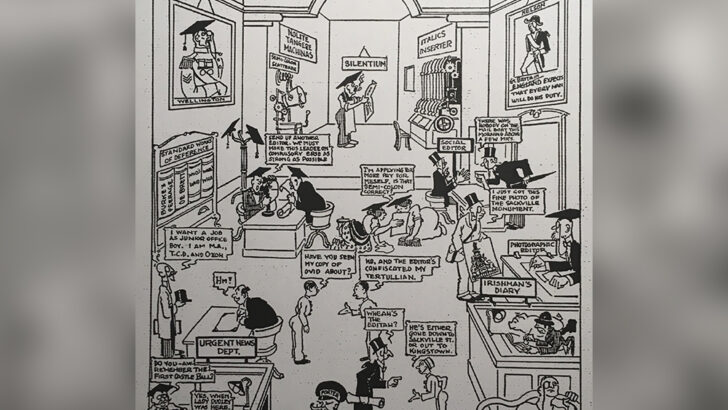
 Dublin Opinion cartoon
 Not Making Hay: The life and deadlines of a “diary” farmer,
by Frank McNally
(Gill Books, €22.99 / £ 20.50)
An Irishman’s Diary”, sometimes “An Irishwoman’s Diary”, in the Irish Times is “a near-century-old institution in Ireland’s most literary newspaper”. These are the words of the current lead writer of the Diary, Frank McNally, in this richly entertaining book.

The book is a series of vignettes from his life, interspersed with some actual Diary columns. McNally is a native of county Monaghan, and the title of his book – Not Making Hay – is borrowed from the poem “Raglan Road” by his fellow-countyman, Patrick Kavanagh.
As McNally points out, the Diary feature began as a sort of “donning of the green jersey” by a newspaper regarded – at least until the 1960s – as a last bastion of Anglo-Irish ascendancy in Ireland.
Thus, when in 1930 the satirical magazine Dublin Opinion lampooned the Irish Times in a full-page cartoon, it isolated the Irishman’s Diary within a corral in the newsroom. It was occupied by a fellow in peasant attire (in marked contrast to the other figures in the cartoon), smoking a clay pipe and with a pig by his side.
Relief
While the Irish Times has moved on into the mainstream of Irish life, the Irishman’s Diary continues to provide some light relief in the midst of news that is often depressing, even distressing.
McNally, however, does not eschew the dark side of Irish life. His book includes two very moving chapters about a school-friend who, as a trainee Garda, was shot and killed along with a young army officer by the IRA while assisting in the effort to free the kidnapped supermarket executive Don Tidey.
He also writes about another school-friend with whom he reconnected after forty years when that friend contacted him from the care home in which he was living; sadly, the friend died of Covid soon afterwards.
A bittersweet note is struck in the chapter about McNally’s friendship with a larger-than-life character called Steve Dunford, who was involved in the re-enactment of Napoleonic-era military campaigns and recruited McNally to the ranks of his “army”.
Escapades
Among the memorable escapades of this happy band of brothers was to retrace in period costume the march of General Humbert’s Franco-Irish army from Killala to Castlebar in 1798. Dunford, too, died young, and McNally recounts his poignant last meeting with him in a hospice in Castlebar.
Much of McNally’s writing is, nevertheless, humorous – as his Irishman’s Diary pieces are usually. His first serious venture into journalism was, in fact, as the anonymous author of the iconic “De Diary of a Nortsoide Taoiseach” – about Bertie Ahern – in The Phoenix magazine.
It owed its inspiration to the Private Eye feature “Dear Bill”, ostensibly written by Margaret Thatcher’s husband. He later joined the Irish Times, first on a freelance basis but eventually as a general staff reporter. He was appointed to the Irishman’s Diary in 2006 and has since then contributed four columns each week (allowing for holidays, etc.) – a prodigious output.
The Diary
The final chapter of his book is about how he goes about writing the Diary, with passing references to other accomplished newspaper columnists. What surprises me is his need for a deadline: he claims that, without a deadline, he cannot deliver his copy to the editor.
There is an earlier chapter on the history of the Irishman’s Diary column, and he discusses some of the previous lead writers of the Diary – Patrick Campbell, Seamus Kelly and Kevin Myers.
McNally’s book begins appropriately with evocations of his childhood in rural Monaghan, on a farm that ‘still produced a bit of everything’”
A popular misconception is that Myles na gCopaleen (aka Flann O’Brien, otherwise Brian O’Nolan) was once the custodian of the Diary. His column was “Cruiskeen Lawn” – and, as McNally acknowledges, it is often confused with the Irishman’s Diary.
McNally is an authority on the work of Flann O’Brien and occasionally refers to it in his Diary columns. He regards “Cruiskeen Lawn” in its heyday, in the first half of the 1940s, as “that era’s funniest column in the English language”.
McNally’s book begins appropriately with evocations of his childhood in rural Monaghan, on a farm that “still produced a bit of everything”. It was, he says, at “the end of the self-sufficiency era” in Irish farming.
The farm included some dairy, and so McNally muses on “one of the more common typos in the world of agri-journalism. That is the tendency, when writers mean ‘dairy’, to type ‘diary’ instead.” Hence the subtitle of his book is “The life and times of a ‘diary’ farmer”.