

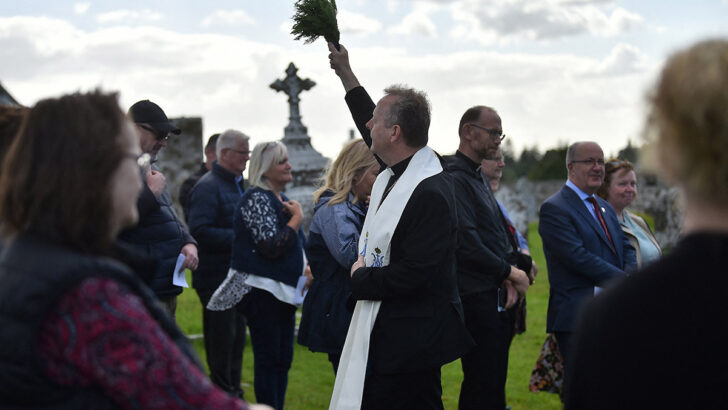
 Archbishop Eamon Martin blesses delegates during a prayer walk at Clonmacnoise in June 2022, at the start of Ireland’s synodal journey that now
continues with the 2025 pre-synodal assembly in Kilkenny. Photo: CNS /Clodagh Kilcoyne, Reuters.
Archbishop Eamon Martin blesses delegates during a prayer walk at Clonmacnoise in June 2022, at the start of Ireland’s synodal journey that now
continues with the 2025 pre-synodal assembly in Kilkenny. Photo: CNS /Clodagh Kilcoyne, Reuters.
Assembly decisions should not be presented as ‘authentic voice’ of Irish Catholics
The Synodal Pathway is “offering the Church here little more than a political-type programme”, a senior priest has warned on the eve of its National Assembly in Gormanston.
Fr Andrew McMahon, a Dromore priest, writer and commentator, said the proposals going before delegates this weekend are “significantly out of sync with the reality of Church life” in Ireland. He warned that they are “likely dependent for its delivery on an ever-expanding bureaucracy”.
Writing in The Irish Catholic, Fr McMahon said the working groups behind the proposals “deserve appreciation for their efforts”. But he said their work “require[s] close scrutiny”, because the Pathway “makes the extraordinary claim of having determined the will of God for the Church in this country”.
He branded as “misleading” the document’s claim that its proposals are the fruit of the discernment of the ‘People of God in Ireland’.
Statistics collated from the 2022 diocesan reports indicated that at most 1.5% of Ireland’s Catholics engaged in the synodal consultations. It is widely recognised, he said, that the Pathway “never really took off”.
Fr McMahon cited campaigning priest Fr Tony Flannery, a passionate supporter of the Pathway and former delegate who recently wrote that “there seems to be very little happening on the ground in parishes and dioceses” and that many people have told him they haven’t “heard one word about synodality in their church at any stage of the process”.
For a process that has made transparency a “core demand”, Fr McMahon said, the reluctance to acknowledge such low engagement “can seem to undermine” that commitment. It has also “left the Pathway vulnerable” to proposing ways forward that are disconnected from parish life, he said.
‘Health farm brochure’
Fr McMahon listed a plethora of proposed national bodies, including a permanent national ecclesial council, a national commission for healing, a national office for women and a national office for life-long faith formation.
These “would surely require the recruitment of a very sizeable and, presumably, costly body of personnel”, he warned. Yet the document shows “no discernible awareness” of “the struggle typically involved in keeping ministries going on the ground, finding volunteers”.
He was scathing about its “technical jargon”, asking: “What is ‘a differentiated co-responsibility’ to the average parishioner?”
A proposed series of “gentle, invitational touchpoints” for families after Baptism “sounds like something adapted from a health farm brochure”, he said. “Would it not be more straightforward – and more worthwhile – to simply encourage them to think about coming to Mass?”
No repentance
Fr McMahon said the document “appears reluctant to propose the Christian and Catholic faith in anything like its fullness”.
There is “no focus whatsoever upon the call to ‘repentance’ for forgiveness of sins”, nor on “the call to conversion”, he said. The Pathway has “avoided any exploration of the question of personal sin” or of the Sacrament of Reconciliation “at any stage”. Where sinfulness or conversion are raised at all, they are applied “exclusively to the institutional life of the Church”.
Even the document’s use of the Emmaus story as its “model for such accompaniment” leaves out the fact that Jesus “rebuked the disciples’ own thinking, upbraided them as ‘foolish men’, and set about correcting and teaching them”, he said.
Fr McMahon cited Gustavo Gutiérrez, who warned that structural reform “at the expense of individual repentance, reduced Christianity to little other than a political programme”. The Pathway’s vision, he said, revolves “largely around power dynamics and structural reform”. Prayer, spiritual growth and holiness “gain little more than passing references”.
‘Spirit of the age’
The proposals “become increasingly ideological”, Fr McMahon said, echoing “the predominant preoccupations of the social ‘progressives’ of our time”.
He questioned a recommendation that members of the LGBT+ community be recruited to a healing commission. He also objected to the apparent suggestion that those who believe they have experienced “marginalisation and exclusion in the Church” be “classified alongside those who have suffered genuine hurt and abuse”.
He described a proposed “preferential option for women at the margins” as “absurd” in a country where “80% of the cases” of suicide are male.
He also noted that the document never suggests the Church “support or make common cause with pro-life advocacy groups”, despite “growing rates of crisis pregnancies and consequent abortions”. That absence, he said, “will further confirm the suspicions of many” that the Pathway has been “more an expression of the ‘spirit of the age’” than “any reflection of the will of the Divine”.
Delegates will also consider proposals that the Irish Church advocate at universal level for “a more respectful and life-giving vocabulary when speaking about LGBT+ people”. A second proposal calls for “on-going exploration of women’s ministry, including the diaconate”. Fr McMahon said the first rests on an assumption that is “neither explained, nor justified” and is “obviously controversial”.
The few hundred gathering in Gormanston are “unlikely to be especially representative of Irish Catholics at large”, he said. It “would seem unwarranted” to present the Assembly’s decisions further afield “as the authentic voice of the Church in Ireland”.