

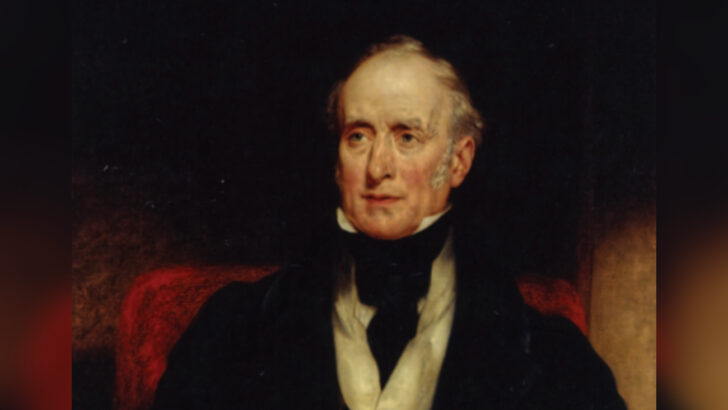
 Maurice Fitzgerald, 18th Knight of Kerry
 Irish history is at times more influenced by places than by persons. Ask many Irish people of an older or rural background where they are from and they will answer (much like the famous Tailor of Garrynapeaka) with a mention, not of the parish they were born in, but the actual townland, the smallest property division in Ireland.

“My own place”, or “my family’s place “ is what shaped their outlook on the wider world. What was true of small farmers was even truer of the lords of the land.
This is well illustrated by the history of Ballinruddery in Co. Kerry, the strong hold of the Knights of Kerry, who belong to an early branch of the mighty Geraldines.
Their history was recently the subject of a review in these pages by poet Thomas McCarthy, but this dealt more with the people rather than their “own place”, on which a few notes seem to be called for.
The area east of Listowel has been known from the earliest of times as Ballinruddery, Baile an Ridire – ‘the district of the knight’”
There is uncertainty as to exactly how or when the Knights received their title or, more accurately, their distinction. Traditional accounts attribute the creation of this distinction and that of the White Knight and the Knight of Glin to John FitzThomas who was killed at Callan on July 23, 1261.
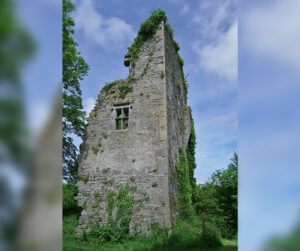
The area east of Listowel has been known from the earliest of times as Ballinruddery, Baile an Ridire – “the district of the knight”. Thus it is fair to conclude that the FitzGeralds, Knights of Kerry, resided here from ancient times. Most probably the remnants of a Norman-style castle, which stands at Ballinruddery beside the river Feale, was one of their early habitations.
The family lost Ballinruddery to Thomas Joy early in the seventeenth century and in the Cromwellian settlement it was divided between James Powell and Symon Eaton. By that time also the ancient castle was still in the hands of Thomas Joy.
However, with the restoration of Charles II, John FitzGerald, the then Knight of Kerry, who was resident at nearby Ennismore, was restored to his estates with letters patent, dated May 14, 1667.
Throughout those times the Knights of Kerry continued to reside in a long, rambling, partly thatched and partly slated, sixteenth century building near the ancient castle. This was the home of Maurice FitzGerald (1772-1849), 18th Knight of Kerry. After his father’s death in 1781 it was here that Maurice and his brother and sister were brought up by their widowed mother,
Catherine
From here he was sent away to school and university. It was here that he and his wife Maria raised their own much larger family – seven sons and four daughters. And it was to Ballinruddery that he regularly returned during his 37 years as a member successively of the College Green and Westminster Parliaments.
Maurice FitzGerald represented Co. Kerry in parliament. He served as Lord of the Treasury, Privy Councillor and Deputy Lieutenant for Co Kerry. He fought for the Kerry militia in Mayo in 1798 during the French incursion.
He was a friend and associate of the leading political figures of his time, such as Daniel O’Connell and the Duke of Wellington. With these he debated important political issues, among them the Act of Union and Catholic Emancipation.
He supported the Act of Union on the understanding that it would bring some relief to Catholics. When this was denied by King George III, he became a “disillusioned Unionist”.
On the home front Maurice was as active as he was in his political life. According to Thomas Radcliffe, who visited Ballinruddery in 1814, he took an active interest in developing his Ballinruddery estate.
He described his residence as ‘beautifully situated in a richly wooded demesne’ with its front covered by a ‘profusion of climbing plants’”
He hired an expert drainer to improve the land and established a lime kiln. He grew excellent crops of potatoes, turnips, oats, vetches and hay. He was heralded as “more a lord of the land than as a landlord”.
Samuel Lewis the topographer visited the 18th Knight in 1837. He described his residence as ‘beautifully situated in a richly wooded demesne’ with its front covered by a ‘profusion of climbing plants’. He also noted the ‘fine carriage road’ which ‘extends for upward of a mile through the demesne nearly parallel with the windings of the river’.
Maurice bought Valentia Island in 1807 which had been leased since the 1750s from the Annesley family. Thereafter Maurice and the succeeding Knights of Kerry for the most part resided at Glanleam on the Island.
At Valentia Island Maurice, with the assistance of a talented Scottish engineer named Alexander Nimmo, promoted agricultural and industrial development, including slate quarries. Maurice even attempted to establish an Atlantic Steamship Company which would link Valentia Island to Nova Scotia. Most importantly Maurice encouraged in the local people a habit of local enterprise and a readiness to co-operate in agriculture, cereal growing and dairying.
The campaign to force landlords to sell their lands to their tenants was as intense in North Kerry as it was elsewhere. Thus by the early twentieth century the Knights of Kerry had sold most of their land holdings to their tenants in accordance with the various land acts. Ballinruddery was divided between twenty-seven workers and tenants.
Sir Arthur Henry Brinsley FitzGerald (1885-1967) was the last Knight of Kerry to be associated with Ballinruddery. He followed as the 22nd Knight (1957-67) when his brother, Sir John Peter Maurice FitzGerald (1915-1957), the 21st Knight, died in 1957.
Earlier Brinsley had acted as Lord Listowel’s agent and while doing so resided in Gurtinard House in Listowel. Subsequently he was agent for his brother, the 21st Knight and resided at Ballinruddery up to 1914. Later he was the private secretary to Lord French, following his appointment as viceroy in
1918
Captain Arthur FitzGerald of the Irish Guards regiment was Brinsley’s nephew. He served as Lord French’s military secretary when French was OC, British Expeditionary Force in 1914-1915. Later he was French’s aide-de-camp when the latter was appointed viceroy in 1918.
Arthur and his newly-married wife Mary were given the Ballinruddery estate as a wedding present in 1914. The ancient dwelling, near the castle, was destroyed in an accidental fire in 1955. Thus apart from the time he was on active service in France, Arthur resided in the substantial steward’s house, from
1914-1918
However, after the War of Independence began in 1919 it was no longer safe for him to reside in the district, so he and his wife departed from the steward’s house for the last time in March 1920.
John Molyneaux, a descendant from one of the families who benefited from the sale of the holdings of the Knights of Kerry, later recalled that there were mixed feelings among the local people at the ending of the immemorial link between Ballinruddery and the Knights of Kerry.
And it was not much later that a visit to the former beautifully-maintained demesne reminded one of lines in Oliver Goldsmith’s poem on the Deserted Village.