

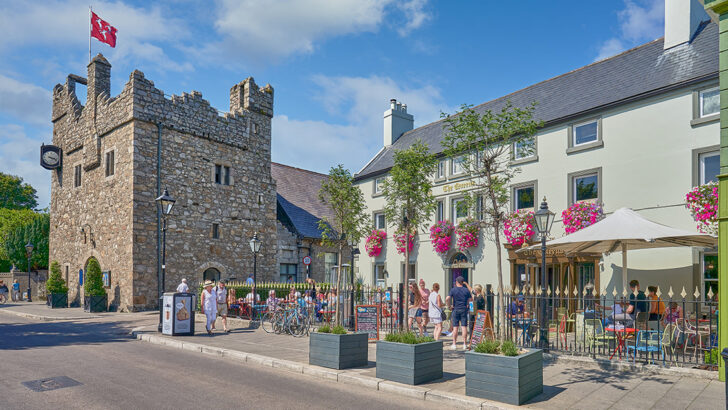
 Dalkey today, a mixture of the meieval and the Victorian. Photo: DLR Council
 Dalkey: an Illustrated History,
by John Martin
(Wordwell / Eastwood Books, €20.00 / £17.50)
This is not merely a good book; it really is a most excellent one. John Martin is well-qualified to write this topographical tour-de-force, being a long-time Dalkey resident, a former town planner, latterly serving in the Department of the Environment. He is also the author of the volume on Dungarvan in the Royal Irish Academy’s Historic Town Atlas series.

His interest in the local history of Dalkey was inspired by guided walks led by the late Harry Latham. Erudite and written in a cool and calm style, his book engages the reader from the first page, with a detailed description of perhaps the most iconic feature of the area – Dalkey Island, with its ruins and memories of the “King of Dalkey”, a late eighteenth-century folk tradition largely (it would appear) lubricated by copious quantities of drink and essentially a satire on the presumptuous pomp of the British monarchy.
The work covers an enormously wide period, from about 5000 BC to the present day. The name “Dalkey Island”, we learn, encompasses one of the earlier eras, being derived from the Norse ‘Dalk Ei’, itself derived from the Gaelic ‘Deilg Inis’, meaning ‘Thorn (or Dagger) Island’.
Essence
Where sea meets land in essence dictates the nature of this south county Dublin idyll. There are its two small harbours – Coliemore and Bullock – predating their now much larger and grander neighbour to the north, Dún Laoghaire (formerly Kingstown), built with stone from Dalkey Quarry. But in earlier times the Dalkey harbours were significant outports for the Dublin area, being more navigable than the entrance to the Liffey.
Dalkey is an idiosyncratic place. Apart from its peace (and, yes, air of prosperity – it isn’t cheap to live in these days) it’s full of crannies, nooks and fascinating places as well as tales of olden times, all of which add to today’s lustre and patina. Just a few examples from Martin’s book.
Its salubrious position and the advent of the railway attracted prosperous Protestants to Dalkey, and it was one of the more ‘Protestant’ towns in southern Ireland”
It has, or had, no less than seven castles: the eponymous Dalkey Castle, often referred to as Goat Castle; Dungan’s Castle; Wolverton Castle; House Castle; Black Castle; Archbold’s Castle; and an unnamed seventh. Only two survive.
A vacuum-powered ‘Atmospheric Railway’ ran from Dalkey to Kingstown between 1843 and 1854.To the south, Killiney Bay was reminiscent of the Bay of Naples, and prompted a rash of Italian-named roads and houses (Sorrento Terrace, Mount Alverno, Nerano Road, Vico Road).
Its salubrious position and the advent of the railway attracted prosperous Protestants to Dalkey, and it was one of the more ‘Protestant’ towns in southern Ireland – even in the 1950s over a quarter of the population was Church of Ireland.
Ecclesiastical
Ecclesiastical architecture competed; the handsome Catholic Church of the Assumption of the Blessed Virgin Mary, first constructed in 1841, was prominently situated on Castle Street while the equally fine St Patrick’s Church of Ireland, slightly out of town, was consecrated in 1843. There, church, rectory and national school formed a sort of ‘gated community’ to protect the minority.
And hotels came and went in this picturesque town – the Queen’s (still there as a hostelry), Cliff Castle Hotel, the exotically-named Khyber Pass and Shangri-La Hotels, the latter featuring fine dining (at a price) and famous film-star guests.
One of the most endearing and interesting features of the book are final chapters on people – those who helped to shape Dalkey over the ages, and ‘notable Dalkey residents’ – no book about the town can be written without mentioning Maeve Binchy and Cyril Cusack. Others included playwright Lennox Robinson and Carmel Snow, noted American fashion arbiter, the latter illustrated here by a commemorative Irish stamp.
This book is both encyclopaedic and economically written. Dalkey may be a relatively compact locality, but the ground covered by Martin is enormous, as evidenced in a comprehensive guide to sources and endnotes.
A dip into this lovely book, great value and lavishly illustrated in colour, excellently printed on satisfyingly weighty paper, will richly reward the curious. Martin suggests that it will engage “the general reader and those with a particular interest in the local history of the area”.
Resident
I’d go further and say that this is a book that should be on the shelves of every resident in the locality. This reviewer’s families were Dalkeyites. I spent the first eleven years of my life in a small, ill-lit, damp and thoroughly magical cottage on the main thoroughfare, Castle Street, and while an avid child wanderer on and around coastline, quarry and hill, was perhaps too young to want to delve into the history.
But I can do so now, with this companionable volume as my explanatory guide – one that I suspect will, in time, receive the accolade of being referred to simply as ‘Martin’s “Dalkey” ’.