

 Eilis Mulroy
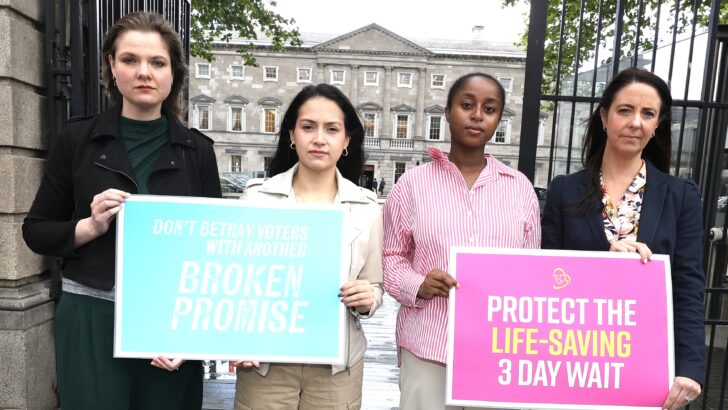 Caption: PLC volunteers outside Leinster House recently. Photo: PLC.
Opponents of the three-day wait before an abortion may have won the first vote, but they haven’t won the argument, writes Eilís Mulroy
Last week was a disappointing one for anyone who supports the life-saving three-day reflection period before an abortion.
The Dáil voted by 86 votes to 70 to advance Sinn Féin’s Second Stage bill to abolish the waiting period. On paper, it was a significant setback. But politics is about far more than numbers on a division board. Sometimes what happens behind the vote tells you far more than the result itself.
What struck me most was where the pressure for change came from.
During previous abortion debates, the media often led the charge. This time, however, the most determined push came from within the political establishment itself. Senior politicians drove this agenda without any meaningful attempt to explain their position to the people they represent.
No two politicians carry greater responsibility for this outcome than Micheál Martin and Simon Harris. Neither man attempted to make a public case for removing the three-day reflection period. Instead, a deal was done with Sinn Féin behind closed doors and presented to the public as a fait accompli.
Both leaders are now supporting a position directly at odds with the assurances they gave to voters in 2018 prior to the referendum. For two men occupying the highest offices in the State, it was an extraordinary display of political cynicism and a massive breach of trust.
Equally revealing was Sinn Féin’s reluctance last week to engage in public debate before the vote. Apart from one exchange between Louise O’Reilly and myself on Newstalk Breakfast, there were no other head-to-head media debates.
That should concern everyone. If a proposal is strong, if the evidence is overwhelming, surely those advancing it should welcome scrutiny. Instead, there seemed to be a preference to avoid difficult questions altogether.
The media, unfortunately, did little to hold proponents of the bill to account. The morning after the vote, RTÉ’s Morning Ireland interviewed Sinn Féin’s David Cullinane, with most of the questioning focused on why Sinn Féin did not go further in expanding abortion access.
On the same programme, Fine Gael TD Micheál Carrigy was repeatedly pressed to justify voting to retain the three-day wait. He defended his position well, but the contrast was obvious in yet another example of RTÉ‘s skewed coverage on the issue.
Meanwhile, The Irish Times columnist Miriam Lord disparaged as “aul fellas” those who voted against the bill, claiming they knew “absolutely nothing” about women in crisis situations and lamented the “dispiriting familiarity” of TDs voting with the pro-life side. Perhaps the real intellectual stagnation lies with commentators who have spent decades repeating the same talking points while showing little interest in engaging with the evidence or arguments put before them.
Ironically, Miriam Lord and others ignore the glaring blind spot at the core of arguments for removing the reflection period. The chair of the review into Ireland’s abortion law recommended removing it – but later acknowledged before an Oireachtas committee that she had not consulted with a single woman from among the thousands who attended an initial abortion appointment but chose not to return after the three-day waiting period.
Think about that for a moment. Thousands of women made a decision not to proceed. Yet none of their voices or stories was heard during a review now being used to justify removing the very safeguard that may have influenced their choice.
That omission is extraordinary. It is also deeply inconvenient for those pushing this legislation. I suspect we will now see renewed efforts to fill that gap through more taxpayer-funded consultations with ‘key stakeholders’, designed less to uncover the truth than to provide political cover.
But for all the disappointment of last week’s vote, there are reasons for hope. The fact that a majority of Government TDs voted against the bill – including several senior Ministers – is encouraging and bodes well for the future. As the bill moves to committee stage after passing second stage by a relatively narrow margin, supporters of the bill will have to deal with the difficult task of constructing a convincing justification for the position they have already taken.
The public response has been interesting. Whether on radio phone-ins or online discussions, there appears to be very little real enthusiasm for abolishing the three-day wait.
Many people are asking a more fundamental question: why are so many senior politicians devoting their energy to making abortion easier while the country struggles with housing, healthcare and the cost of living?
That question is not going away.
Nor is the growing frustration with political leaders who claim to listen to all sides while repeatedly engaging with only one.
It is also important to acknowledge those who stood firm. Aontú, Independent Ireland and a number of independent TDs deserve immense credit for the part they played throughout the debate. Tribute is also due to those members of Fianna Fáil and Fine Gael who worked hard within their parties and who voted with their conscience to protect the three-day wait rather than follow the party leadership. Their courage matters.
Most importantly, this vote is not the end of the story. The bill has only progressed to committee stage. There are further battles ahead and significant hurdles still to overcome. Defeating the legislation at its final stage will require a major effort, but the fight to retain the three-day wait is far from over.