

 Fr John McCarthy
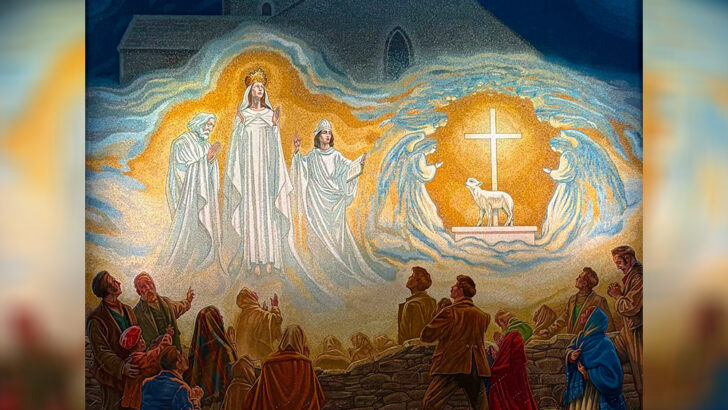 The mosaic depicting the Apparition at Knock, with angels surrounding the Lamb of God. Photo: Knock Shrine.
 Around the lamb I saw angels hovering during the whole time, for the space of one hour and a half or longer; I saw their wings fluttering, but I did not perceive their heads or faces, which were not turned to me’’ (Patrick Hill, witness).

The angels seen at Knock belong to a reality deeply rooted in Scripture and Christian tradition. Our Lord says that the angels “always behold the face of my Father who is in heaven” (Mt 18:10), while the psalmist describes them as the “mighty ones who do his will, hearkening to the voice of his word” (Psalm 103:20). St Gregory Nazianzen urges Christians to regard the heavenly Jerusalem, “the city glorified by angels”, as our true home. And the Catechism reminds us that the existence of these spiritual, non-corporeal beings “is a truth of faith” (#328).
Knock is a summons to, as well as a reminder of, heavenly realities. The apparition breaks into our visible world calling us to the other one that awaits us. We get so distracted and caught up with endless busyness that we often lose sight of the real purpose of our existence. One of the fruits of our frenetic lifestyle has been that with the time-consuming pursuit of constant gratification especially on our phones, we are currently experiencing emptiness, exhaustion, and mental ill health at unprecedented levels.
What is presented on angels is far from our traditional Christian understanding of healing through prayer and sacraments as well as Church teachings on angels”
However, despite this endless ‘going’ we still feel somehow incomplete and often experience a deep sense of longing and belonging. The culture of comfort leaves us bereft of spirit.
One of the surprising characteristics of modern culture is the irrepressible search for the spiritual – but in anything other than “organised religion.” People place their trust in, and feel re-assured by, any number of alternative ways of ‘being.’ Strangely, among them is an off-centre belief in the understanding of the purpose of the existence of angels. Some modern emphasis on angels as personal guides is not a terrible thing, but as it is expressed in many modern books, it is woefully inadequate. Devotion to angels tends in some quarters either to be saccharine or to be mixed up with other odd, even harmful, practices which we call the New Age. Mind-body-spirit seminars for healing and wholeness are all the rage, but what is presented on angels is far from our traditional Christian understanding of healing through prayer and sacraments as well as Church teachings on angels.
The inclusion of angels in the Knock apparition is therefore the deliberate will of God and once more, timely. Not only because it reflects the biblical tradition as seen in the Book of Revelation, but as an invitation to consider once more their role and their relationship with the People of God as conscience guides, directing us to what is better and above all, to God.
Angels around the Lamb
The place of angels in the apparition encircling the Lamb inviting us to meditate on how the Book of Revelation presents them to us.
When we look at the apparition, the presence of angels adds yet another dimension to the whole ‘arrangement’ as it were. They are present only encircling the Lamb. It is worth opening the pages of the Book of Revelation displayed by St John in the apparition.
The book of Revelation does not make light reading. But in broad brush strokes Revelation – or ‘Apocalypse’ which means ‘unveiling’ – points to the final triumph of the Lamb of God over the Evil one and a corrupted world at the end of time. In the sacred book, angels are presented first as messengers sending warning signs through plagues to humanity to repent, warning of the ultimate catastrophe to befall paganism. The lesson for the reader therefore is that the time is at hand for Christians to definitively break free from the false spirit of the world, pagan customs, and immoral practices while the opportunity presents itself. The future earth-shattering events depicted are but the birth pangs of the ushering in of a final era of peace and victory when ‘all is made new’ (Isaiah 42:19, Revelation 21:5). While Jesus as Lamb of God features in 28 references, angels appear more often in number and kind with a myriad of roles. In chapter 10, we will see the connection between angels in John’s vision of heaven and their participation in the Mass.
Angels and the saints of Knock
The interconnection of angels with other aspects of the apparition, namely Mary, Joseph, John, and the Passion.
Theologians tell us that the term “angel” applies to the heavenly spirits in their role as messengers. As St Augustine said, “‘Angel’ is the name of their office, not of their nature.”
Throughout Scripture angelic visitations occur at key moments of Israel in the Old Testament and in the Acts of the Apostles in the New. God sent angels to help inaugurate the Good News in Nazareth and Bethlehem, in Jerusalem and at Galilee (see references below). The early Church needed the admonishment and encouragement of angels sent by the Lord.
It is significant that in the New Testament we can find angels with the saints of the apparition – Our Lady, St Joseph, and St John”
In relation to Mary of course, the Hail Mary consists of the words of the angel Gabriel – ‘Hail, full of grace’ (Luke 1:28). Several mysteries of the rosary feature the angels – such as the Annunciation (Luke 1: 26-38), the birth of our Saviour (Luke 2:1-15), the Agony in the Garden (Luke 22:43), the Resurrection (Matthew 28:2-8, Mark 16:5-7, Luke 24:4-5,23), the Ascension (Acts1:10-11).
It is significant that in the New Testament we can find angels with the saints of the apparition – Our Lady, St Joseph, and St John.
Our Lady
The Hail Mary, the Angelus prayer, as well as the first Joyful mystery all commemorate the “angelic salutation” of Gabriel to Mary, the first to hear the Good News of salvation. The concluding prayer of the Angelus states “pour forth we beseech Thee O Lord Thy grace into our hearts that we, to whom the Incarnation of Christ was made known by the message of an angel…”
St Joseph
The angel appears to Joseph with advice and warnings in St Matthew’s Gospel (Mt 1:20, 24, 2:13, 19).
St John
An angel delivers John and Peter in a couple of episodes from prison in the Acts of the Apostles (Acts 5:19, 12:7-10).
And it is an angel who leads and goes with John through the Book of Revelation, showing him marvellous signs but admonishing him not to worship him (e.g. Revelation 1:2, 20:15, 22:1, 6-9).
The angels can, likewise, be our moral guides and messengers if we allow them. The Church encourages us to pray to our guardian angel who speaks to us in “the still small voice” of conscience. As St Basil said, “Beside each believer stands an angel as protector and shepherd leading him to life.”
The presence of angels at the Knock apparition, therefore, is a timely reminder of the universal standing invitation to our true home, “where restless yearnings cease,” as well to the heavenly banquet of which the Mass is but the foretaste.