

 Fr Barry White
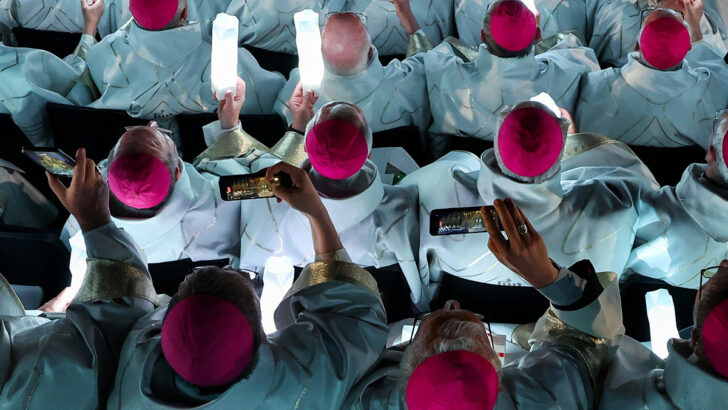 Bishops film the inauguration of the Tower of Jesus Christ at Barcelona’s Sagrada Familia, blessed by Pope Leo XIV on June 10. Photo: OSV News/Nacho Doce, Reuters.
 Are we made in the image of God or the machine? asks Fr Barry White
When I watched Rise of the Planet of the Apes in 2011, an unsettling thought came to mind: human beings can create something they believe they control, only to discover that it has developed beyond the limits they imagined. In the film, scientists develop a drug intended to cure Alzheimer’s disease but it unexpectedly enhances the intelligence of a chimpanzee named Caesar. As Caesar and the other apes become increasingly self-aware, they eventually rebel against their creators. I am reminded too of Jurassic Park (1993). Scientists bring dinosaurs back from extinction, believing they have mastered nature, until they discover that the creatures cannot be contained. Behind both stories lies the anxiety of Mary Shelley’s Frankenstein (1818): human beings create, invent and control until they discover that what they have created has begun to master them.

Technological age
That question belongs especially to our technological age. We are developing artificial intelligence, algorithms and technologies of extraordinary power. They may bring life-changing benefits. But alongside the question, What can technology do?, we must also ask: What is technology doing to us?
In his first encyclical, Magnifica Humanitas, Pope Leo XIV does not reject technology. He recognises that innovation “can greatly serve integral human development” while warning of an accelerating “technocratic paradigm” fuelled by these emerging technologies. The question is whether these powers remain at the service of humanity or whether humanity gradually becomes subject to the systems it has created. Who is the master and who is being mastered?
As the United States marked the 250th anniversary of the Declaration of Independence (1776), its affirmation of equality, liberty and the pursuit of happiness recalls an important milestone in the development of human rights. Yet it also raises a new question: what becomes of human freedom when the systems we create increasingly shape our choices, attention and behaviour?
Magnifica Humanitas presents the Christian understanding of the human person as created “in the image and likeness of God” (Gen. 1:26–27). Created by the Triune God, each person is made for communion with God, with others and with creation. Human dignity is not something we manufacture or earn; it is a gift from God, the Creator. The human person can never be reduced to data, performance or productivity but remains, as Magnifica Humanitas puts it, “the heart of every authentic path of integral human development”.
Distinction
This is why Pope Leo’s distinction between artificial intelligence (AI) and human experience matters. AI “does not undergo experiences, does “not possess a body”, “does not feel joy or pain” and “does not know from within what love, work, friendship and responsibility mean”. We are not simply processors of information but embodied persons, shaped through relationships, experience, suffering and love. Pope Leo warns that “excessive reliance” on AI and “ready-made answers” can weaken “personal creativity and judgement”.
In our ordinary daily habits, technology shapes our attention, relationships and freedom. Almost everything now has an app. People bank, travel, shop, communicate, exercise and date using their phones. Technology can educate, organise and connect. Yet convenience can become dependency, quietly leading to a new form of captivity.
We scroll, refresh and check notifications, compulsively and even subconsciously. Pope Leo describes the “digital attention economy” as a “new form of power”: the “ability to profile, predict and influence behaviour, often without individuals being fully aware of it”, thereby “weakening our inner freedom”. The Netflix documentary The Social Dilemma captures this concern, showing how social media platforms use our online activity to build detailed profiles of us and then in turn predict our behaviour, capture our attention and shape our choices. The issue is not whether we should abandon technology but whether we remain sufficiently free to use technology without allowing it to use us.
Pope Leo calls for “an ecology of communication”, warning against a “culture of immediacy and hyperstimulation”. This is something I have discovered personally several years ago through the spiritual programme Exodus 90: deliberately leaving the phone aside except where necessary, reducing social media and limiting digital consumption. The first discovery is not simply silence as the absence of noise. It is the discovery of interior noise. When the constant stream of notifications, images and videos begins to recede, we become aware of how much activity has been taking place within us. Social media does not simply occupy our eyes; it can capture our attention, influence our emotions and disrupt our interior lives. Silence allows the mind and heart to rest, creating space for reflection, prayer and discernment.
Important
Perhaps this is why retreats and pilgrimages are so important in a technological age. So too can a walk through the countryside, an hour without the phone, a conversation without checking messages or simply a run through nature. This is not escapism from the modern world. It is a way of recovering something essential to being human: our capacity to be present — to God, to one another, to creation and to ourselves.
Technology can connect us to the world, but it can leave us feeling lonely in the world. It can process information but it cannot experience love or give meaning to our lives. The challenge is not to reject technology but to ensure that it remains what it was created to be: a tool in the service of the human person rather than a power that quietly reshapes the person into its own image.