

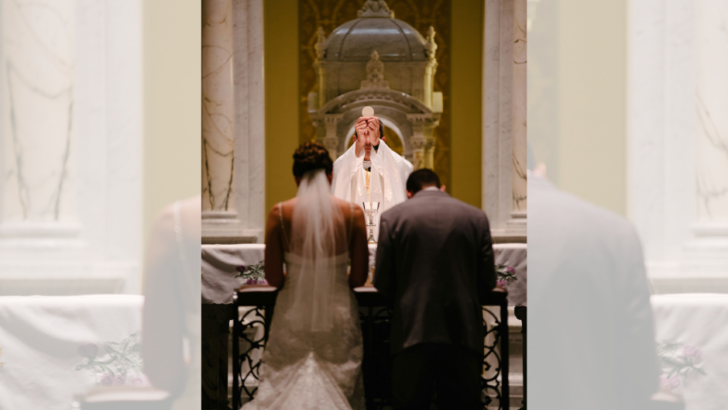
Companionship, family, security, marriage gives us all of these. But what is God’s plan in designing it this way?

We would like to share three principles, each drawn from Sacred Scripture, and each quietly at work in every ordinary marriage, including our own.
-
Marriage is a sign, not just an arrangement
St Paul writes in his letter to the Ephesians: husbands, love your
wives, just as Christ loved the Church and gave himself up for her (Ephesians 5:25).
That verse does not simply tell husbands to be kind or faithful, good advice as that is. It says the love between husband and wife is meant
to make something visible in ordinary, everyday life, what Christ’s love for his people looks like. When we choose patience after a hard day or put the others’ needs ahead of our own tiredness, we’re not only
being good spouses. In some small way, we’re making God’s faithful love visible to whoever happens to be watching.
That is a humbling thought, because it means our marriage was never really a private matter, even in its quietest moments. Pope Francis writes in Amoris Laetitia that the love of husband and wife becomes an
image of God’s own inner life not a perfect image, but a real one, lived out in flesh and blood, in the washing up and school runs. Marriage is not just an arrangement two people enter for their own happiness, though happiness is certainly part of it. It is a sign. Other people are meant to look at a marriage and catch a glimpse of
God’s love.
-
We are accompanied, not self-sufficient
The Old Testament gives us one of its most striking images here. God
told the prophet Hosea to marry Gomer, a woman who was unfaithful to him repeatedly and astonishingly, God tells Hosea to go on loving her, to bring her back, to remain faithful through her infidelity.
It’s one of the strangest love stories in Scripture, but its purpose
is clear. Hosea’s marriage becomes a living picture of God’s covenant
with Israel, who wandered and turned away again and again while God’s fidelity never wavered, but because that is simply the way with God’s love. This is not the exception in Scripture; it is the model. God does not reserve his fidelity for the couple who never fail each other. He shows it precisely in the marriage that has known failure and stayed.
We all hurt each other over the years, nothing dramatic, with the
ordinary failures of impatience, distraction, and unkind words we wish we could take back. Hosea’s story tells us that isn’t a departure from God’s plan for marriage; it’s where his plan shows itself most
clearly, in a fidelity that outlasts failure. We are not two people
sustaining a perfect love by our own willpower. We are two imperfect people, held up by a covenant love that is not our own, it is God working through us, especially when we fall short ourselves.
-
Children learn theology by watching
Long before a child sits in a classroom and is taught that God is love and God is faithful, they have already begun forming an idea of what
those words mean from watching their mother and father. A child who grows up watching two parents speak kindly, forgive, and choose each
other again on ordinary difficult days has already received a kind of catechesis not in words, but in witness. The reverse is also true, a child who watches contempt or coldness between their parents is also learning theology, learning, wrongly, what love, or even God, is like.
That is not meant to add pressure — none of us are perfect parents,
and children are remarkably capable of absorbing grace even from
imperfect homes. But it underlines how much is quietly at stake in the
ordinary, unwitnessed moments of a marriage: the tone of voice at
breakfast, how a disagreement is managed, whether reconciliation is
visible after a row. Our own children are grown now, we are “empty
nesters” but we still think of this often. The theology we taught them
most durably was never a lesson we sat them down for. It was simply
how we treated each other on any given day.
So marriage is a sign, not just an arrangement. A covenant of
accompaniment, not self-sufficiency. A quiet, ongoing theology lesson for anyone watching, especially our children. Three principles, but
one underlying truth: God’s plan for marriage was never simply for our own comfort or convenience. It was always something larger, something
He intended to be visible, faithful, and formative, right in the middle of ordinary life.
Mike and Rose Curtin are involved with Catholic Marriage Encounter in Ireland. Its next Marriage Enrichment Weekend takes place at the Focolare Centre, Prosperous, Co. Kildare, from October 2–4, 2026. More information is available at marriageencounter.ie.