

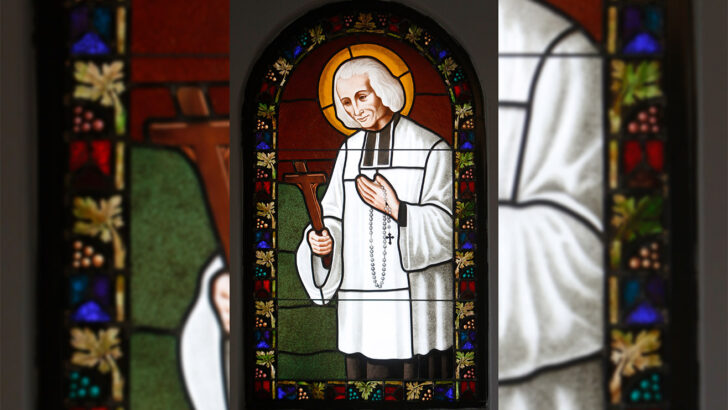
 St John Vianney, patron of parish priests, is depicted in a stained-glass window at Our Lady of Victory Church in Floral Park, New York. Photo: OSV News /Gregory A. Shemitz.
 As the Church in Ireland approaches the National Synodal Assembly this October, one of the seven priorities that will be discussed and discerned will be ‘Formation and Catechesis’. According to the synodal preparatory document ‘Baptised and Sent’, the hope of renewal in this area of the life of the Irish Church, is to “deepen faith…that is Christ-centred, experiential…rooted in learning, liturgy and the sacramental life”. Crucially, this clarity around the theme of ‘Formation and Catechesis’ can only be understood in the light of the overall theme of ‘Living out of our Baptism’.

The renewal of the sacraments and the renewal of the life of the Church go hand in hand. If the sacraments are renewed, then the life of the Church is refreshed. One sacrament that is need of renewal is the sacrament of reconciliation. So many people no longer have recourse to the sacrament of reconciliation, even those who are otherwise committed. For thousands of children who make their First Confession each Lent, it will also be their last, at least for a long time. All the more reason then, to look again at the sacrament of reconciliation and how it can be renewed in the light of living out our baptism.
Renewal
On August 4, the Church celebrates the feast day of St John Vianney (1786-1859), also known as the Curé of Ars, whose priestly ministry was especially associated with the sacrament of reconciliation. He spent over twelve hours every day ministering the sacrament to the thousands of pilgrims who came to Ars, and of course, to his own parishioners. He had a gift for reading the state of souls, having listened to what they shared with him in the Confessional. For the Curé of Ars, the sacrament of reconciliation did not entail a superficial admission of sins followed by absolution that made the penitent feel better. Rather it was about real transformation born of admission of and sorrow for sin, a desire for change, for reconciliation with others and the restoration of intimate communion with God. Just as a doctor is not satisfied with wiping away blood from a patient with a haemorrhage, but wants to find the wound the blood is coming from, so St John Vianney’s ministry in the confessional was about healing spiritual wounds and setting hearts on fire with the original holiness of their baptism. In his own words: “It is always springtime in the heart that loves God”.
Yet, for St John, this renewal in holiness and faith was not an abstract ideal or spiritual dream. Holiness increases or diminishes with concrete actions, expressions and habits. There is a shape and form of the Christian life that is visible in everyday life. Thoughts, words and actions are in keeping with our Christian commitment or they are not. Thoughts words and actions matter.
Growing in holiness and integrity of life was a journey that he shared with his parishioners and as a great priest”
That is why the Church’s request to confess the “number and kind” of grave sins, is not an invasion of privacy but a real invitation to honesty that tests the sincerity of our repentance (cf. Code of Canon Law, 988, 1). It is a disposition to openness to allow God’s grace and light to penetrate every nook and cranny of our human condition.
John Vianney ministered to God’s people, acutely conscious of being a sinner himself. Growing in holiness and integrity of life was a journey that he shared with his parishioners and as a great priest, he saw himself as a dispenser of God’s infinite mercy to restore the baptismal holiness of God’s people.
Forgiveness
As we celebrate the feast of St John Vianney, we are reminded of the sublime gift of God’s forgiveness that cleanses us and reconnects us with the dignity and identity conferred at our baptism. For the desired renewal of the sacrament, its connection with baptism is crucial. In the words of Pope Francis: “When we go to confess our weaknesses, our sins, we go to ask the pardon of Jesus, but we also go to renew our Baptism through his forgiveness. And this is beautiful, it is like celebrating the day of Baptism in every Confession” (General Audience, November 13 2013).
May the prayers and example of St John Vianney help renew the life of the Irish Church by renewing the sacrament of reconciliation. Going to Confession is humbling but is never meant to be humiliating. For it is Christ Himself who waits for us there to encounter us with his infinite mercy, to change and transform us. There we are forgiven and renewed. It “is like being baptised for a second time” (Pope Francis).