

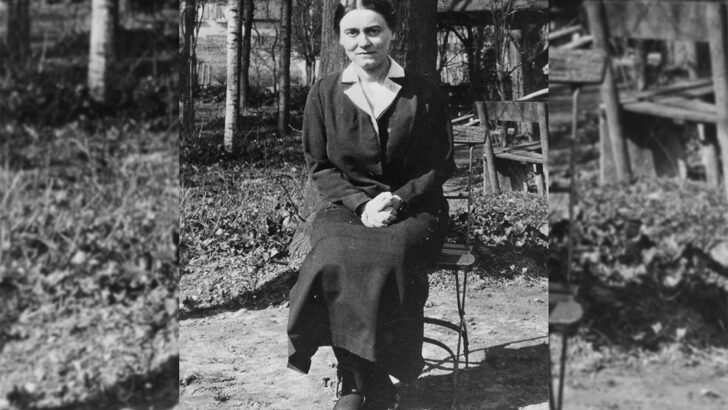
 St Teresa Benedicta of the Cross, also known
as Edith Stein, is pictured in an undated photo. St Teresa
converted from Judaism to Catholicism in the course of
her work as a philosopher, and later entered the Carmelite
order. She died in the Nazi concentration camp at
Auschwitz in 1942. Photo: OSV News /CNS Archive.
St Teresa Benedicta of the Cross, also known
as Edith Stein, is pictured in an undated photo. St Teresa
converted from Judaism to Catholicism in the course of
her work as a philosopher, and later entered the Carmelite
order. She died in the Nazi concentration camp at
Auschwitz in 1942. Photo: OSV News /CNS Archive.
Dr Robert McNamara, lecturer in philosophy and head of department at St Patrick’s Pontifical University in Maynooth, first encountered St Edith Stein’s book On the Problem of Empathy while passing it daily on a library shelf. “There was an alluring character to her presence,” he remembers. “I tried to read it but found it impossible and left it aside.”

Only later, with the help of a mentor, Dr Mette Lebech at Maynooth University, did he gain a foothold in her work.
“She just seemed like a trustworthy person,” he says. “Her life exhibited this profound rest in divine providence. For me, that was a big theme. I found her rest in providence to be so trustworthy you couldn’t go wrong reading her philosophy.”
Dr McNamara, studied physics before he spent time in seminary before turning to teaching. He says St Edith Stein became for him a guide through faith, life, and the world. Especially in a culture that many describe as facing a ‘meaning crisis’ he believes her witness is more relevant than ever.
“She’s not just an intellectual heavyweight of the Catholic Church; she’s also a devotional figure,” he says. “Often she’s read for her Christian feminism or her metaphysics – but when you pray to her, she answers, and she draws you close.”
At the heart of her appeal, he insists, is her insight into the soul’s need for meaning. “The nourishment of the soul is meaning. Just as the body needs food and exercise to grow, the soul matures by engaging with meaning – with truth, value and goodness. If we don’t nourish the soul, we remain stunted.”
Such nourishment, he says, is found not only in prayer and the sacraments but also in the ordinary things we engage with deeply.
“If you live in a superficial way, everything will appear flat to you,” he explains. “But if you engage with the meaning of things – a walk in nature, listening to good music, real conversations, thinking, praying – the world becomes more colourful, more alive. Christ tells us we live not by bread alone but by every word from the Father, by the meaning he gives. When we engage with meaning, our souls grow and mature.”
Born in 1891 to a devout Jewish family in Breslau (now Wrocław, Poland), young Edith drifted from the faith in her teens, calling herself agnostic. Yet the hunger for truth never left her.
“She was always, always interested in truth, period,” says Dr McNamara. “Even as a young woman she wanted to know what the soul is, what the human person is.”
Journey
Her intellectual quest took her to Edmund Husserl’s phenomenology. In 1916 she completed a pioneering doctorate on empathy and became his assistant. But her deepest insights came not in lecture halls but in the face of suffering.
When fellow philosopher Adolf Reinach was killed in the First World War, Edith was asked to help his widow settle his papers. There she met not the despair she expected but a serene Christ-centred hope.
“She testified that in the suffering of Reinach’s widow she saw ‘the power of the cross’ – the presence of Christ in the midst of loss,” Dr McNamara says. “That moment showed her that the faith she had set aside had a power she could not explain away.”
A few years later, when her own sister Else was widowed, Edith interrupted her academic work to help care for her sister’s children a moment that revealed her understanding of empathy was inseparable from practical love. “Stein’s empathy wasn’t just a theory,” Dr McNamara notes. “She was a person of great heart. She could be present to suffering, attentive to others in their need.”
St Edith Stein shows that reality is not flat – it has depth, and so do we”
Her conversion came in 1921, when she spent a night at friends’ house reading the Life of St Teresa of Avila. “She closed the book and said simply, ‘This is the truth,’” Dr McNamara recounts. “For her, it wasn’t an argument won so much as an encounter with a living witness to God.”
Baptised in 1922, she united intellectual search, empathy for others and recognition of Christ in suffering.
“Her life’s work centres on the truth of the person and the truth of the soul,” says Dr McNamara. “She uses the phenomenological method, draws on Thomistic metaphysics and then introduces the Carmelite mystical tradition to cast light on both. She gives us a comprehensive understanding of what it means to be a human person.”
This synthesis, he says, is crucial in our time.
“Our culture tends to flatten everything. St Edith Stein shows that reality is not flat – it has depth, and so do we. She helps us see that becoming truly ourselves means engaging meaning and conforming ourselves to the truth, ultimately to Christ.”
St Edith Stein’s life was marked by suffering: denied university teaching first for being a woman, then for being Jewish; distanced from her family by her conversion; and finally murdered in Auschwitz in 1942.
“At every stage of her life it looked like a life cut short, a life frustrated,” Dr McNamara says. “But in the face of that suffering, because she was able to rest in the providence of it, it formed her as a person. And we’re now sitting here talking about her.”
She loved the line of St Augustine: “Evil does not thwart God’s purposes, for from evil he can draw great good.”
“When you meet suffering, it’s not resolved by some theoretical dictum,” Dr McNamara adds. “It’s resolved by facing it nobly. That’s what a martyr does.”
Relevance
As the Church considers naming St Edith Stein a Doctor of the Church, Dr McNamara believes her relevance is already clear.
“She went deeply into reality for us,” he says. “She helps us see things more clearly, more beautifully, more colourfully. And she shows us how to rest in God’s providence even when our lives seem thwarted.”
Above all, he says, she points us to what truly matters. “In the end, what matters is who we become in relation to love. St Edith Stein shows us that path.”