

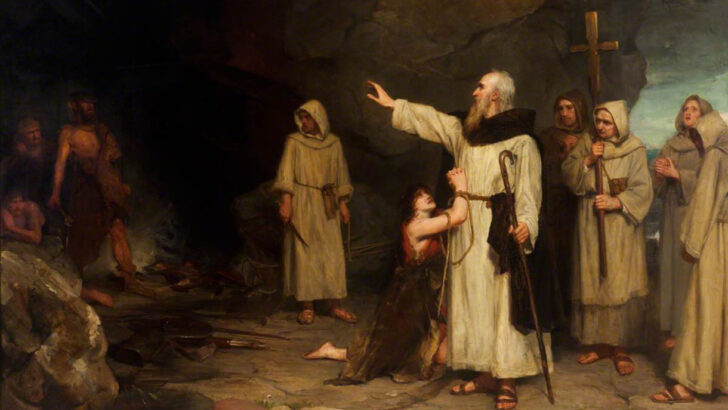
 St Columba Rescuing a Captive’ by Robert Herdman, 1883. Photo: Wikimedia Commons / Public Domain.
 There are many examples in Scripture of people elected by God to fulfil a special mission that involved them moving away from home. Abraham was asked by God to trust Him, to leave his homeland and travel towards a destiny known as ‘the promised land’ (cf. Gen 12:1ff). Moses was chosen by God to lead Israel out of Egypt and into the desert. For the Apostles and disciples, Jesus’ call to ‘follow me’ meant taking a risk and trusting in the One who invited them to a new way of life and to go where he brought them. After Pentecost, the Apostles travelled beyond Jerusalem and far from home, preaching the Good News everywhere they went. In the First Letter of Peter, written to Christians in Asia Minor at a time of trial and exile, the Apostle reminds them that they have been chosen for this time and for this place to give witness to unbelievers, leaders of civil authority and those who viewed marriage differently. Peter urges them to be perfect examples to those around them and to keep their witness pure. God had chosen them and was working his salvation through them in a new place.
Placing his trust in divine providence, Columba left his homeland with twelve companions”
There are similar examples in the Irish faith tradition of the same dynamic of mission linked to exile from home. We think of St Patrick who left his home in Britain to evangelise the Irish and St Columbanus who left Ireland to evangelise Europe. The other example is St Columba, one of Ireland’s three Patron saints with Patrick and Brigid, who left Ireland and evangelised Scotland from his monastic base at Iona and whose feast we celebrate on June 9.
The precise circumstances of Columba’s exile from Ireland in 565, are complicated and controversial. What is more certain is the reality of how Columba’s exile shaped him in the Biblical tradition of being a ‘Pilgrim for Christ’ – a name attributed to him by his biographer Adomnán’s in his Vita Columbae. Placing his trust in divine providence, Columba left his homeland with twelve companions, aware of his missionary calling to spread the Gospel in obedience to Christ. The displacement of Columba from the western periphery to a more central location, altered his identity and self-understanding as someone whose vocation connected him to a greater whole of the Church and the wider world. It was within that greater whole that Columba lived out his mission as a pilgrim for Christ, an evangelist and the founder of an influential monastic movement.
Displacement
Displacement and migration effect the lives of millions around the world. I write these words away from home in Rome. Many of you who read them will do so away from your home county or country. The experience of displacement is one that is familiar to most of us. This experience of displacement is not only geographical but can also be existential – like the uprootedness we experience after a bereavement.
What the story of St Columba’s life teaches us is that our vocation and election by God from our baptism, is intrinsically linked to where we find ourselves, especially away from home. Columba’s mission extended beyond himself with the foundation of Iona that was indirectly the source of Christianity in northern Scotland with the monastic presence continuing there until 1164. From Columba we learn that the experience of displacement, the invitation to faith and accepting the gift of God’s love moves us into a new space and invites us to trust going forward. As Church, we walk forward in hope on the synodal path and towards the future that awaits us.
As St Columba carried his faith with him to new people and places beyond his home, so may we bring the salt and light of the Gospel wherever we find ourselves. Exile from home is painful and disorientating. Yet, throughout it all there is a reconfiguration to a greater state of maturity as we contribute on a bigger stage, beyond our own borders and comfort zones. The story of St Columba opens up the possibility for modern Christians to discern the providence of God at work in experiences of displacement where new places and conditions forge a new identity and a new sense of mission.