

 Peter Costello
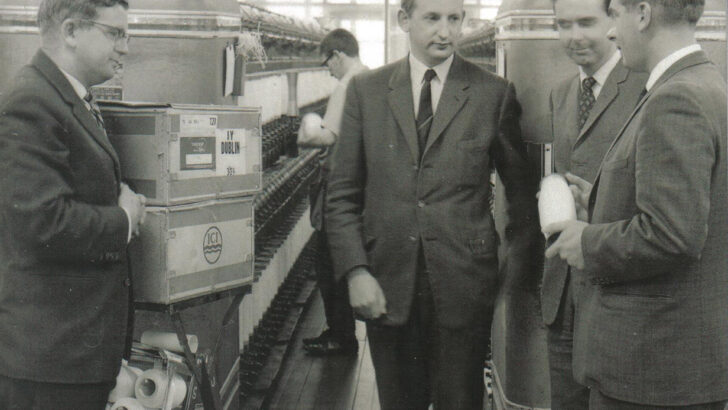 The executive style of modern Ireland at Industrial Yarns.
Factory life in Industrial Yarns Ltd Bray, 1958-98,
by Kieran Devenish
(Maynooth Studies in Local History / Four Courts Press, €12.95 / £13.50)
Back in the early 1960s Dublin Opinion published a satirical cartoon of the then Taoiseach Seán Lemass cutting the ribbon at the opening of a new Irish factory devoted to the task of making keys for opening factories.

It was a neat summary of the feelings many had at that time of Ireland that after de Valera’s seamless transition to the Park there was a sense that the long sustained vision of Ireland as an agricultural nation was transmuting into a modern industry based economy.
As too large a proportion of Irish historiography is devoted to the period before 1924, this little work is to be welcomed as dealing in detail with the making of something new in Ireland which would form the basis of the economy of today.
Bray
Author Kieran Devenish, himself a native of Bray, Co. Wicklow, is currently a student researcher at the University of Galway. He is to be congratulated on this work, which as a contribution of Irish anthropology explores the work life of the greater Dublin region in an era of change (what period of history is not indeed an “era of change”; the tree goes on changing, yet remains completely itself).
Industrial Yarns Ltd. was one of a set of factories in Bray which provided a new kind of employment, mostly though for young men. This was at a time when the universities and technical colleges were transitioning from teaching “Commerce” into lecturing on “Economics”. Emigration was high, as it had been for a century – it was only in 1966 that a reverse of this state of things was achieved in a small way.
This book is based on some twenty one recorded interviews with workers at Industrial Yarns, all men save a single woman who worked in the accounts department, supplemented by a small amount of interview material from four other sources. It is important to realise that this is about the experiences of those working in the factory; all too often histories of businesses devote themselves to the executives rather than the workers, which is rather like seeing a school as the careers of the principals rather than the experiences of the students.
He presents a vivid picture of the social nature of the factory rather than a fuller image of the society from which it sprang”
We should also bear in mind that Bray was then the concentration of other kinds of industrial enterprises, of various kinds: there was Ardmore Film Studios for instance (opened in May 1958), Solus Éireann which made light bulbs, and even a small factory devoted to the curious business of reconditioning the cathoid ray tubes of television sets, which the present reviewer’s father owned for a for a few years: Irish-made television had arrived on New Year’s Eve 1961.
All of these enterprises great and small belonged to a new kind of society. This is the period reflected in Alexander J. Humphries New Dubliners (from 1966), where this important development in Irish history was studied as it happened.
Oddly Devenish does not refer to Fr Humphries’s study, though it would seem to have a direct bearing on the social nature of the lives of those he interviewed about life in Industrial Yarns. He presents a vivid picture of the social nature of the factory rather than a fuller image of the society from which it sprang. But that is all to the good for such a focus is very rare in Ireland.
His concentration is on gathering experiences. However what he has set forth will be read with great interest by those researchers who are anxious to have Irish history dealt with as something more than a chronicle of chieftains rather than workers and peasants.
Dimensions
Indeed the book suggests that Bray might well be an ideal location for a much larger sociological study of the changing nature of Irish society. One has only to allude in passing to the fact that the initial date of this book is the year in which commenced the calling of a Church Council which was to transform the core element of Irish society.
Here again is a dimension which Devenish’s method of inquiry excluded, but which might prove fruitful for those engaged as I suggest on a larger study of a place which was not so much a provincial town, as a sea-side suburb of the capital.
There is a nice quote at the end of the book from Peter Winn, of Columbia University, author of Weavers of Revolution, that “workers can be as articulate about the historical experience as presidents – and less prone to alter that experience in the telling.”