

 Peter Costello
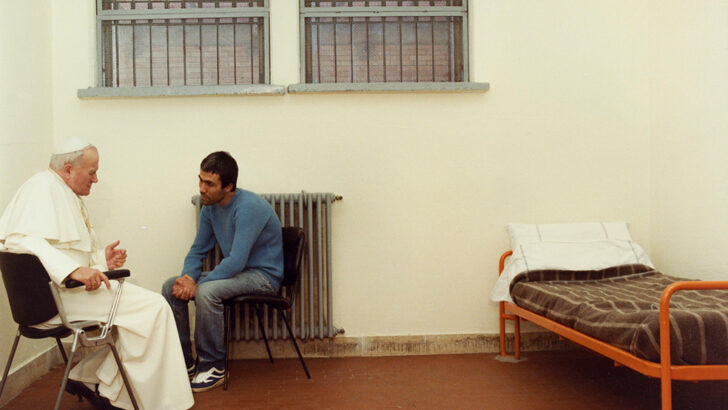 Pope John Paul II sits with his would-be assassin Mehmet Ali Agca, in Rome’s Rebibbia Prison in 1983. Photo: OSV News /Arturo Mari, L’Osservatore Romano.
 Vatican Spies, from the Second World War to Pope Francis,
by Yvonnick Denoël
(Hurst and Company, £25.00 / €32.99)
This book first appeared in French back in 2021, so it is about time that an English language version appeared, for it will certainly be of great interest, not only to Catholics of all kinds, but also to anyone concerned about what is really happening in the world today, especially “behind the scenes” of the stage on which global politics are acted out.
It comes, however, from a specialist press rather than one of the larger mainstream publishers, perhaps because it may run counter to what so many think about the Vatican and its activities.
It may help Irish readers to orient themselves if I mention that Denoël was co-author with the late Gordon Thomas, a long-time Irish resident, well known to Irish readers, on the dark side of the Central Intelligence Agency.
So we are in a world of inconvenient revelations and sensational facts rather than sober history. Nevertheless, read with caution this is a most revealing book, as well I think as a reassuring one.
The use of the term “spies”, with its Bond-like implications, is a little overdrawn perhaps. What is involved here more accurately is the Vatican use of “confidential agents”, for confidentiality is the essence of the approach of the Vatican and the Curia to all things.
Realpolitik
The author disavows any interest in doctrinal or merely clerical matters. The focus here is on realpolitik.
But for many years, writing about the annual releases of our own state files, I have always gone at once to review what our ambassadors to the Vatican reported to Iveagh House, having become aware of the importance of the Vatican post.
This was always of interest, as the Vatican was a listening post for global affairs. So in reality, an Irish reader will naturally turn to see what the author has to say about Ireland and what it is based on. Despite our own concern for our place in the world in this book there is only one reference to Ireland, or really one and half.
This was a report from Joseph Walshe, our man in the Vatican, at the time of the first post-war election in Italy, expressing his conservative fears that the country would go Communist. This is taken from an academic paper by the late Dermot Keogh, rather than the Department of Foreign Affairs files in our National Archives.
Revelatory
The London Observer may well have thought this book “revelatory”. Yet these pages have a jaded sense of déjà vu. Take for instance the death of John Paul I – an unexpected event that shocked Catholics around the world, and which was indeed badly handled by the Vatican. But what we find here is an account based not on new research, but on contrasting David Yallop’s book with that of John Cornwall. Denöel, despite his claims to broad research, adds nothing new.
The longest and best documented part of the book is however, the long reign of Pope John Paul II, in which the struggle the Church had waged with Communism”
So too in other instances, one feels that the author is recycling material he has in his own files from past books, and has actually not done much fresh research. Here are all the old scandals, shocking and sensational as they all were, the Legionaries of Christ, Marcinkus, and Banco Ambrosiano. And across it all, Denöel’s long-term fascination with the activities of the CIA.
The longest and best documented part of the book is however, the long reign of Pope John Paul II, in which the struggle the Church had waged with Communism since the 1920s, came to a head. The changes in Russia have, alas, brought about new problems for us all.
China
Towards the end, there is a return, however, to the matter of the Catholic Church in China. Now this is an important issue, and one where one can see that the “confidential agents” of the Vatican must play an important part.
Having suggested that Cardinal Spellman brought a radio transmitter into the Conclave and sent the result of the election of Montini to the CIA before it was announced formally. This is a rather blithe assumption typical of the book.
President John F. Kennedy received the news from the CIA, along with a profile of Montini, while he was in Dublin; this is the half reference mentioned above.
In his conclusion, the author alludes to the fact that future Popes will be drawn less from Europe, and more from other continents, the Americas, Africa and Asia. Yet the focus of his book is quite European; the allusions to, say Brazil, Peru, China, India, indeed Africa and Asia in general, are few enough. If old ways linger on in the Curia, it seems they also do in the ranks of espionage aficionados.