

 Photos: Mykhailo Markiv.
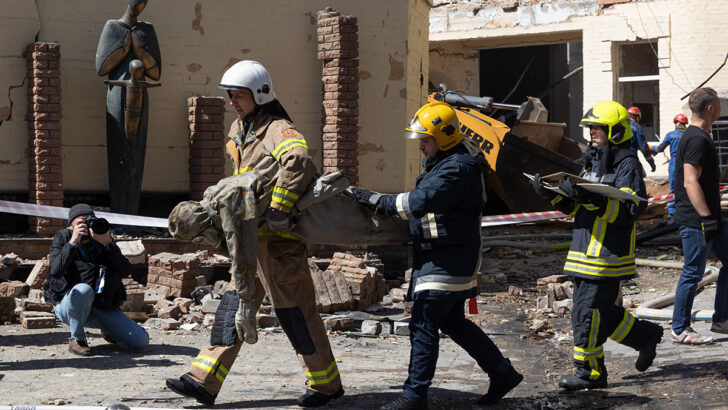
 Moscow not only continues to systematically kill Ukrainian civilians and wipe out entire families in their homes with missile strikes; it is also deliberately targeting historical and architectural heritage. During the latest massive attack on Kyiv, the aggressor damaged a number of sites such as the Church of the Nativity of Christ, the Postal Station, the National Opera of Ukraine, the Kyiv Small Opera, the Dynamo Stadium, and the National Museum, and effectively destroyed the recently renovated ‘Chernobyl’ Museum.

In particular, Moscow is attempting to erase the traces of its crimes dating back to Soviet times. The consequences of the Chernobyl nuclear power plant accident were catastrophic not only for the environment and the health of Ukrainian people, but also for many other countries around the world. These consequences are still being felt today.
The ‘Chernobyl’ Museum was a unique museum. It housed artefacts that preserved not only the history of the tragedy, but also personal destinies, emotions, and the memory of generations. It included a library, a coworking space, multimedia, and exhibition halls. There was a permanent exhibition featuring a chronology of the Chernobyl disaster, personal stories of liquidators and victims, as well as an overview of the current state of the exclusion zone.
Overall, the exhibition included more than a thousand exhibits: authentic objects, copies, reprints, and tactile 3D models of Units 3 and 4 of the power plant before and after the accident. All of them were accompanied by multimedia elements.
A large collection of ethnographic artefacts, religious objects, early printed books, icons, and various decorative elements brought from churches that once operated in the exclusion zone was also kept there. These items were likely lost due to the collapse of a massive layer of concrete. Approximately 40% of the exhibits in the permanent exhibition were irretrievably lost after the missile strike.
One of the surviving sculptures is The Hope, by the famous Ukrainian artist Zoia Skoropadenko, who lives in Monaco — a small bronze bird perched on a rock.
Like millions of Ukrainians abroad, she spent hours scrolling through the news, terrified for her country and for the people living there”
“I think what happened is deeply symbolic. The Hope was created after Fukushima and Chernobyl as a quiet reminder that even after catastrophe, humanity must preserve dignity, memory, and hope. Seeing this small sculpture survive among destruction felt almost unreal to me,” she says. “Of course, I do not see it as some ‘victory’ of art over tragedy — because people died that night, and this is the most important thing. But perhaps it is a reminder that even during the darkest moments, hope and humanity can still remain standing.”
When she saw the images from Kyiv, her first feeling was shock and pain. Like millions of Ukrainians abroad, she spent hours scrolling through the news, terrified for her country and for the people living there. “As an artist, it is especially painful to see museums, historical buildings, and cultural institutions damaged or destroyed. These places preserve not only objects, but memory, identity, and human stories. When culture is attacked, it is not only architecture that suffers — it is our collective memory and humanity itself,” she adds.
“I believe the role of artists is to preserve memory, humanity, and truth. When museums, cultural sites, and historical places are damaged, it is important that artists continue documenting, creating, and speaking about what people are living through. Art cannot stop tragedy, but it can help future generations remember and understand it. Culture becomes a form of testimony — and preserving testimony is essential so that human suffering is never forgotten or repeated.”